In foreign policy debate, US president says current military, intelligence cooperation with Israel is unprecedented.
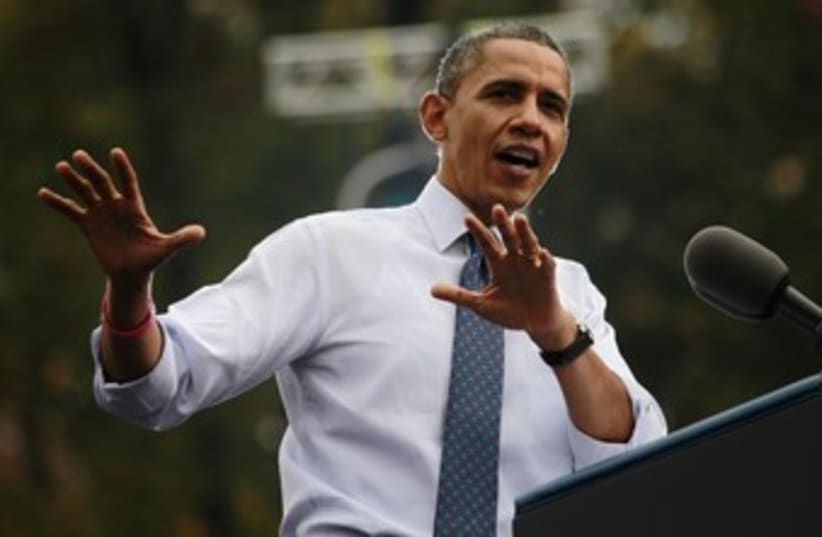
By HILARY LEILA KRIEGER JPOST CORRESPONDENTUS President Obama at a campaign rally 370 (R)(photo credit: Jason Reed / Reuters)
WASHINGTON – Pointing to his own record of support for Israel in order to question those of his Republican rival, Obama asserted that cooperation between Washington and Jerusalem has never been stronger than during his presidency, speaking at a campaign rally in Florida Tuesday.He recalled a statement by Mitt Romney from earlier this year in which the Republican presidential candidate said of his positions on Israel, “I think by and large you could just look at the things the president’s done and do the opposite.”“Last night I reminded [Romney] that cooperation with Israel has never been stronger,” Obama retorted in front of a crowd of supporters.During the final debate before the election, Obama said that when it came to the relationship with Israel and other allies, “Our alliances have never been stronger, in Asia, in Europe, in Africa, with Israel, where we have unprecedented military and intelligence cooperation, including dealing with the Iranian threat.”Obama is open to having bilateral talks with Iran about its nuclear program, but the United States has not scheduled any negotiations, White House Press Secretary Jay Carney said on Tuesday. “We have been open to considering negotiations that are bilateral, but we have none scheduled, and we have no agreements with the Iranians to do that,” Carney told reporters. “There is nothing scheduled. There is no agreement.”Citing Obama administration officials, The New York Times reported on Sunday that the US and Iran had agreed in principle to oneon- one negotiations on Iran’s nuclear program, but both the White House and Iran have denied the report.During the final presidential debate on Monday, Obama said he had long offered Iran the possibility of bilateral discussions, a point Carney reiterated, saying, “We are and have been open to pursuing negotiations if and when the Iranians are serious about having negotiations.”Click here for special JPost coverageDuring the debate, both candidates expressed their intention never to let Iran acquire nuclear weapons, but voters said Obama did a better job than Romney.According to a Reuters/Ipsos poll released on Tuesday, voters’ opinions of each candidate did not shift significantly. Some 47 percent of registered voters surveyed in the online poll judged Obama the victor, while 31 percent believed Romney won.During the debate, held in Boca Raton, Florida and devoted to foreign policy, both candidates said they would stand by Israel should it be attacked by Iran.Both candidates said they would stand by Israel if it was attacked by Iran.“If Israel is attacked, America will stand with Israel,” Obama said when asked whether they would treat an attack on Israel as an attack on the United States, a status extended to several allies – by moderator Bob Schieffer of CBS.GOP challenger Mitt Romney echoed Obama, saying, “If Israel is attacked, we have their back, not just diplomatically, not just culturally, but militarily.”But both candidates declined to answer what exactly they would do should they receive a phone call informing them that Israel was attacking Iran.“Let’s not go into hypotheticals of that nature,” Romney responded, adding that the US relationship with Israel was so close that, “We would not get a call saying our bombers are on the way, or their fighters are on the way.“This is the kind of thing that would have been discussed and thoroughly evaluated, well before.” He said.Obama, for his part, did not address the question, relating instead to other aspects of Middle East policy that Romney had broached as part of his answer.Romney repeatedly referred to tensions between the US and Israel, saying that the president’s omission of a visit to Israel during his Middle East tour in the first year of his term was noticed by Arab states, and that “daylight” between the two countries that was noticed by Iran.Obama responded by talking about the trip he took to Israel as a candidate in 2008, contrasting it with Romney’s own visit this summer, which included a high-priced fundraiser.“When I went to Israel as a candidate, I didn’t take donors. I didn’t attend fundraisers,” Obama said. “I went to Yad Vashem, the Holocaust museum there, to remind myself the nature of evil and why our bond with Israel will be unbreakable.“And then I went down to the border towns of Sderot, which had experienced missiles raining down from Hamas,” he said.Obama said that when it came to the relationship with Israel and other allies, “Our alliances have never been stronger, in Asia, in Europe, in Africa, with Israel, where we have unprecedented military and intelligence cooperation, including dealing with the Iranian threat.”On Iran, Romney labeled it “the greatest national security threat” America faces, and repeatedly noted that Tehran is now “four years closer to a nuclear weapon” than when Obama entered office.Obama, in contrast, pointed to terrorist networks as the biggest threats. But he stressed, “Iran will not get a nuclear weapon.” Though red lines on Iran have been getting a lot of attention recently, Obama staked out one on Egypt during the debate. “They have to abide by their treaty with Israel. That is a red line for us, because not only is Israel’s security at stake, but our security is at stake if that unravels,” he said.Iran was the foreign country mentioned the most during the debate, at 47 times. Israel came in second at 34, followed closely by China at 32. The Palestinians, in contrast, were mentioned only once.Romney made the sole reference when he said, “Are Israel and the Palestinians closer to reaching a peace agreement? No, they haven’t had talks in two years.” Neither candidate’s favorable ratings shifted in the wake of the debate, the last of three televised matchups before the November 6 election. Likewise, voter assessments of the candidates on a range of issues from the economy to foreign policy did not change by a statistically significant margin.The full impact of the debate on the race won’t show up in opinion polls for several more days, but it is unlikely that it will give either candidate a big enough boost to break their statistical tie, Ipsos pollster Julia Clark said.“By this point in the election cycle a lot of people have formed a more complete view of each candidate,” Clark said.The accuracy of Reuters/Ipsos online polls are measured using a credibility interval. The survey of 515 registered voters, conducted on Tuesday following the debate, has a credibility interval of 4.9 percentage points. Reuters contributed to this report.Reuters and Jerusalem Post staff contributed to this report.
if(catID != 151){
var cont = `Take Israel home with the new Jerusalem Post Store