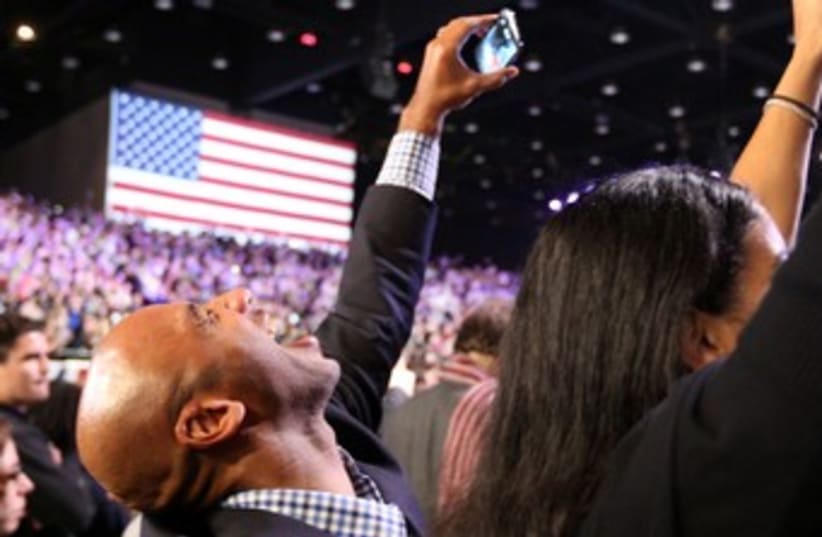
WASHINGTON - US President Barack Obama called it - in less than
140 characters.
Around 11:15 pm EST (4:15 am GMT), just as the networks
were beginning to call the race in his favor, Obama took to Twitter to proclaim
himself the winner over Republican candidate Mitt Romney.
"This happened
because of you. Thank you," Obama tweeted.

That the president would take
his message to Twitter before taking the stage in Chicago underscored the
tremendous role social media platforms like Twitter played in the 2012
election.
Minutes later, with the race called in his favor, Obama tweeted
again.
"We're all in this together. That's how we campaigned, and that's
who we are. Thank you. -bo." Through the course of a long and bitter
presidential campaign, Twitter often served as the new first rough draft of
history.
Top campaign aides used the Internet tool to snipe at each
other, the candidates used it to get out their messages and political reporters
used it to inform and entertain.
On Election Night, the tweets were
flowing.
By 10 p.m. EST, with the race still up for grabs, Twitter
announced it had broken records.
There were more than 31 million
election-related tweets on Tuesday night, making Election Night "the most
tweeted about event in US political history," said Twitter spokeswoman Rachael
Horwitz. Between 6 p.m. and midnight EST, there were more than 23 million
tweets.
Horwitz noted the previous record was 10 million, during the
first presidential debate on October 3.
"Twitter brought people closer to
almost every aspect of the election this year," Horwitz said. "From breaking
news, to sharing the experience of watching the debates, to interacting directly
with the candidates, Twitter became a kind of nationwide caucus." In the moments
following Obama's win, Twitter was in a frenzy, with a peak of 327,000 tweets a
minute.
Another tweet from Obama, one that read: "Four more years" and
showed a picture of him hugging his wife, became the most retweeted tweet in the
history of the site.
First Twitter electionLove it or hate it, Twitter
and its role in politics appears to be here to stay.
For Rob Johnson,
campaign manager for Texas Republican Governor Rick Perry's failed presidential
run, Twitter "changed the dynamic this cycle and will continue to play a bigger
role in years to come." "We no longer click refresh on websites or wait for the
paper boy to throw the news on our porch," Johnson said. "We go to Twitter and
learn the facts before others read it." The 2012 race was the first where
Twitter played such an important role. Top campaign advisers like Romney's Eric
Fehrnstrom and Obama's David Axelrod engaged in Twitter battles through the
year.
With many political reporters and campaign staff on Twitter and
Facebook, social media websites were often the first place news broke. Some top
news stories were kept alive or thrust into the headlines after becoming hot
topics on Twitter.
"It was one heckuva echo chamber," Dante Scala, a
political science professor at the University of New Hampshire, said in an
email.
Johnson said Twitter was the driving force behind some of the
year's biggest political news stories.
"The twitter-verse shapes the news
and public opinion," Johnson said. "The Internet is truly a real and powerful
tool in politics." In future elections, candidates and their campaign staffs
will have to include social media as another battleground, Democratic strategist
Jamal Simmons said.
"This was the first Twitter election and social media
is now fully a part of our election mechanics," Simmons said. "Going forward
candidates must have an aggressive social media strategy if they want to win."