Israeli official: If anyone still thinks Iranian efforts are peaceful, then he also probably believes in the Easter Bunny.
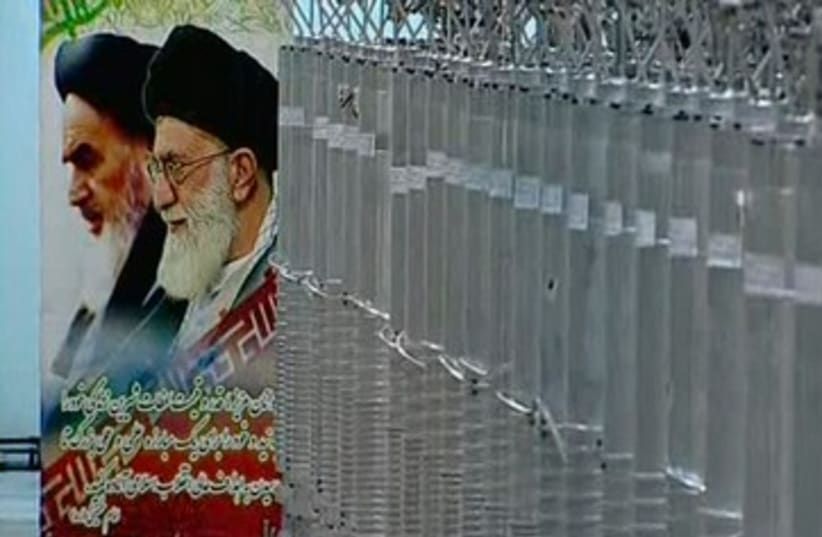
By HERB KEINON, REUTERSAyatollahs centrifuge 390(photo credit: REUTERS)
Tehran proclaimed advances in nuclear know-how on Wednesday – including new centrifuges able to enrich uranium much faster – a move that may hasten a drift toward confrontation with the West over suspicions it is seeking the means to make atomic bombs.The nuclear achievements proclaimed by Tehran also involved the loading of its first domestically produced batch of fuel into a research reactor that is expected to soon run out of imported stocks.The Islamic Republic was driving home its resolve to pursue a nuclear program that its hard-line clerical leaders see as a pillar of power, protection and prestige, despite Western sanctions that are inflicting increasing damage on its oil-based economy.Iran also aimed to show that the tightening sanctions noose has failed to stop it from making progress in nuclear technology and to firm up its hand in any renewed negotiations with world powers.“The era of bullying nations has passed. The arrogant powers cannot monopolize nuclear technology. They tried to prevent us by issuing sanctions and resolutions but failed,” President Mahmoud Ahmadinejad said in a live television broadcast. “Our nuclear path will continue.”One Israeli official responded to Wednesday’s Iranian moves by saying that Tehran was still trying to convince the world that its program was meant to produce nuclear isotopes for medical purposes, but that if anyone still believed them, then they also probably believed “in the Easter Bunny.”“Their underlying message is that this is all for civilian purposes,” the official said. “But everyone knows that the Iranian program is not about isotopes. There is an international consensus now that this program is not benign.”However, Iran’s Arabic-language Al-Alam television said the Iranian government has handed a letter to EU foreign policy chief Catherine Ashton expressing readiness to “hold new talks over its nuclear program in a constructive way.”An Ashton spokeswoman confirmed receipt of the letter, saying she was evaluating it and would consult with the United States, Russia, China and other partners among the big powers.Iranian officials have long refused to negotiate curbs on its program, saying it aims solely to produce electricity for booming domestic demand in OPEC’s No. 2 oilexporting state.Underlining the high stakes, and at times nervous confusion, arising from the nuclear standoff, Iran’s Oil Ministry denied a state media report that it cut off oil exports to six European Union states. Brent crude-oil prices jumped up $1 a barrel to $118.35 in reaction to the announcement.“We deny this report... If such a decision is made, it will be announced by Iran’s Supreme National Security Council,” a spokesman for the ministry told Reuters.Iran’s English language Press TV said Tehran had halted oil deliveries to France, Portugal, Italy, Greece, the Netherlands and Spain – its biggest EU customers – in retaliation for an EU ban on Iranian crude due to take effect in July.After the EU’s decision on January 23 to impose stronger sanctions, hard-line Iranian parliamentarians mooted legislation to freeze oil exports to the EU, but no date for a session to take such a step has been set.“It is not really surprising that we are seeing this chaos as it reflects the fractured political process in Iran,” said Nic Brown, head of commodities research at the Natixis corporate and investment bank in London.“You have the Oil Ministry responsible for revenues, while other parts of the government are trying to make political statements. At the end of the day, they need revenues and they will remain dependent on the Europeans if they cannot place their oil elsewhere. Iran remains absolutely dependent on income from its oil exports,” Brown told Reuters.The Islamic Republic is the world’s No. 5 oil-exporter, with 2.6 million barrels going abroad daily, and the EU consumes around a fifth of those volumes.With Western sanctions now spreading to block Iran’s oil exports and central bank financing of trade, Tehran has been resorting to barter to import staples such as rice, cooking oil and tea, commodities traders say.The most recent talks between world powers and Iran failed in January 2011 because of Tehran’s unwillingness to discuss transparent limits on nuclear enrichment, as demanded by several UN Security Council resolutions passed since 2006.Tehran has for years been developing and testing new generations of centrifuges to replace its outdated, erratic P- 1 model. In January it said it had successfully manufactured and tested its own fuel rods for use in nuclear power plants.Ahmadinejad said the “fourth generation” of centrifuge would be able to refine uranium three times faster.If Iran eventually succeeded in introducing modern centrifuges for production, it could significantly shorten the time needed to stockpile enriched uranium, which can generate electricity or, if refined much more, nuclear explosions.Last year, Iran installed two newer models for large-scale testing at a research site near the central town of Natanz.“We have seen this before. We have seen these announcements and these grand unveilings and it turns out that there was less there than meets the eye. I suspect this is the same case,” said Shannon Kile at the Stockholm International Peace Research Institute.However, in a further comment that may add to Western worries, Ahmadinejad said Iran had significantly increased the number of centrifuges at its main enrichment site at Natanz, saying there were now 9,000 such machines installed there.In its last report on Iran in November, the UN nuclear watchdog said there were 8,000 installed centrifuges at Natanz, of which up to 6,200 were operating.France said Tehran’s latest moves again demonstrated that it would rather ignore international obligations than cooperate.“These statements are an extra concern for the international community,” Deputy Foreign Ministry spokesman Romain Nadal said.“The Iranian military nuclear program constitutes one of the most serious threats to peace not only in the world but in the region. We are convinced that Iran continues to develop this program. [Today’s] announcements reinforce that conviction.”A British Foreign Office spokesman said: “[This] does not give any confidence that Iran is ready to engage meaningfully on the international community’s well-founded concerns about its nuclear program. Until it does so we’ll only increase peaceful and legitimate pressure on Iran to return to negotiations.”But Russia said global powers must work harder to coax concessions from Iran, warning that Tehran’s preparedness for compromise was waning as it makes progress toward the capability to build nuclear warheads.Making a case for a renewed dialogue, Deputy Foreign Minister Sergei Ryabkov said UN sanctions and additional measures introduced by Western nations had had “zero” effect on its nuclear program.Iran has threatened retaliation for any attack or effective ban on its oil exports, suggesting it could seal off the main Gulf export shipping channel, the Strait of Hormuz, used by a third of the world’s crude oil tankers.State television aired live footage of Ahmadinejad loading Iranian-made fuel rods into the Tehran Research Reactor and called it “a sign of Iranian scientists’ achievements.”The reactor produces radioisotopes for use in medical treatments and agriculture.Iran says it was forced to manufacture its own fuel for the Tehran reactor after failing to agree to terms for a deal to obtain it from the West to replenish imported Argentinean stocks that will run out soon.In 2010, the Islamic Republic alarmed the West by starting to enrich uranium to a fissile purity of 20 percent for the stated purpose of reprocessing it into special fuel for the Tehran reactor.In boosting enrichment up from the 3.5% level suitable for powering civilian-nuclear plants, Iran moved significantly closer to the 90% threshold suitable for the fissile core of a nuclear warhead.Analysts remained doubtful that Iran would be able to operate the research reactor with its own special fuel.Click here for full Jpost coverage of the Iranian threat
if(catID != 151){
var cont = `Take Israel home with the new Jerusalem Post Store