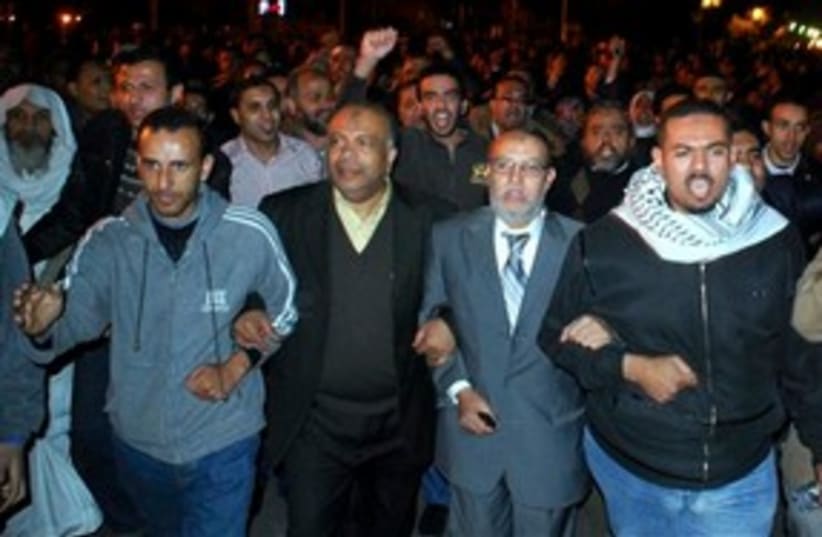
Muslim Brotherhood: With Israel, no agreement is eternal
Moderate Egyptians say group less powerful than media thinks; conspiracy theorists blame Brotherhood for violence that's beset Cairo.
By MELANIE LIDMAN, JERUSALEM POST CORRESPONDENTSenior Muslim Brotherhood members 311 AP(photo credit: AP)
CAIRO – There are flecks of blood on Muhammad H’s blue dress shirt, remnants of last night’s battle.Like almost every man lounging in Tahrir Square on Thursday morning, the morning after a fierce 16-hour battle with stones and clubs, he has a bloodied bandage on his head from where he was hit by a rock. He’s visibly exhausted. He hasn’t left the square since Saturday.RELATED:Analysis: Tahrir square had Twitter, Mubarak the muscleMubarak: I'd resign, but Egypt would descend into chaosUS to Jewish leaders: We won't recognize Muslim Brotherhod“They used knives, horses and camels. Our protests here were totally peaceful; we had no weapons, so we used stones, but what happened yesterday was the last card,” said Muhammad, a member of the Muslim Brotherhood, as he sat on a traffic divider along with two friends.“Last Friday, the police used the most powerful weapons they could use. They were shooting us while we were praying. After that, they used criminals to shoot us. They know we’re peaceful, and they press on that.”The Muslim Brotherhood’s power, or lack thereof, is one of the most discussed undercurrents of the January 25 revolution among media pundits and international leaders. For years, Hosni Mubarak has held onto his international support by stating firmly: It’s me, or it’s them.Now that Mubarak will be out of the picture in the near future, Israel and the United States are worried about a government controlled by the Muslim Brotherhood.“All of us hate Israel,” said Muhammad, who is a lecture assistant in the engineering faculty at a government university in Cairo. “Israel is the best friend for Mubarak, they said clearly that he’s strategic for them.”But he cautioned that Egypt needed to concentrate on its internal politics before dealing with the problem of Israel.“Regarding Israel, Egypt has a peace agreement with Israel and any new government should respect that agreement,” Muhammad said. “However, if the government wanted to change that agreement, it has the right after taking the opinion of the people. No agreement is eternal.”Click here for full Jpost coverage of unrest in EgyptThroughout the week, many religious Muslims insisted that they do not want a government headed by the Muslim Brotherhood.“I can practice Islam in my home, not in my government,” one demonstrator wearing a head scarf told the media.Indeed, many moderates denounced the Brotherhood and insisted that its importance has been overblown by the foreign media looking for a villain. Even Muhammad explained that the Brotherhood was only one group of many calling for change in Egypt. “The Muslim Brotherhood did not organize this,” he said, gesturing around the square. “All of us in the square represent all the colors in the Egyptian political map.”But some conspiracy theorists blamed the Brotherhood for the violence that has beset Cairo in the past 24 hours. One prominent blogger who also works in the Egyptian stock market told The Jerusalem Post that it was in the Muslim Brotherhood’s interest that the city descend into lawlessness.“After Mubarak’s speech on Tuesday [when he announced he would not seek reelection], many of the people that tried to protest calmed down,” said the blogger. “But this does not sit too well with Muslim Brotherhood, which is trying to create a place for themselves and take advantage of everything. They’re trying to be a political party, but they’re not accepted by many people. If protesters stop, we will continue in a more civilized situation, but they won’t let this happen at any cost.”
if(catID != 151){
var cont = `Take Israel home with the new Jerusalem Post Store