Hours before a big debate showdown with her primary rival, US Rep. Haley Stevens began a routine campaign stop Monday seemingly comfortably in her element.
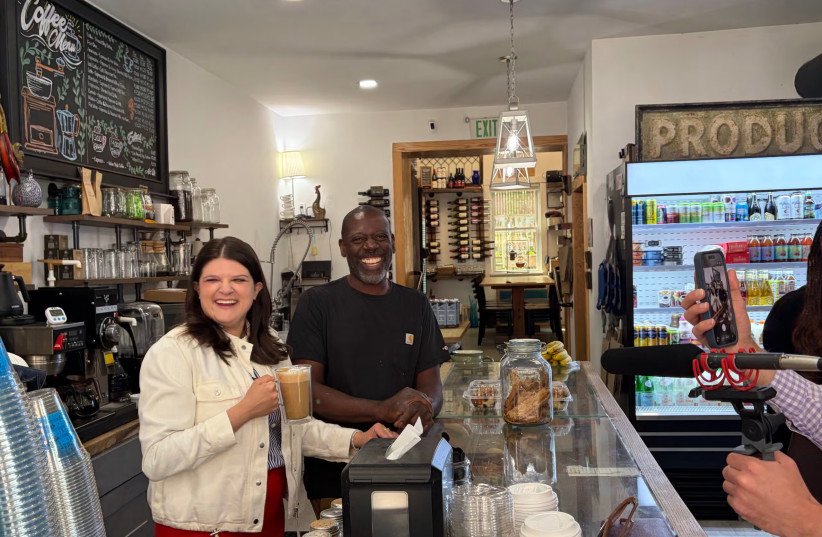
The Michigan candidate for US Senate walked into The Roost, a cafe and wine shop in the Woodbridge neighborhood, chatting up her record on small businesses with the owner, Jeff Tatum. She gamely made herself a cappuccino, exclaiming with glee that the store used Dial soap like her father’s business had.
She also made a play for party unity. Asked by the Jewish Telegraphic Agency about Jewish Democratic donors who have indicated they would fundraise for Republican candidate Mike Rogers if Stevens lost the primary, she responded, “I’m on the Democratic team. I’m on the Beat Mike Rogers team.”
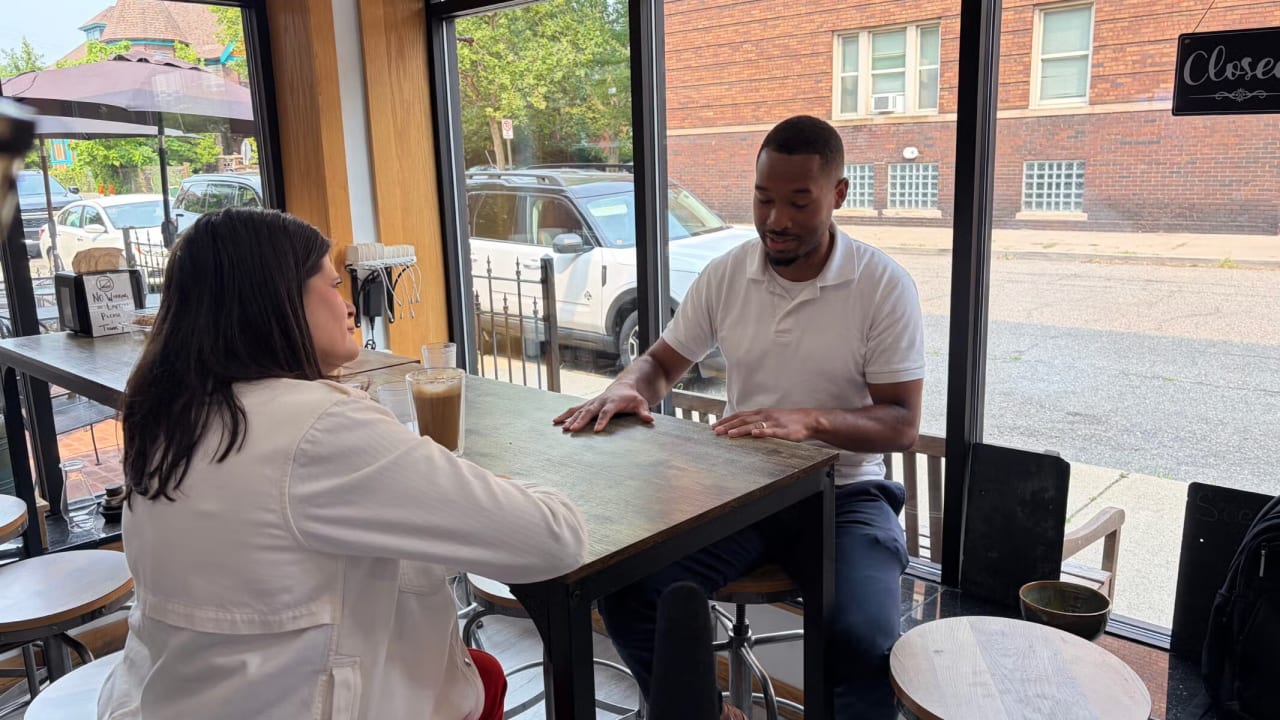
But things went off-script for Stevens when she sat down with Jai Singletary, director of a local neighborhood improvement association, who revealed, midway through their conversation, that he had already cast his early voting primary ballot for her opponent, former county health director Abdul El-Sayed.
What’s more, Singletary made it clear to Stevens that the candidates’ respective stances on aid to Israel were the deciding factor for him.
“Genocide isn’t a Palestinian issue. We’ve all got to care about this,” Singletary told Stevens, a pro-Israel centrist who has received nearly $30 million in outside spending from the American Israel Public Affairs Committee to date in her primary, the organization’s largest-ever investment in a single race, according to CBS News. He believes, he said, that “our country is directly responsible for peace not being achieved.”
The director of Woodbridge Neighborhood Development and local soccer coach added, “We’ve got to have the money stay here. I don’t think we should be giving any more aid to the State of Israel while they’re committing the atrocities they’re committing in widespread collective punishment.”
The interaction spotlighted two of the biggest questions hanging over Michigan’s closely watched and hard-fought Democratic Senate primary: To what degree are the state’s voters factoring Israel into their decisions, and does the pro-Palestinian sentiment driving El-Sayed’s campaign cross racial lines, including in the Black communities where Stevens has long maintained strong relationships?
Many of the Jews in Michigan who form a major base of support for Stevens have made clear their distrust of El-Sayed, who has questioned whether Israel should exist as a Jewish state. Meanwhile, the state has a large Arab and Muslim voting bloc, and voters here helped propel a 2024 Democratic revolt over Israel’s war in Gaza that helped lead to the party’s current civil war. But the situation is less clear with voters from other groups.
Israel central to El-Sayed's race
El-Sayed and the insurgent progressive movement he represents have sought to make Israel central to the race and have tried to turn Stevens’ AIPAC support into her biggest liability. But the Stevens campaign has made the calculation that most of the state’s voters, including Detroit’s majority-Black population, with whom she has enjoyed good relations in the past — would rather talk about other things.
Not so, according to Singletary, who is Black. In his own Detroit community, he told JTA, Israel was an important issue.
“It’s connected,” he said, comparing the Israeli-Palestinian state of affairs to Apartheid-era South Africa, adding, “$3.3 billion to the state of Israel, and that’s money that could be helping out here. I think people are now seeing the links.” He told reporters that, though he does not have Palestinian family himself, his own vote was “100% exclusive” based on Israel.
After the campaign left, Singletary told JTA that he had no affiliation with the El-Sayed campaign and had stopped by at the store’s owner's invitation. He said he would not vote for Rogers in the general election even if Stevens wins and came because he hoped to develop a connection with her in the event she became the nominee.
The question of whether backers of either candidate across the yawning policy divide would continue to vote for a Democrat in the general election if their preferred choice loses is an emerging one. Last week, Democratic US Rep. Hillary Scholten of Michigan, a Stevens backer, refused to commit to voting for El-Sayed if he wins the primary. Scholten cited the candidate’s campaigning with left-wing streamer Hasan Piker, who has repeatedly said he would “vote” for Hamas over Israel. Her objection, she said, was to his comment that “America deserved 9/11.”
A 'direction we don't want to go'
“Abdul El-Sayed is taking us in a direction we don’t want to go as a party,” Scholten told CNN host Jake Tapper.
Stevens’ campaign is also touting her backing from a growing number of establishment Democrats, including Michigan Gov. Gretchen Whitmer on Friday. She and El-Sayed face off Monday evening in their final televised debate before the Aug. 4 primary.
Speaking to Singletary, Stevens smiled and nodded. She name-dropped a Palestinian supporter of hers, and mentioned legislation targeting China that she’s worked on with “my colleague Ro Khanna," the staunchly pro-Palestinian Democratic congressman from California, who has endorsed El-Sayed. She added that she believes in a two-state solution and has been attacked “by name” by Israeli Prime Minister Benjamin Netanyahu.
She also turned to her staff and excitedly indicated to Singletary: “He voted for Abdul in the primary, and he came here to talk to me.”