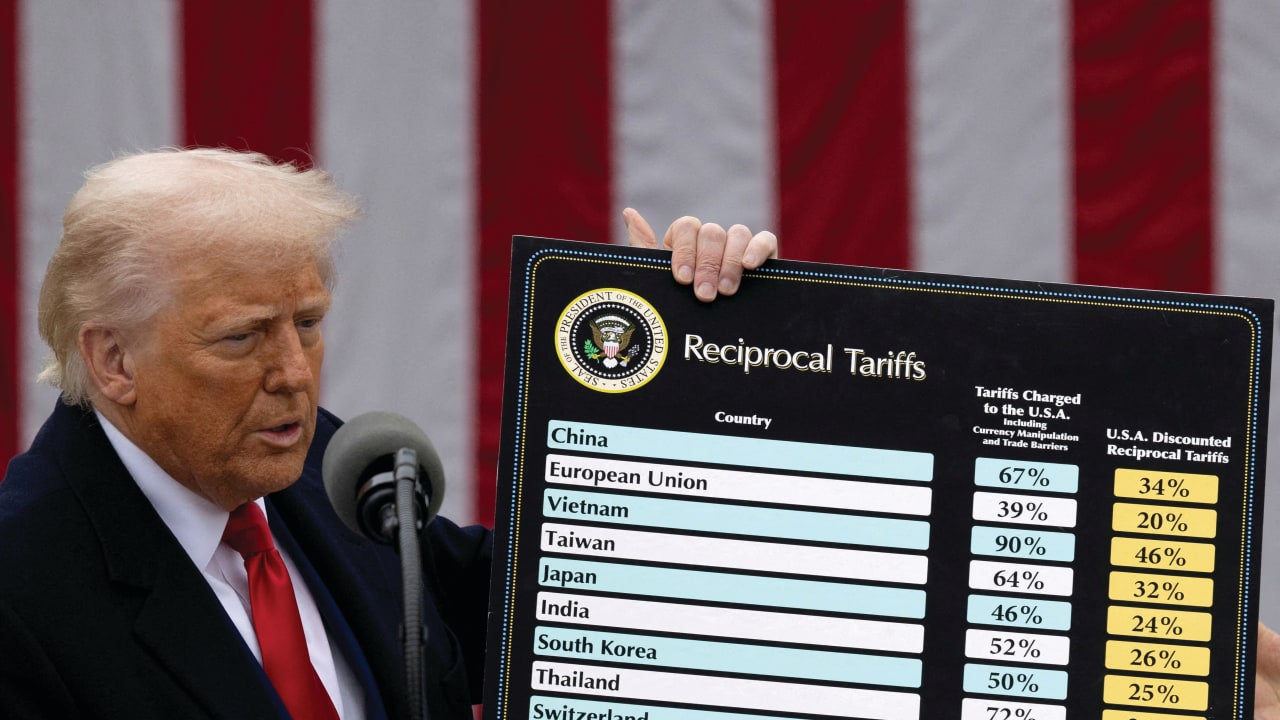
Businesses everywhere need to be aware of the new US tariffs that began on Thursday.
President Donald Trump issued executive orders on April 2, July 31, and August 6 that are intended to counter “large and persistent annual US goods trade deficits [that] constitute an unusual and extraordinary threat to the national security and economy of the United States.”
Commencing August 7, tariffs will be imposed at modified rates on goods from most countries other than China (due to ongoing talks). These include: 10% for the UK; 15% for Israel, Japan, Jordan, South Korea, and Turkey; 20% for Vietnam; 30% for South Africa; 39% for Switzerland; 40% for Myanmar (Burma); and 50% for India.
For Canada, a separate executive order says a tariff of 25% on many Canadian products is going up to 35%. This is because of “among other things… Canada’s efforts to retaliate against the United States.” Nevertheless, the rate remains 10% for Canadian energy resources.
For Brazil, a separate executive order imposes a tariff of 40%, because “the policies, practices and actions of the Government of Brazil are repugnant,” including action against US companies coercing them to censor US persons for speech protected by the US first amendment made on US soil.

What will happen with the new tariffs?
Suppose goods are rerouted? An article determined by US Customs to have been transshipped to evade applicable duties under Section 2 of this order shall be subject to an additional duty of 40% as well as other applicable fines, penalties, duties, fees, taxes, exactions, or charges.
In addition, the secretaries of Commerce and Homeland Security are required to publish every six months a list of countries and specific facilities used in circumvention schemes.
The US will step up efforts to prevent duty-free imports for low-value products with an aggregate value of $800 or less per person, per day – generally and in particular from Canada, Mexico, China, and Hong Kong. Instead, a flat-rate duty will be imposed on transportation carriers and international postal shipments ranging from $80 to $200 per item for six months (apparently), commencing August 29.
Israel has a free-trade agreement with the US dating back to 1985. This undoubtedly helped Israel trade its way out of a period of hyperinflation that was ended abruptly on July 1, 1985. The government claims that in 2024, the export of goods to the US stood at $17.3 billion, while the export of services was estimated at $16.7b.
But the US has different statistics. According to the Office of the US Trade Representative, US goods imports from Israel totaled $22.2b. in 2024… The US goods trade deficit with Israel was $7.4b. in 2024.
What is Trump’s problem with Israel? First, based on Trump’s executive order, we assume the $7.4 million goods trade deficit is one factor.
Second, the Foreign Ministry admits in the above announcement that Israeli customs duties were imposed on US food and agricultural products despite the US-Israel free trade agreement. Apparently, only 1% of goods from the US were affected. Nevertheless, these customs duties were hurriedly repealed on April 1.
Can Trump do it to Israel? Around half of Israeli exports are services or digital supplies that don’t pass through Customs and are not subject to import duties. But they may be liable to a sales tax, depending on the rules in each state and city.
Also, according to Article 22 of the US-Israel FTA: “Either Party may terminate this Agreement by written notification to the other Party. This Agreement shall expire 12 months after the date of such notification.”
So, a question arises regarding whether the US can impose the 15% tariff on Israeli goods now, or whether it must give notice of FTA termination and wait 12 months.
The Trump tariffs raise US duties on many products imported into the lucrative US market. It remains to be seen what happens to digital products, such as digital books.
As always, consult experienced tax advisers in each country at an early stage in specific cases.
leon@hcat.co
The writer is a certified public accountant and tax specialist at Harris Consulting & Tax Ltd.