
Somewhere over Gaza right now, a drone is making a decision. Not a soldier. Not a commander hunched over a screen in a bunker. The drone. That moment, replicated thousands of times a day across active conflict zones, is the clearest signal we have that warfare has entered a new era. The technology driving it has a name most people haven’t heard yet: physical AI.
Physical AI isn’t chatbots or recommendation algorithms. It’s intelligence embedded in machines that move, perceive, and act in the real world. Autonomous drones. Ground robots navigating urban terrain. Naval systems conducting persistent surveillance without crews. The output isn’t a report or a prediction. It’s motion, force, and presence. That distinction is what makes it a national security issue, not just a technology story.
Israel already has the proof of concept
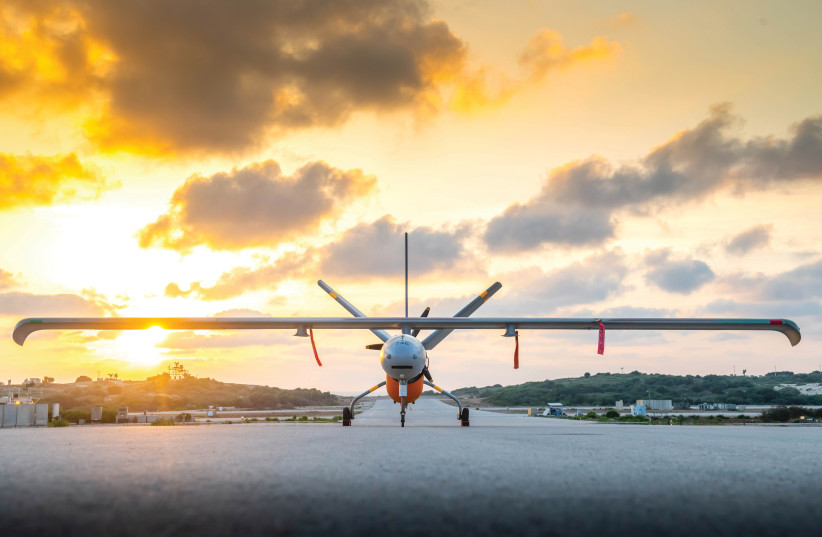
Israel didn’t stumble into this. The IDF has been one of the world’s most demanding operational test environments for autonomous systems for years. Elbit’s Hermes drones have flown in contested airspace for over a decade. Rafael’s autonomous weapon stations guard Israel’s borders. Iron Dome’s targeting logic, operating under real engagement timelines with zero margin for error, is an early form of physical AI that has already saved Israeli lives.
These aren’t demonstration projects sitting in a lab waiting for a defense ministry tender. They’ve been used. Tested under fire. Iterated in real conditions.
What that history creates is something money can’t easily replicate: a generation of Israeli engineers who’ve built systems that had to work when it mattered.
Unit 8200 and the broader intelligence community have produced AI and sensing talent that understands operational constraints most engineers in the world have never encountered. When those people leave the military and start companies, they carry that experience with them.
That pipeline is one of Israel’s most underappreciated strategic assets.
Ukraine changed the calculus for everyone
The war in Ukraine has been a live proving ground for physical AI at scale. Ukraine’s use of FPV drones, coordinated by AI-assisted targeting, demonstrated that autonomous systems can be battlefield-decisive even when deployed asymmetrically by a smaller, outgunned force. The lesson landed hard in every serious defense ministry.
Russia adapted. Iran-supplied Shahed drones pushed autonomous loitering munitions into mainstream military doctrine overnight. The question being asked in Tel Aviv, Washington, and Beijing isn’t whether autonomous systems matter. It’s how fast you can field them, how many, and how reliably.
Israel’s October 7 experience added another layer. While the failure wasn’t technology, the aftermath has driven an urgent rethinking of border sensing, autonomous alert systems, and the human-machine teaming required to respond faster than any purely manual system allows.
The American bet
The United States is moving with unusual urgency. The Pentagon’s Replicator initiative is explicit: thousands of autonomous platforms, attritable and expendable, deployed at scale. Not a future program. Funded and in production.
Companies like Anduril and Shield AI are building the integrating software that makes autonomous systems operationally viable. DARPA has been laying the scientific foundation for autonomous ground vehicles and collaborative combat aircraft for years. The money following these companies reflects a consensus that physical AI is where the next decade of military advantage gets decided.
For Israel, the US trajectory matters for two reasons. First, interoperability. Israeli systems need to work alongside American platforms in any serious conflict scenario. Second, competition. American companies are moving fast into markets where Israeli firms have historically had an edge.
What Israel needs to get right
The hardware exists. The talent exists. What’s still underdeveloped is the software stack that makes physical AI scalable and reliable: autonomy software that functions in GPS-denied environments, simulation platforms for testing before deployment, and sensor fusion systems that work in degraded conditions.
That’s where the next layer of Israeli defense-tech companies needs to emerge. Not more drones; smarter drones; systems that can operate in communications blackouts, make sound decisions at the edge, and be validated to the standards that both the IDF and NATO partners will require.
The countries that solve reliable autonomous systems first will have a military advantage that traditional defense spending can’t easily offset. Israel has the operational history, the engineering talent, and the threat environment to be a genuine leader here.
The window to build that position is open. It won’t stay open indefinitely.
The writer is a founding partner at Aurelius Capital, a defense-led dual-use technology fund investing in Israeli founders across cybersecurity, autonomous systems, drones, and communications.