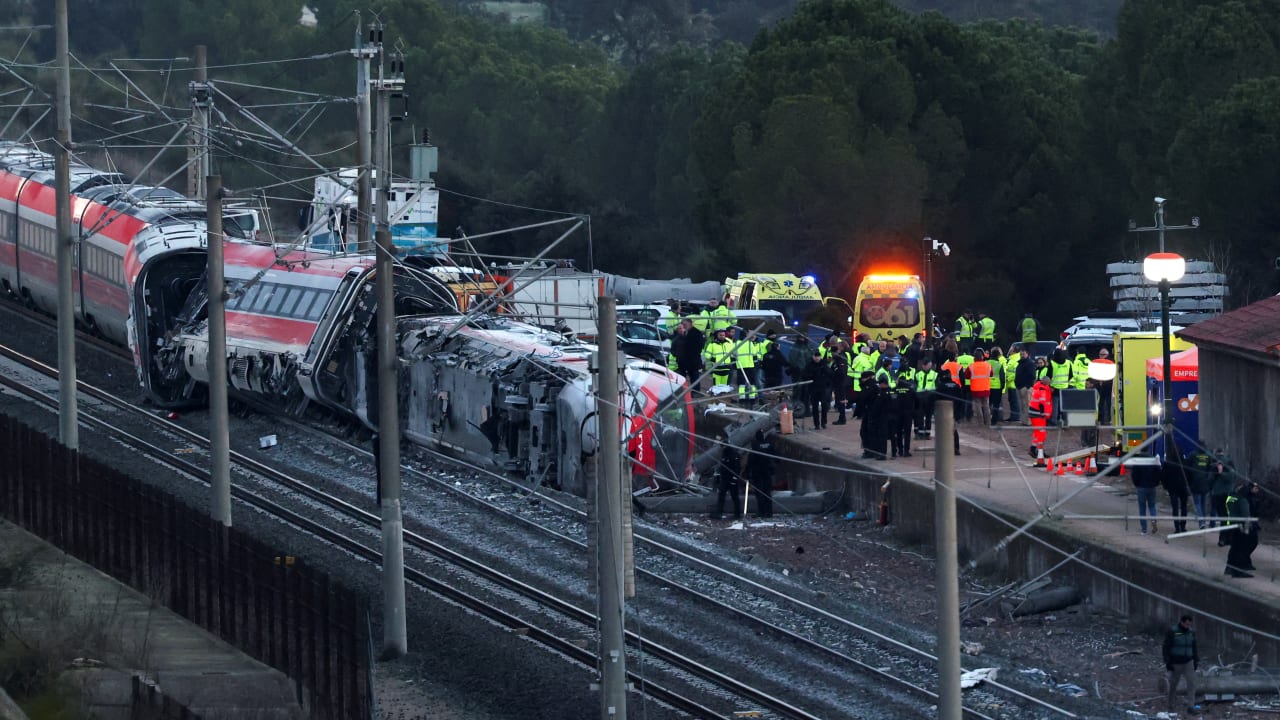
Spain will dedicate three days, beginning on Tuesday, to an official mourning period after a train crash killed at least 40 people and injured over 122, The Guardian reported.
Spanish Prime Minister Pedro Sanchez announced a period of national mourning after the accident, which was declared the worst the country has seen in more than a decade, BBC reported.
Rescuers continue to look under the wreckage of twisted train cars to locate victims of the collision.
On Monday, around 18 hours after the collision of a high-speed train carrying about 400 passengers, people across the country were still trying to contact missing loved ones.
The accident happened near Adamuz in the province of Cordoba, about 360 km (223 miles) south of the capital Madrid. It left 122 people injured, with 48 still in hospital and 12 in intensive care, according to emergency services.

Passengers who were present described horrific scenes of the train crash following the accident.
"The train tipped to one side, then everything went dark, and all I heard were screams," one woman told BBC reporters.
"I started to get up and thought, this isn't normal. Then I looked for my sister. That's the last thing I remember before everything went dark," said Ana Garcia Aranda, 26, who was traveling to Madrid from Malaga with her sister and their dog after visiting family.
Other passengers subsequently broke windows and pulled her from the wrecked carriage.
Most survivors said on Monday that they were unaware of the scale of the disaster until they made it outside and witnessed injured or dead passengers, and rescuers working under floodlights beside the tracks.
Spanish Prime Minister visits train crash site
Sanchez visited the train crash site with senior officials on Monday afternoon.
"This is a day of sorrow for all of Spain, for our entire country," he told the BBC.
The Spanish PM vowed to "get to the truth" and find the real answer to the tragedy origin. "When that answer about the origin and cause of this tragedy is known, as it could not be otherwise, with absolute transparency and absolute clarity, we will make it public."
'You knew they were going to die, and you couldn't do anything'
"There were people who were fine and others who were very, very badly injured. You had them right in front of you, and you knew they were going to die, and you couldn't do anything," Aranda said, wearing sticking plasters on her face.
Firefighters later rescued her sister from the train and took her to the hospital, where she is in intensive care.
Outside the crash site, sirens echoed through the night as emergency vehicles flooded the narrow roads. Residents of Adamuz said the whole town mobilized, bringing water, blankets, and food to help the stranded passengers.
"That won't be forgotten," Salvador Jimenez, a journalist with Spanish public broadcaster RTVE, who was pulled from one of the trains, said. "In the end, it's a lottery. Many of us were lucky."
Jerusalem Post Staff and Reuters contributed to this report.