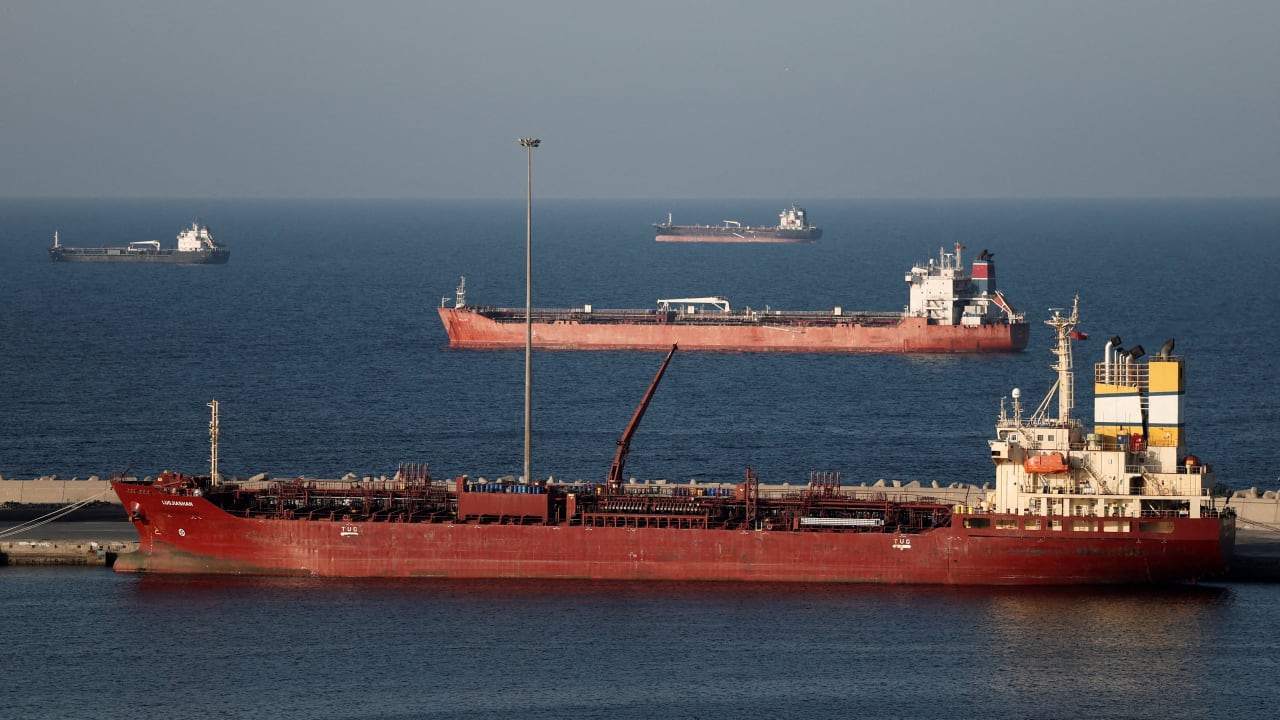
Several US allies said on Monday they had no immediate plans to send ships to unblock the Strait of Hormuz, rebuffing President Donald Trump's request for military support to keep the vital waterway open.
Trump called on nations to help police the strait after Iran responded to US-Israeli attacks by using drones, missiles, and mines to effectively close the channel for tankers that normally transport a fifth of global oil and liquefied natural gas.
Germany, Spain, and Italy were among the allies that ruled out participating in any mission in the Gulf, at least for now. Other countries were more circumspect, with Britain and Denmark saying they would consider ways they could help, but emphasising the need to de-escalate and avoid being dragged into the war.
"What does (...) Donald Trump expect a handful or two handfuls of European frigates to do in the Strait of Hormuz that the powerful US Navy cannot do?" German Defence Minister Boris Pistorius said in Berlin on Monday, downplaying threats from Trump that failing to come to Washington's aid could have consequences for the NATO alliance.
"This is not our war, we have not started it," he added.

The conflict has nothing to do with NATO and Germany has no plans to be drawn into it, German government spokesperson Stefan Kornelius said.
"Neither the United States nor Israel consulted us before the war, and ... Washington explicitly stated at the outset of the war that European assistance was neither necessary nor desired," the spokesperson said.
Spain said it would not do anything that could escalate the conflict, while Italian Deputy Prime Minister Matteo Salvini said sending military ships to a war zone would be interpreted as joining the conflict.
"Italy is not at war with anyone and sending military ships in a war zone would mean entering the war," Salvini told reporters in Milan.
NATO countries, several of whom have been at the sharp end of criticism from Trump in recent months, are wary of angering the White House, and some signalled willingness to help find a solution, even if plans remain vague for now.
EU foreign policy chief Kaja Kallas said the bloc was in talks with the United Nations about replicating a deal that had been used to allow grain to be exported out of Ukraine during its war with Russia.
EU discussing mandate of Red Sea mission
The EU is also discussing whether it could change the mandate of its Middle East naval mission, Aspides, which currently protects ships in the Red Sea from attacks by Yemen's Houthi rebel group, to include the Strait of Hormuz, Kallas said.
But Greece, which leads the Aspides mission, will limit its participation in the Middle East to the Red Sea, said government spokesman Pavlos Marinakis.
Britain's Prime Minister Keir Starmer, whose reluctance to help the initial US attacks drew sharp criticism from Trump, said Britain would work with allies on a collective plan to secure freedom of navigation through the strait.
But he said this would not be easy, and he reiterated that the UK would not be drawn into a wider war. Britain has autonomous mine-hunting systems that could be used, Starmer said.
Denmark, traditionally one of the most enthusiastic NATO allies, but which has clashed with Trump over his demands that it cede Greenland, said the EU should consider helping reopen the strait even if it didn't agree with the war.
"Even if we don't like what's going on, I think it's wise to keep an open mind on whether Europe ... in some way can contribute, but with a view towards de-escalation," Danish Foreign Minister Lars Lokke Rasmussen said.
Dutch Foreign Minister Tom Berendsen said that if NATO were to agree on any mission in the Gulf, it would take time to draw up a framework.
"These are weighty decisions, and any action must be both feasible and impactful. At this moment, no decision is on the table," Berendsen said on Monday in Brussels.
Pakistan-bound oil tanker passes through Hormuz Strait amid Iran war
Ship-tracking data shows a Pakistan-bound oil tanker passing through the Strait of Hormuz over the weekend, indicating that some countries are able to negotiate safe passage for their vessels despite the US-Israeli war with Iran.
Since the war began more than two weeks ago, Iran has attacked several ships in the Gulf, in effect closing the strait, a conduit for a fifth of the world's crude oil and liquefied natural gas, and driving up global energy prices.
Iran has, however, let some vessels through. Treasury Secretary Scott Bessent said on Monday that the US believed some Indian and Chinese as well as Iranian fuel tankers had passed through the strait.
The Kpler data provider MarineTraffic said the Karachi was "the first non-Iranian cargo to transit the chokepoint while broadcasting its AIS signal, suggesting that select shipments may be receiving negotiated safe passage" in a post on X.
Middle East oil exports drop at least 60% as Hormuz stays mostly closed, data shows
Daily oil exports from the Middle Eastern Gulf, home to top exporter Saudi Arabia and other major producers, have dropped by at least 60% in the week to March 15 compared to February due to disruptions and output cuts amid the US-Iran war, according to shipping data and Reuters calculations.
The effective closure of the Strait of Hormuz, normally used to transport about a fifth of the world's oil supply, has forced exporters to cancel shipments and shut down production at oilfields, creating the world's biggest-ever supply disruption. Crude oil prices have surged to the highest in four years, and those of some fuels have reached record highs.
Crude, condensate, and refined fuels exports from eight Middle Eastern countries - Saudi Arabia, Kuwait, Iran, Iraq, Oman, Qatar, Bahrain, and the United Arab Emirates - in the week to March 15 averaged 9.71 million barrels per day, data from Kpler showed, down 61% from 25.13 million bpd in February.
Data from Vortexa shows an even more dramatic drop, with exports from the eight countries last week reaching 7.5 million bpd, down 71% from February's 26.1 million bpd.