
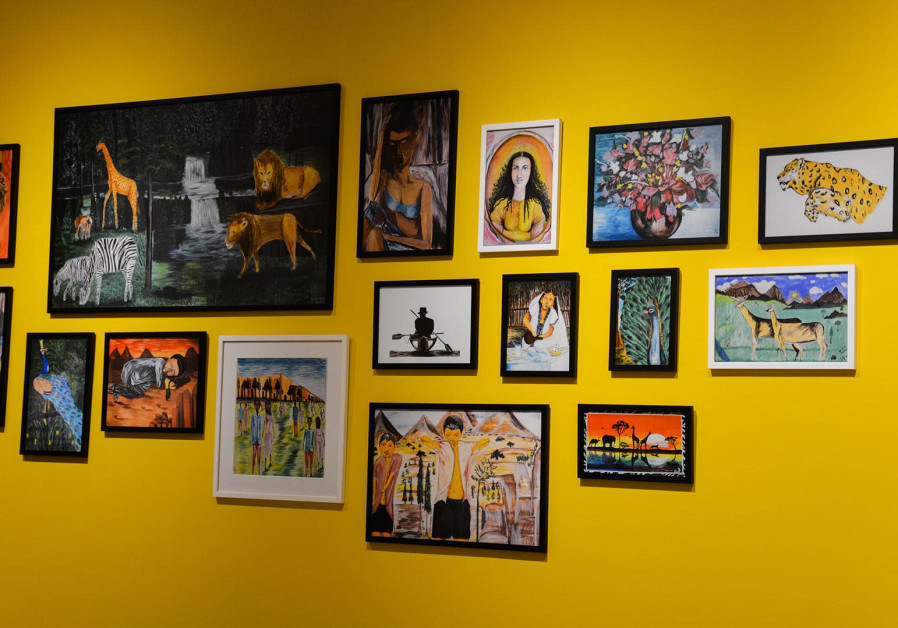
The Hotline for Refugees and Migrants has produced a unique Haggadah which mixes artwork from African migrants in Israel with messages about their community wanting to find a new home in the Jewish state, just as the biblical Jews did after the Exodus from Egypt.
Sadan said she has been volunteering for the hotline for three-and-a-half years, had written about the artwork of around 20 African migrants, and had undertaken a broad survey of their culture and music.
The project involved a range of people due to the parallel English and Hebrew translations and the mix of artwork and graphics.
She said the artists are a wide mix of Eritreans, Sudanese, Congolese, both older and younger artists, male and female, using different kinds of media.
“The art adds to the text and the text to the art. It’s the unification of the two sides which helps create a powerful emotional, historic and political message,” she said.
One piece of artwork in the Haggadah highlights the concept of a “humanitarian animal,” while another highlights the idea of humans lacking humanity. The idea is to present the message that sometimes “with humans, you don’t see humanity, but with animals you see it.”
Another page mixes art about the Holot detention center for migrants with the biblical verse “from the depths I call out to god” for help.
Sadan said the artwork depicts a “black pipe with a view of the desert. In Holot, they just want better lives as when someone recites the biblical passage ‘from the depths I call out to God.’ Migrants just want normal and regular lives.”
In 2015, “A group of Israelis did a Passover seder with the migrants at Holot in the heart of the desert. The Israelites journeyed from Egypt through the desert to Israel. The migrants traveled through the desert to Israel. They now ask, ‘please tell our story’ just like the biblical verse ‘and you shall tell your story to your children.’”
With another image, “There is a picture of a ship. They are not sure where to go. What about going back home I asked the artist? He doesn’t know what home is. He can’t go home and he is not being integrated into Israel.”
Another theme explored in the Haggadah’s artwork is, “A square within a square within a square” Sadan discussed a 22-year-old migrant who is completely Israeli in language, mannerisms and culture, works on art through a kibbutz and has no memory of Africa.
For this migrant, Sadan hopes the Haggadah will convey the command that “every generation is obligated to see themselves as if they” were saved from Egypt, or in this case from danger in Africa.
In this way, Sadan said that the idea of preserving one’s Exodus story can unite both the migrants and the general Israeli population, which ends up having so many interwoven conceptual parallels that it is like “A square within a square within a square.”
Though most additions to the Haggadah are artwork, it has five new texts put together by Sadan and the Hotline.
“Because the Haggadah itself is already so full, and we did English and Hebrew translations, which made the text longer, we didn’t want to overdo new text. We wanted the Haggadah to be primarily visual and artistic,” she explained.