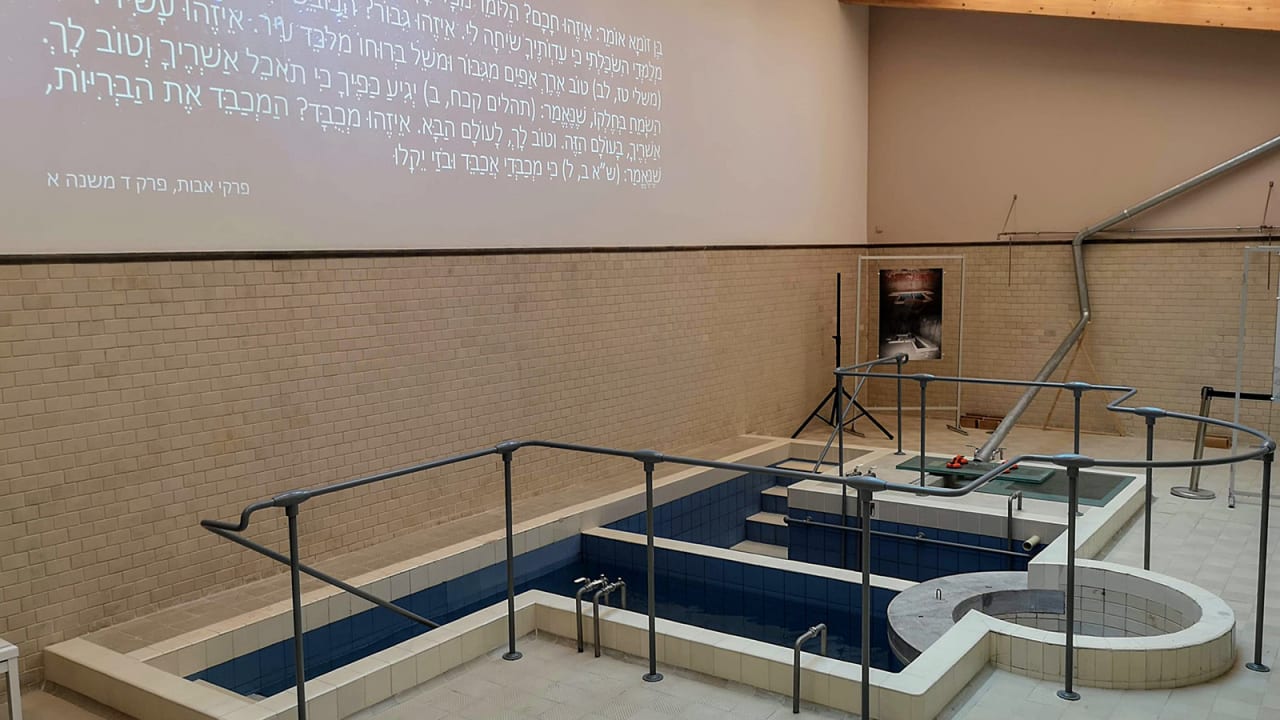
Nearly two weeks after the start of the war, the Religious Services Ministry on Tuesday published a centralized list of women’s mikvaot (religious bathhouses) equipped with accessible protected spaces, following pressure from the religious rights organization ITIM and after days in which women were left without a clear official tool to determine which facilities met wartime safety requirements.
Under wartime guidance issued shortly after the outbreak of the Iran War, women’s mikvaot were permitted to remain open only if the facility included a standard protected space that could be reached within the required alert time. Men’s mikvaot, by contrast, were ordered closed at that stage.
But while the operational condition was set early, a centralized public list identifying which mikvaot actually complied with it was published only on Tuesday, after ITIM appealed to the Chief Rabbinate and the Religious Services Ministry to make the information accessible to the public.
In a March 2 letter, ITIM said it had received inquiries from women across the country asking where they could immerse safely under the new rules but found that, in most places, the relevant information was not available in an orderly or accessible format on local religious council websites.
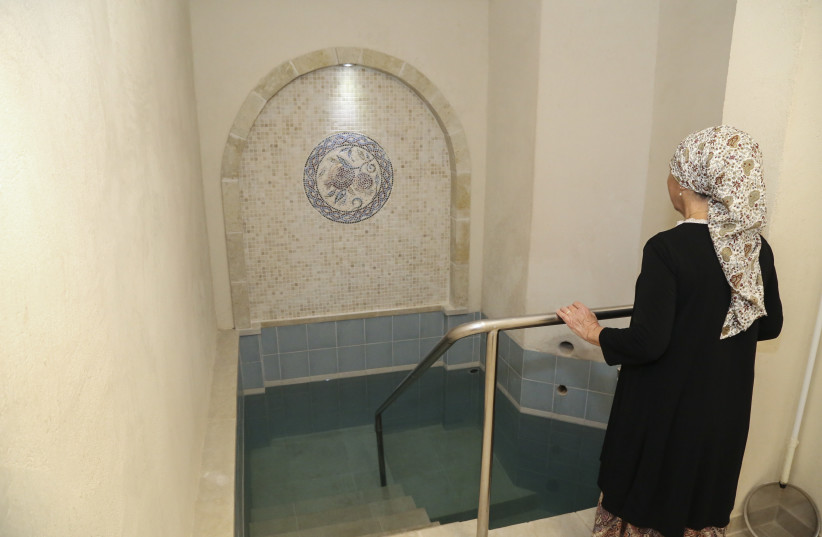
Religious Services Ministry updates website with list of protected mikvaot
The organization said women were effectively being asked to navigate scattered municipal websites or make direct phone calls in order to determine whether a mikveh was usable during missile alerts.
ITIM said the issue was especially pressing because many of the women seeking the information were themselves reservists or married to reservists. The group argued that once the state conditioned mikveh use during wartime on the presence of accessible shelter, it also needed to ensure that the public could easily identify which facilities met that standard.
The ministry on Tuesday uploaded the protected mikvaot information to its national database page, a step ITIM welcomed. ITIM founder Rabbi Seth Farber said the lack of a public list had left women in an untenable position: instructed to use only protected mikvaot, but without a simple official guide showing where those mikvaot were.
The dispute does not turn only on religion-state questions but also on implementation.
Mikveh immersion is a religious ritual, and there is room for debate over the extent to which the state should be responsible for regulating access to it during wartime. But once the ministry chose to keep women’s mikvaot open under specific emergency conditions, the question became less whether the state should be involved and more how fully it intended to carry out that role.
ITIM noted that a similar problem arose in the early months of the war following the October 7 attacks, when, it said, information was eventually provided only after delays and was not made sufficiently accessible to the public. In the meantime, the organization said, its MyMikve website had functioned as the country’s most comprehensive public source for nationwide mikveh information.
For women trying to observe immersion during a period of continued rocket fire, the publication of the ministry’s list resolves at least part of that uncertainty. But the timing still leaves open a narrower administrative question: why it took nearly two weeks from the start of the war to publish, in centralized form, information that had become essential the moment the wartime restrictions were announced.