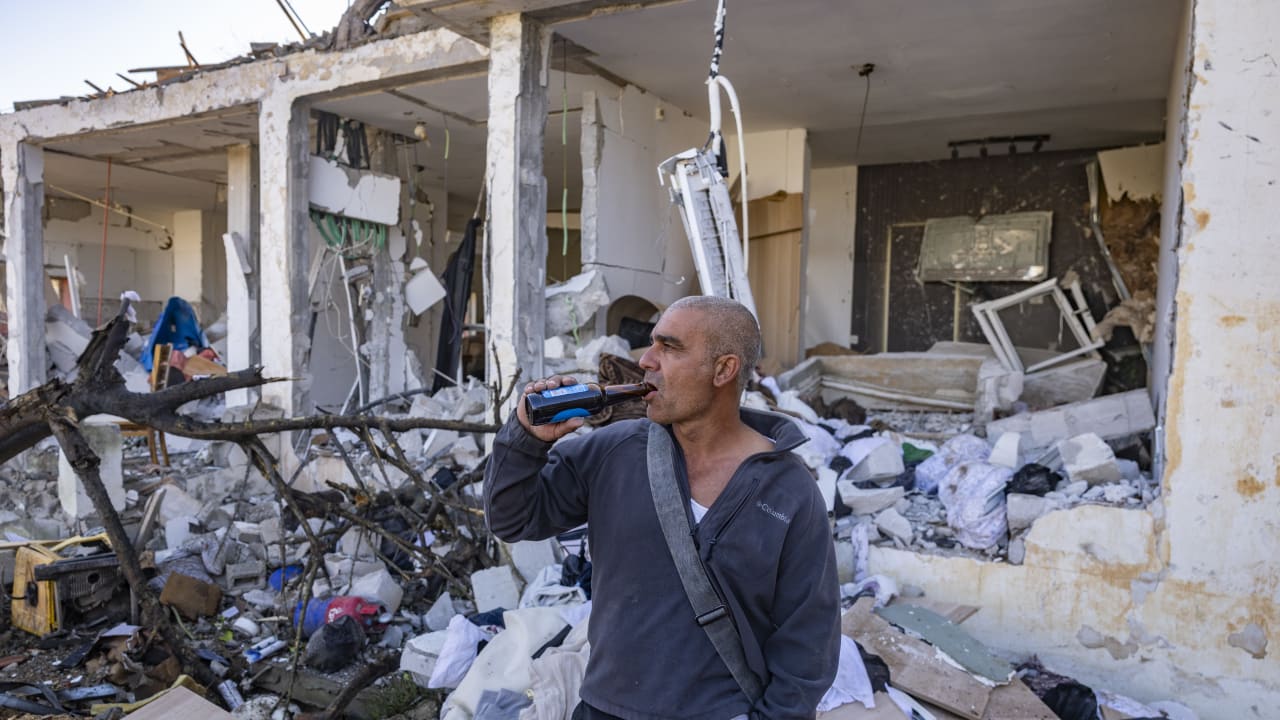
Reporter’s notebook: The Dimona neighborhood that was hit by an Iranian cluster-munition missile on Saturday evening looked on Sunday morning like it had been torn apart by a hurricane.
“I don’t know where we’re being evacuated to, but we’re leaving our apartment,” Ilanit Biton, a local resident and mother of five, said as she stood near the damaged building where she lives. “I asked to get alternative housing here in Dimona.”
Biton lives in the neighborhood that absorbed the full force of the blast from the Iranian missile that struck on Saturday. She and her family survived because they went to the neighborhood’s communal shelter after the first siren sounded.
Dimona resident: Everything here is destroyed
“Now I’m looking for a place to store whatever I have left in the house,” she said. “Everything here is destroyed.”
From one of the windows of her apartment, the shelter is clearly visible. It protected her and the family members who were with her. The apartment itself, like many others nearby, was hit by the shockwave. Inside, nearly everything had been smashed.

The blast zigzagged between the neighborhood’s aging three-story apartment blocks, built decades ago in long, low rows. Huge numbers hang from the buildings so drivers can easily spot each one from the street. The force of the explosion ripped away balcony sections, windows, exterior panels meant to create a uniform facade, and belongings stored in small side sheds, then hurled debris into the apartments themselves.
Inside, the destruction continued. Television screens were shattered. Glass was blown apart. Furniture was knocked over. Pictures were torn down. Homes were left violated.
“I saw this disaster with my own eyes,” said Roni Cohen, 60, who arrived in the neighborhood on Sunday morning wearing a yellow vest and looking for ways to help residents. “It was a very large missile, with a very powerful blast. The shockwave reached the area where I live, near the neighborhood mikveh (ritual bath). Hundreds of people lost their homes.”
“Now people need to come together and help those who lost everything and are being evacuated to hotels,” he said. “It’s surreal to see these buildings now.”
Cohen praised Dimona Mayor Benny Biton, saying he had done everything he could for residents whose homes were damaged. Then he returned to the lesson he said the neighborhood had learned the hard way.
“We have to learn from this disaster,” he said. “When you hear the alert, you must go down to the shelter.”
A young woman in tactical military uniform walked slowly along the street, holding her phone in front of her during a video call. She pointed the camera toward the wrecked buildings.
“Look, this is Hila’s parents’ house, and David lives here,” she told her friend. “Look at this destruction. My God, what destruction.”
Near one of the buildings, a pile of cleaning supplies had been set down: brooms, oversized garbage bags, and other equipment. A group of volunteers in orange vests waited for instructions before being sent to help residents clear apartments. Every few minutes, another family emerged, dragging trolley suitcases, loading them into a car trunk, and driving away.

Some were heading to relatives. Others were being sent to hotels arranged by the municipality.
Outside the entrances to the apartment buildings, residents placed large sacks filled with whatever they had managed to save. Some of the belongings would remain there. Essential items would be taken on to temporary housing.
“This isn’t my apartment. I’m clearing out my daughter’s apartment,” one woman said sadly after setting down a full plastic bag near the gate. “She’s pregnant with her first child. She was evacuated to a hotel near the Dead Sea.”
The street was crowded with people in yellow and orange vests. Some belonged to volunteer groups, including Shomer Achi, while others came from different organizations. They helped residents load essential belongings into cars parked along the road. Many of the vehicles had shattered windows. Some had no windows left at all.
By then, compensation fund assessors from the Israel Tax Authority had already arrived. They too wore yellow vests, with their role printed in large letters across them. Two of them stood at the entrance to the yard of one of the low-rise buildings, then walked inside toward a tall hedge that concealed what had happened behind it.
Through the gaps, it was possible to see the remains of a kindergarten that had been devastated by the blast. The force of the explosion had been so great that much of the structure was nearly destroyed. The walls still standing seemed almost embarrassed before the open void left behind after one of the exterior walls simply came apart.
A security officer who had cordoned off the area with police tape warned people not to get too close.
“Take your pictures quickly and get out,” he said. “It’s dangerous.”
Looking at the faces in the street, the same expression appeared again and again: shock. The sadness was everywhere. People who had lived in these modest apartment blocks for decades were now being forced to leave with no warning at all. For many, it was hard to take comfort in the fact that they had survived physically unharmed.
By noon, the politicians had arrived to visit, embrace, strengthen, and console.
“The war will end when we win,” Prime Minister Benjamin Netanyahu said during his visit to the city, where he met his longtime ally, Mayor Benny Biton, and toured the damage to buildings, infrastructure, and personal property. Netanyahu spoke about the aims of the war.
“We have two goals: to crush the nuclear program and to crush the missile program,” he said. “The third is to create for the Iranian people the conditions to remove the burden of this regime. On the first two goals, we are almost there. I cannot elaborate further.”
He spoke about Israel’s coordination with the United States. He spoke to world leaders. He spoke about the progress of the war.
He said nothing about the future of the residents who had lost their homes and were now leaving them behind.