
For most of the past year, the war has arrived at Soroka Medical Center by ambulance. Civilians and soldiers wounded across southern Israel are rushed through its emergency entrance, even as the hospital continues to treat thousands of patients whose lives have little to do with the battlefield. Then, last year, the war struck the hospital itself. An Iranian missile hit the Soroka complex, damaging several buildings and forcing staff to reorganize their work overnight. This International Women’s Day, three doctors at Soroka reflected on what the past months have looked like from inside the hospital’s walls. Their experiences move between the emergency room and the battlefield, between operating rooms and bomb shelters, and between the professional demands of medicine and the personal realities of family life during war. Their stories offer a glimpse of what it means to stand at the intersection of medicine, conflict and resilience, and of the women who continue to do so every day.
Dr. Ofira Azulay: "You put everything you’re feeling aside, and you just work.”
On the morning of October 7, Dr. Ofira Azulay was not in the emergency room where she normally spends her days. She was in Tel Aviv with her family for the Simchat Torah holiday when the sirens began. “Very quickly the hospital understood that something unusual was happening,” she recalls. “They declared a mass casualty event at the highest level and asked the staff to come in.”
Azulay and her husband, an orthopedic surgeon at Soroka Medical Center in Beersheba, were with their four children, including a one-year-old. The decision to leave, she recalls, was not simple. “We had four kids with us, a baby, the sirens, the uncertainty. But we both felt we couldn’t stay where we were. We knew we had to get to the hospital.”
They drove south as the scale of the attack was only beginning to emerge, leaving the children with friends in Omer before heading straight to the emergency department. “When we left Tel Aviv, people were talking about maybe thirty casualties,” Azulay says. “But when we arrived, it was already clear that this was something completely different.”
Over the course of that day, Soroka treated around 670 wounded patients, with the hospital’s emergency department alone administering roughly 250 units of blood. “The numbers are almost impossible to imagine,” she says. “Patients just kept coming, people from the music festival, soldiers, civilians from the surrounding communities."
Some of the stories arriving with the wounded were difficult even to process. “A soldier crying and telling me his entire unit had been killed,” she recalls. “I remember trying to reassure him, telling him maybe it just seemed that way in the chaos. At the time, it was hard to grasp that things like that could really be happening, but you have put everything you’re feeling aside, and you just work.”
The pressure didn't end with the initial days of the war. Last year, an Iranian missile hit the Soroka hospital complex, severely damaging one building and forcing departments to relocate patients overnight. Suddenly, the emergency room became the center of all activity.
"We had to absorb patients from across the hospital,” Azulay recalls, highlighting the incredible teamwork and determination that allowed the hospital staff to keep up their life-saving mission. Although it might seem unbelievable to an outsider, Azulay's account reveals the atmosphere that fosters this unmatched resilience.
"Soroka is more than a workplace. I grew up here professionally,” she says. “This hospital feels like home.” What has sustained her, she adds, is the people around her. “The staff here represent every part of Israeli society – Jewish, Arab, Bedouin, people from the north and the south. And everyone shows up for the patients.”
Still, the demands of the job don’t go away when she leaves the hospital. At home, the war has raised tough questions from her eight-year-old daughter. “She asks me why I’m always the one going to work,” Azulay says with a small smile. “Why are the other mothers home more.”
Her answer, she says, has become part of an ongoing conversation about what it means to grow up as a girl. “I tell her that I go to work so that one day, when she chooses what she wants to do, she’ll know she can do it too,” Azulay says. “I want her to understand that it’s important to follow what you love, and that women shouldn’t have to apologize for that.”

Dr. Lianne Dym: The power of female solidarity
For much of the past year, Dr. Lianne Dym has been living between two very different worlds. On some days she is a fifth-year resident in obstetrics and gynecology at Soroka Medical Center in Beersheba, helping bring new life into the world. On others, she wears an army uniform as the battalion physician for a reserve infantry unit operating along Israel’s northern border.
“I sometimes feel like I’m moving between two parallel realities,” she says. “In the hospital you deliver babies. In the army you prepare for war.” The transition began abruptly on October 7. Due to her keeping Shabbat, she was not on her phone and like many other religious people on that day, didn’t realize the scope of the tragedy until hours later.
“At first we didn’t fully understand what was happening,” she recalls. Later that day came the message from the army: she was being mobilized with her battalion from the Carmeli Brigade. Within hours she was heading north. In the early days, the unit focused on preparation. As one of the few women in the battalion, Dym quickly formed a close partnership with the unit’s female paramedic.
“Having another woman there who understood both the medical responsibility and the environment. It mattered,” she says. “There’s a kind of solidarity.” Together, they trained soldiers in battlefield medicine and prepared for the possibility that they might one day have to treat their own friends.
One conversation shortly before the brigade entered Lebanon remains etched in her memory. “Our paramedic told us very calmly that we had to be ready for something,” Dym recalls. “She said: ‘There may be a moment when we will have to do whatever we can to save everyone, but also content with the fact that we may not succeed.”
The brigade later crossed into Lebanon, and in between deployments, Dym would return to Soroka whenever she could, continuing her residency while many of her colleagues juggled reserve duty and family responsibilities.
When an Iranian missile struck the Soroka hospital complex last year, she was on her way to a work at the local clinic. “I immediately changed direction and went to the hospital,” she says. “We started discharging as many patients as possible and making space.” For Dym, however, the story of the past year is not only about those who served in uniform. “There are so many women carrying this war in different ways,” she says – nurses working endless shifts, residents covering for colleagues in reserve duty, and the partners of soldiers managing families on their own. “My story happens to include a uniform,” she adds. “But there are many women around me whose strength is just as remarkable.”
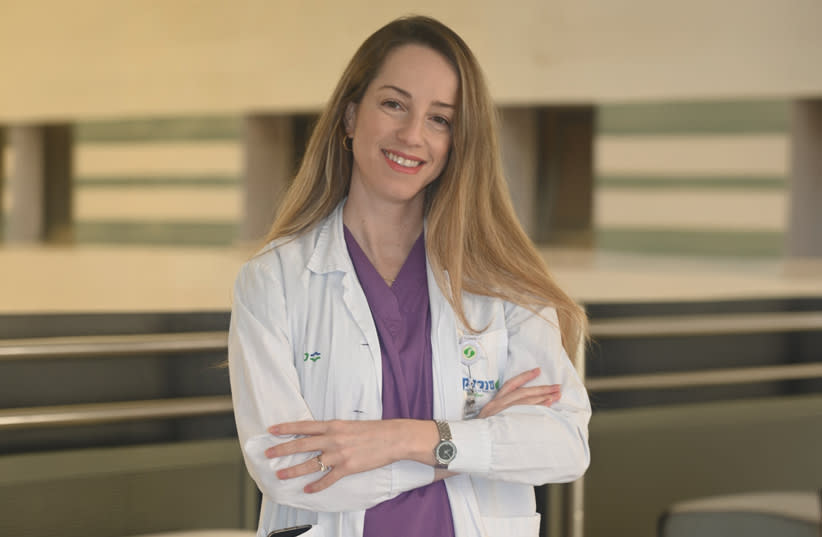
Dr. Katia Averbukh-Oren: “Stopping is never an option.”
The last two and a half years have unfolded along a series of fault lines for Dr. Katia Averbukh-Oren – personal, professional, and national. A surgical resident in the ear, nose, and throat department at Soroka Medical Center, she has watched the war shape her life in ways she could not have anticipated: through the loss of a close colleague on October 7, through months of military service while on maternity leave, and later through the destruction of her own department when a missile struck the hospital.
When the war began, Averbukh-Oren was on maternity leave in Tel Aviv with her four-month-old daughter. “In some ways I experienced October 7 from the outside,” she says. “But emotionally it hit very close to home.” A close friend and colleague from her department, Dr. Daniel Levi. The two had started their residency around the same time and trained together. “We were really good friends,” she says.
That morning, Levi, who was called in to help at the hospital, messaged the department group chat to say he would be late. Soon after, he wrote that there were terrorists in the area. “At that point none of us understood what was happening,” Averbukh-Oren recalls. “We thought it was a local incident.” Levi ran over to Kibbutz Be’eri’s clinic to help paramedics who were trapped there taking care of wounded, holding on for hours before the terrorists reached them. Levi was killed while treating patients at the clinic. “It left a huge hole,” she says solemnly. “Everyone loved him so much.”
Almost a year and a half later, just as she was preparing to leave for her morning shift, an Iranian missile struck the hospital, destroying the ENT department and damaging nearby facilities. The blast tore through the upper floors, rendering the wards unusable. Averbukh-Oren, whose apartment was only two streets away, remembers how the shockwave ripped their shelter door from its hinges.
Despite this, she didn’t hesitate to rush to work right afterward. “We don’t really have the option of stopping,” she explains. “Soroka is the only hospital providing life-saving services for the entire region. A missile hitting this hospital," she reflects, "was a malicious and strategic act.” The department had to be relocated overnight, dispersing staff and equipment across other wards, yet work continued almost immediately.
For Averbukh-Oren, the challenges of the past year have also intersected with another reality: building a career in surgery while raising a young family. “Surgery is still a very male-dominated world,” she says. “You want to be an excellent surgeon, publish research, and be present at home. It’s a constant juggling act.” But she also sees it as a responsibility. “I hope my daughter grows up seeing that women can do these things,” Averbukh-Oren says. “Even when it isn’t easy.”
Written in collaboration with Soroka