
On a recent morning, somewhere between a siren and the return to silence, an Israeli family resumed the small, ordinary task they had been forced to abandon just moments earlier. A kettle was set back on the stove.
A chair was straightened. Life, briefly suspended, gathered itself again. Across the country, such fragments of routine have come to define these weeks of war with Iran, days measured not only by headlines but also by interruptions.
And yet, as Passover approaches, when asking participants to see themselves as if they personally left Egypt, the present feels unusually close to the ancient story as displacement, uncertainty, and the search for shelter no longer seem like metaphors.

It is precisely in this space that Keren Hayesod – UIA, one of the founding National Institutions of the State of Israel, has taken on a renewed urgency, not as an abstract institution but as a living network – linking Jewish communities around the world and Christian friends of Israel, with individuals on the ground, translating solidarity into immediate, tangible support.
In recent months, its presence was felt not only in words but also in direct and concrete actions. From the outset of the war, Keren Hayesod has provided direct support to municipalities affected across Israel, which includes crucial funding, strengthening community resilience, and assisting displaced communities and individuals.
“During these challenging times of war affecting so many across Israel, we are once again witnessing the extraordinary strength and resilience of Israeli society and the deep bonds of solidarity shared with Jewish communities and Christian friends of Israel around the world,” says Sam Grundwerg, world chairman of Keren Hayesod.
“The force that guides our work and the enduring commitment of our donors is the belief that no one in Israel will be left alone, whether in everyday life or in crisis.
“As we approach Passover, we feel a profound responsibility to help those affected rebuild, supporting everyone from the elderly to young families. For over 100 years, together with our partners at The Jewish Agency for Israel, we remain committed to standing by the people of Israel.”
‘Helping someone is almost an act of creation’
Daniel Asher doesn’t tell his story in chronological order. It reflects how his life has been in recent years – events piled on top of each other, each nearly overwhelming on its own. “Calling it ‘intense,’” he says with a slight smile, “would be an understatement.”
Four years prior, he was diagnosed with cancer. What followed was a lengthy and exhausting series of treatments: surgeries, chemotherapy, and radiation. Though he ultimately recovered, peace did not return with his health. On Oct. 7, that fragile sense of normalcy was shattered by a phone call from his daughter, who was at the Supernova music festival.
“They’re shooting at us – there are wounded, there are dead,” he recalls her saying. She managed to escape on foot, crossing open fields from Kibbutz Re’im to Moshav Patish. “She got out by the skin of her teeth,” he says quietly. “She survived.”
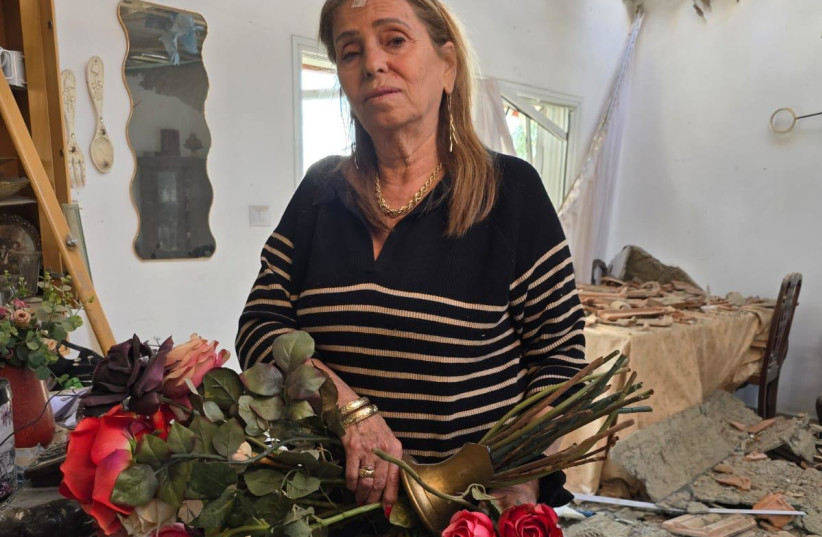
Almost three years later, during the current war with Iran, another rupture came. A missile landed just 20 meters from his home. “My wife was cleaning for Passover, and I was painting a cabinet when the siren started. We put everything down and went into the safe room. Sixty seconds later – an explosion. A massive one,” he recalls.
When they emerged, the house had vanished. “The roof, the windows, the car, everything was destroyed. You stand there, touch yourself, and say: ‘I’m alive.’” He pauses. “Isn’t that a miracle?”
Today, Asher and his wife are staying in a hotel, but his story does not revolve solely around loss. “After losing our home,” he says, “I realized how many kind people are in this country.” Volunteers arrived almost instantly, and chief among them was Keren Hayesod.
“They came with their hearts open,” Asher recounts, “asking what we needed, and staying to support us days and even weeks later.” A financial grant from the Fund for Victims of Terror of The Jewish Agency followed, but what stayed with him most was something else: “‘You’ve entered our hearts,’ they told us. “‘We’ll be with you not only now, but when you rebuild your home.’”
For Asher, the experience has fundamentally changed him. “It showed me that even from my little, I should give to others,” he says. “Helping someone take one more step forward is almost like an act of creation. It’s divine.” And then, almost as an aside, he goes back to the single moment that divided everything into before and after: “We were just one minute away,” he says. “Just one minute.”
Rebuilding safety, delivering hope
If Daniel Asher’s story unfolds at the scale of a single home, the work described by Erez Shani, CEO of Amigour, stretches across an entire population, one that is often overlooked, even in quieter times.
“We’re talking about some of the most vulnerable people in Israeli society,” he says. “Elderly individuals, many of them immigrants from the former Soviet Union, some Holocaust survivors, living only on a basic National Insurance stipend. No pension, no assets. Just enough to get by.”
Amigour, a subsidiary of The Jewish Agency, operates dozens of housing facilities for this population. In ordinary times, the challenge is already considerable. In wartime, it becomes something else entirely.
“On the morning Operation Roaring Lion began, we started getting calls,” Shani recalls. “Residents were afraid to leave their apartments, expressing how afraid they were to go out and buy food. And you have to understand, these are people who can’t run when there’s a siren.”
His response was immediate. “My first call was to Keren Hayesod. I told them: ‘I don’t have an order, I don’t have a budget, but we need to act.’”
The answer, he says, came just as quickly: “Go ahead – we’ll raise the money.” Within days, a large-scale operation was underway. “So far we’ve distributed 10,000 food packages,” he says. “Not symbolic packages, real ones. Milk, eggs, vegetables, bread. Things people actually need to live day to day.”
A second round is already in motion, tailored for Passover. “Matzah, gefilte fish… products that matter for the holiday, so the people don’t have to go out.”
Beyond immediate relief, the partnership has extended into longer-term solutions. In older Amigour buildings, many of which lack adequate protected spaces, a new urgency has taken hold. “We realized we had to act,” Shani says. “We launched a project worth over $60 million to build proper protected rooms.”
Some are already completed; others are underway. Here, too, Keren Hayesod plays a central role in mobilizing support from Jewish communities worldwide. But for all the numbers, Shani repeatedly goes back to something less tangible.
“It’s this feeling that you’re not alone. That there are communities, thousands of miles away, who see you, who care. I always tell them that while we may live in different places, we are one heart.”
In the days leading up to Passover, that idea takes on a particular weight, with Amigour staff remaining on duty throughout the holiday, ensuring that residents are not left alone, that meals are delivered, and that someone is there.
“Without this support, we simply couldn’t do it at this scale,” Shani says. “Not like this.” And yet, in the background of systems and structures, the goal remains disarmingly simple – that even now, even here, no one is left without what they need to endure, and, perhaps, to celebrate.
‘Community remains a community’ – a journey of faith and belonging
For Sacha Halfon, the journey to Israel did not begin with the war, but it came to fruition in its shadow. He arrived on March 17, stepping off a plane into a country already deep in conflict. “I started my aliyah process two years ago,” he says. “I didn’t want to wait any longer.”
Halfon, 25, who is originally from Versailles, France, speaks with a quiet certainty. “I am Israeli, with or without war,” he says simply. “I have faith in this country.” For now, he has settled in Ra’anana, close to his family in Netanya and Jerusalem, suspended between familiarity and new beginnings.
The practicalities of the move, often daunting even in calmer times, were eased by Keren Hayesod. “They helped me a lot,” he says, “with the plane ticket and all the administrative procedures.”
Like many others, he found his way to the organization through friends. “They told me that they also relied on them to come here.” If his timing might seem unusual from the outside, to him it feels almost self-evident.
“You get used to the war,” he says. “I’m not afraid. I trust the State of Israel. Even though the situation is difficult, a community remains a community. There is a real sense of solidarity.”
Between departure and arrival, uncertainty and conviction, his story quietly affirms that this is a place one can choose, and choose again, to call home.
This article was written in cooperation with Keren Hayesod.