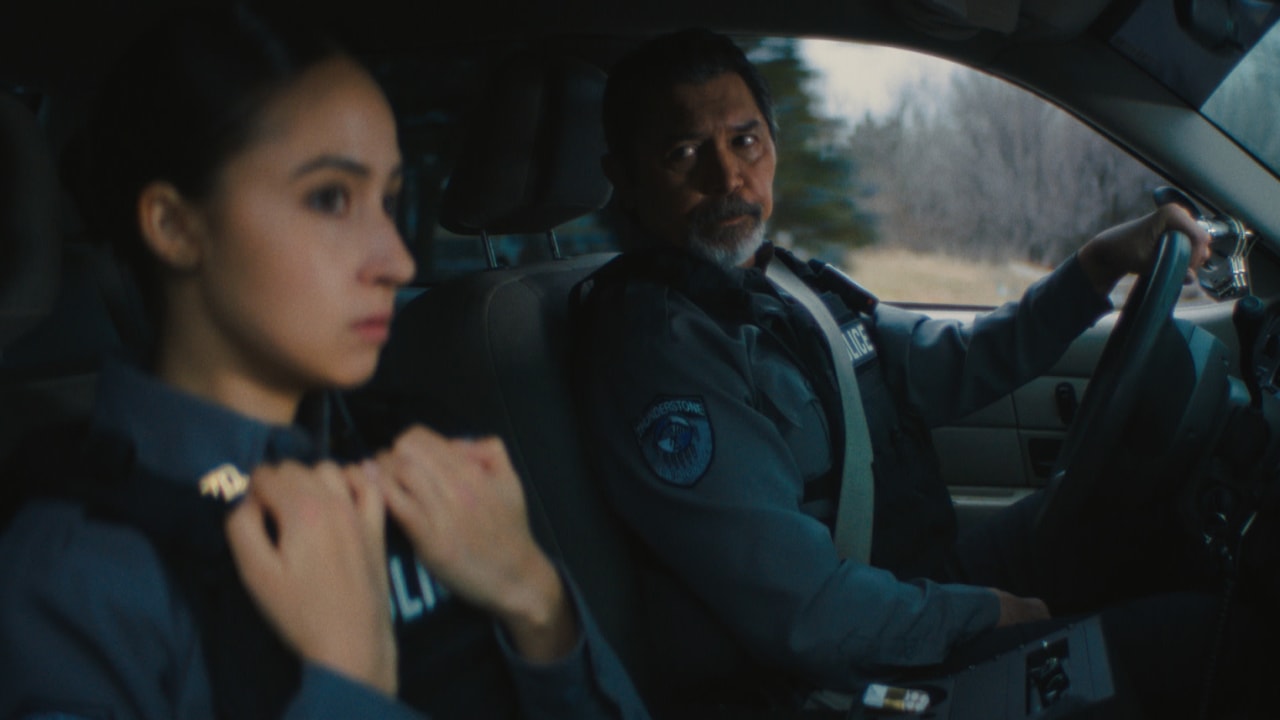
When Vincent Grashaw, who will be a guest of the Jerusalem Film Festival this week, first read the screenplay for Gangland, a crime drama starring Lou Diamond Phillips as a veteran tribal police chief, he was immediately struck by how authentic the world of the film felt.
“It felt wholly authentic and lived-in,” Grashaw said in an interview ahead of his visit to Jerusalem, where he will present the movie. “That’s how it registered to me – very believable.”
Set on the fictional Thunderstone Reservation in the American Southwest, Gangland examines a Native American community struggling with poverty, drug trafficking, gang violence, and the weight of generations of trauma.
Phillips plays Teddy, the head of a small tribal police force, who is joined by Sandra (Dana Namerode), an officer transferred from outside the community and carrying her own troubled history.
Phillips, who was a rising star in the 1980s in such movies as Stand and Deliver and La Bamba, gives the performance of his career as the troubled but devoted cop.

Grashaw, who previously visited Israel for a wedding, found the script while browsing the Black List, a website where screenwriters can upload their work. The screenplay had not appeared on the organization’s prestigious annual list of highly regarded unproduced scripts. It was simply the first screenplay uploaded by its writer, Zach Montague.
When Grashaw contacted him, he learned that Montague was a Canadian police officer who had worked in communities on reservations.
'It just felt very real'
“That made a lot of sense because, like I said, it just felt very real,” Grashaw said.
The director had already been interested in gang culture and in the forces that lead people into violent organizations.
“I’ve always been curious about how people can fall into that certain way of life, which is violent and ugly in a lot of ways,” he said. “What was the appeal to it? I was always interested in why people make those decisions.”
Although the script was originally set in Canada, Grashaw and his collaborators adapted it to the United States, where tribal police departments operate under a complex system of agreements and jurisdictions involving local sheriffs and other law-enforcement agencies.
“Sometimes they help each other, and sometimes there’s conflict,” he said. “That’s a real thing in the treaties there, and we thought it was really interesting.”
Randomix Productions, a company he has partnered with several times in the past, came on board and was supportive of his vision for this story. The filmmakers considered setting the story on a specific reservation, such as Pine Ridge in South Dakota, which has faced serious gang problems. But consultant Marcus Red Thunder, who had previously worked with Phillips on the television series Longmire, advised them not to identify the community with one particular tribe.
“He said, ‘Make it Native American – like it could be any tribe,’” Grashaw recalled.
Red Thunder helped create the fictional Thunderstone Reservation and advised the production on the script, locations, policing, and numerous cultural details.
The film was ultimately shot in Oklahoma, with Native American performers and community members involved both in front of and behind the camera. Some were experienced actors, while others had never performed professionally.
Michael Tubby, who plays gang member Luke Spencer, was appearing in his first movie. Grashaw said Tubby had once belonged to a gang and had served time in prison.
“Lou Diamond Phillips was his hero,” he said. “And here he is acting in the rain opposite him.”
Grashaw acknowledged that he approached the film as an outsider.
“I’m not Native American,” he said. “But I have a curiosity inherently. I want to make movies where I don’t necessarily know the world. I want to inject myself into learning it.”
He described his method as investigative and collaborative. While filmmakers are often advised to tell only stories they know personally, Grashaw said he is also attracted to scripts that offer entry into unfamiliar lives.
'You fall in love with it'
“You fall in love with it, and then you make it your own, and you learn, and you collaborate,” he said. “I really enjoyed that process on this one.”
One memorable image in the film is a herd of bison, shown both during the story and again near the end.
Grashaw filmed the animals on the Cheyenne and Arapaho reservation after witnessing a similar moment while scouting locations.
“I was like, ‘Please let me film this. This is just beautiful,’” he said. “It’s emotional, actually, to see that, because it’s such a part of their culture.”
At the center of the movie is Phillips, whom Grashaw described as both an exceptional actor and an unusually generous presence on the set.
“He’s a gem,” Grashaw said. “He levels everybody up. He’s such a good guy and really generous to everyone on set.”
Grashaw also praised Namerode's performance as Sandra. "If the Sandra and Teddy chemistry isn't there, the film doesn't work. And I owe a lot of that to her preparation and their work together.
The film’s distributors are mounting an awards campaign on his behalf.
“It is his best performance, in my opinion,” he said. “I think a lot of people are seeing that.”
The director was equally enthusiastic about Elisha Pratt, who plays the menacing gang leader Richie Black Lance.
“When those choices are limited, it’s easy to judge,” Grashaw said. “But I at least wanted people to understand where he was coming from and how you can fall into that sort of life.”
That moral ambiguity extends throughout the film. Teddy and Sandra may be the protagonists, but they are not always correct, while even the most threatening characters occasionally have understandable motives.
“Everybody is sort of right and wrong at times,” Grashaw said. “Maybe the heroes and the good guys are right 80% of the time, but wrong 20% of the time.”
Sandra also acts as the audience’s guide into the reservation, but her own experience of drugs, guilt, and loss complicates her perspective. Teddy, Grashaw suggested, may know more about her past than he initially admits, and hires her partly because he senses that her instincts resemble his own.
Beyond the film itself, Grashaw hopes Gangland will create opportunities for its Native American cast members, including Pratt, James Whitecloud, and Riker Sixkiller.
He would especially like to see them cast in stories that are not defined entirely by Native American identity.
“These are fantastic actors,” he said. “I hope their careers flourish as ordinary people, too. I don’t see enough Native American actors in movies that don’t revolve around the theme of their identity. Why not cast these actors in roles that are just everyday life? I hope that happens.”
Gangland is scheduled to be screened on Friday, July 17, at 6:45 p.m. (followed by a Q&A with director Vincent Grashaw) and on Saturday, July 18, at 9:30 p.m.