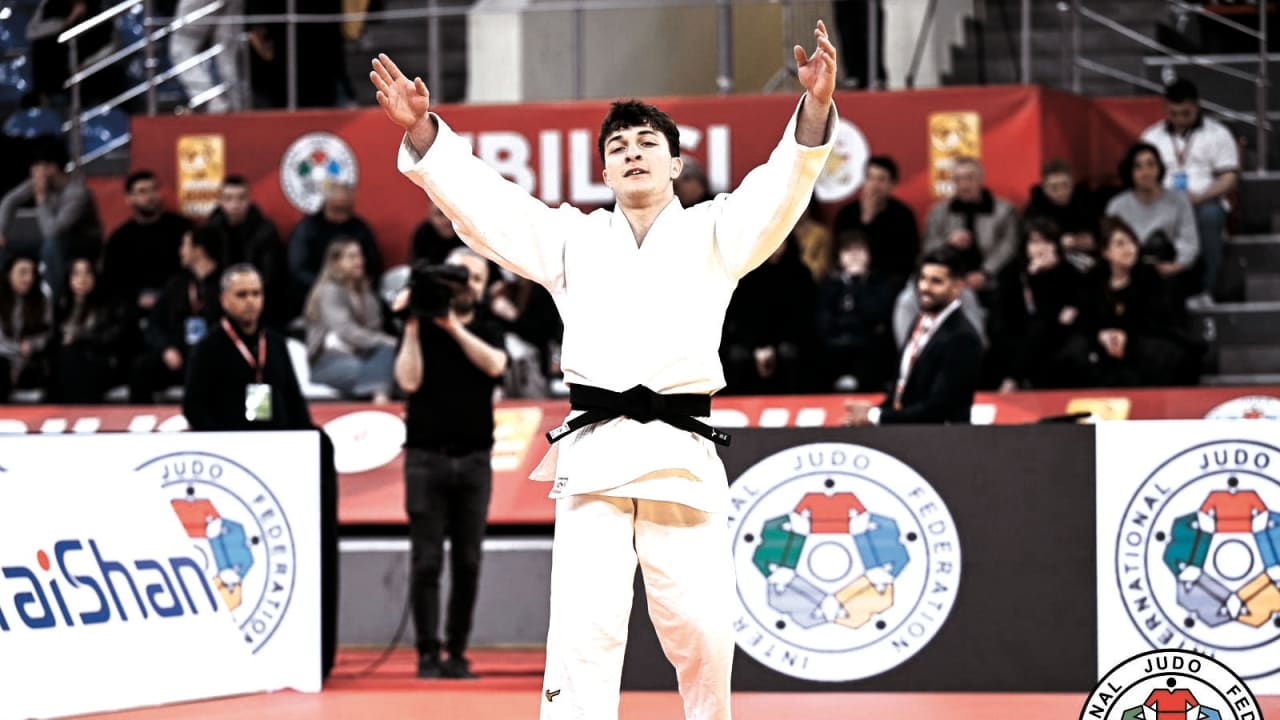
The air in the Olympic Palace in Tbilisi didn’t just vibrate with the roar of the Georgian crowd; it thickened with the sudden realization that a global hierarchy was being dismantled in real time.
As the final buzzer echoed across the arena, Israel’s Izhak Ashpiz didn’t collapse in exhaustion or erupt in theatrical celebration. Instead, he adjusted his blue judogi with the stoic calm of a master craftsman finishing a routine shift, despite having just secured a historic gold medal at the Tbilisi Grand Slam. This wasn’t just another podium finish; it was a geopolitical statement in the world of high-performance sports.
To understand the weight of this moment, one must understand the environment. Georgia is a nation where judo is not merely a sport, but a core component of the national identity, a lineage of strength stretching back generations.
Winning gold here as an outsider is akin to winning a high-stakes poker game in a room full of professionals who own the house. Ashpiz didn’t just win; he dictated the terms of the engagement.
Tbilisi was the crucible that transformed the 18-year-old from Rishon Lezion from a “prodigy” into a “predator,” and it is where the moniker “The Prince of Tbilisi” was officially ratified. This title is no longer just flattering prose; it is the definitive seal establishing Ashpiz as a legitimate, perhaps even the consensus, frontrunner for a medal at the Los Angeles 2028 Olympics.

The transition from a promising junior to a senior-level threat is often a violent one, littered with the broken dreams of athletes who couldn’t handle the physical brutality of the elite circuit.
Israeli teen Ashpiz wins gold, reshapes judo hierarchy in Tbilisi
Ashpiz, however, skipped the traditional “learning phase” and went straight to the head of the table. For the Israeli delegation, this gold served as the unambiguous opening chapter of what is now recognized as the “Ashpiz Era.”
The dominance Ashpiz displayed in Tbilisi was less about the color of the medal and more about the terrifyingly efficient manner of the conquest. His path to the final was a masterclass in varied execution. He wasn’t relying on a single “money throw”; he was adapting his center of gravity to exploit the specific anatomical weaknesses of every opponent he faced.
In recent conversations with professional avid judo fan Dean Carmeli and analyst Yevgeni Klushin, the voices behind the Nafalta Hazak podcast, we dissected the startling statistical reality behind this rise. We spoke at length about the “eye test” versus the “data test,” and in Izhak’s case, both metrics scream of a generational shift.
“What we are witnessing isn’t just a hot streak,” Klushin remarked during our discussion, pointing to the sheer technical variety Ashpiz used to navigate the preliminary rounds. “It is a total recalibration of the world’s -60kg category.”
According to the data, Ashpiz is currently performing at a historical pace that places him in a statistical bracket shared only by the greatest legends of the Japanese and Soviet schools. In the modern era of the IJF World Tour, the -60kg category has become a “speed trap,” a place where veterans usually use their superior mat sense to drown younger, faster athletes. Ashpiz has inverted this logic. He is the youngest Israeli medalist – male or female – to ever reach the podium in a Grand Prix and a Grand Slam.
The conversation took a deep dive into the historical comparisons. We looked at the early careers of legends like Tadahiro Nomura and Rishod Sobirov. While those icons dominated through specific stylistic hallmarks, Ashpiz possesses a “modular” style. He can fight as a counter-puncher or as a relentless aggressor.
On the international stage, Ashpiz is the second-youngest male gold medalist in Grand Prix history, trailing only Olympic champion Zelim Kotsoiev. Even more staggering is his standing in the Grand Slam hierarchy, where he is the second-youngest gold medalist in history, sitting just behind the legendary double Olympic champion Hifumi Abe.
“When you are being mentioned in the same breath as Abe before you’ve even had your nineteenth birthday,” Carmeli remarked, “you aren’t just a talent. You are an anomaly.”
The “Ashpiz System” is not merely about physical output. We discussed the concept of “cognitive load” on the mat. Most fighters are thinking one or two steps ahead; Ashpiz seems to be processing the entire decision tree of the match in real time. This mental elasticity was evident in the final in Tbilisi, where he faced a home-crowd favorite. The noise was deafening, the pressure was immense, and yet, his heart rate seemed to remain in a resting state. This ability to remain “sub-zero” in the heat of battle is what separates a world-class athlete from an Olympic champion.
The journey of this newly crowned Prince began far from the screaming crowds of Georgia, in the quiet, suburban confines of a country club in East Rishon LeZion. It is a humble origin story that belies the ferocity of the outcome. It was there that his parents, Arik and his mother, first enrolled him in judo classes, a serendipitous beginning that brought him face-to-face with Ido Romi, the coach who would become the architect of this masterpiece.
Romi is not your typical coach; he is a technician who views judo as a series of solved and unsolved puzzles. When he first saw the young Izhak, he didn’t see a champion; he saw a kid with a unique “proprioceptive intelligence,” the ability to know exactly where his body was in space at all times.
“I met him the moment his parents signed up for the country club membership,” Romi recalls. Romi told me about the early days, where the challenge wasn’t teaching Izhak the moves, but slowing him down so his peers could keep up. He describes a boy who possessed an eerie internal drive from the age of four, a child who would finish a grueling set of drills and immediately demand the next challenge.
“The gym would be empty, the lights would be dimmed, and I’d look back and see him practicing his footwork in the shadows,” Romi says. “Most kids need to be pushed; Izhak needed to be steered.”
This steering process involved Ido Romi purposefully putting Izhak in “unwinnable” situations during training. He would have him spar with athletes twice his size or give his opponents a massive tactical advantage before the clock started. The goal was to build a brain that thrived on disadvantage. This “stress inoculation” is why, today, when an opponent gets a dominant grip on Ashpiz, he doesn’t panic. He smiles, because he’s been in that hole a thousand times in a quiet gym in Rishon.
Despite this meteoric rise to global fame, Ashpiz remains anchored by a family foundation that prioritizes character over trophies. In my research for this piece, I found that the family dinner table is a “judo-free zone.” While the media focuses on his world rankings, his parents have worked tirelessly to ensure that Izhak remains grounded in humility, shielding him from the distorting effects of the “hype machine.”
Arik, his father, has been the emotional stabilizer, ensuring that Izhak understands that a gold medal doesn’t make him a better human being – only a better fighter. This philosophical grounding is Izhak’s secret weapon. He doesn’t need the win to feel whole, which paradoxically makes him more dangerous on the mat, as he fights without the fear of failure.
The scholarly aspect of his life is also a major talking point in the judo community. In a detail that perfectly encapsulates this multifaceted upbringing, it is often noted that Ashpiz reached a remarkably high rank in the National Bible Quiz. This isn’t just a trivia fact; it speaks to his ability to memorize, synthesize, and retrieve complex information under pressure. He is a scholar of the ancient text just as he is a scholar of the grip.
During our talks, Yevgeni mentioned how this “Bible Quiz mindset” manifests in his judo. There is a “hermeneutic” quality to his fighting; he interprets his opponent’s movements like a text, looking for the underlying meaning and the eventual contradiction.
The tactical complexity of his game is rooted in kumikata, the sophisticated art of the grip, which Ashpiz uses as a psychological garrote. In the -60kg division, the fight for the grip is usually a frantic, high-speed exchange. Ashpiz, however, uses a “low-frequency” approach. He waits for the precise moment, and when he connects, the match is effectively over. He treats the world’s elite as if they were stationary training dummies.
One of the most compelling parts of the “Ashpiz Narrative” is his dual life as a soldier in the IDF. We discussed how he balances the extreme physical demands of professional judo with his military duties. This isn’t just a logistical challenge; it’s a mental one. While his rivals in Japan or France are living in high-performance bubbles, Ashpiz is living the reality of an Israeli citizen-soldier. This provides him with a perspective that many of his peers lack. When you have real-world responsibilities, a gold medal match, as intense as it is, feels like a privilege rather than a burden.
As the global sports community pivots toward Los Angeles 2028, the consensus among experts is that Ashpiz is the man to beat. However, we also discussed the “target on the back” phenomenon. For the next two years, every video analyst in the judo world will be frame-stepping through Ashpiz’s matches, looking for a “tell.” To stay ahead, Ashpiz and Romi will need to innovate faster than the world can adapt.
This brings us to the most intriguing strategic pivot: the -66kg question. Coach Ido Romi has discussed the eventual possibility of transitioning to the -66kg division as Izhak’s frame matures. In my discussions with the team, it became clear that this isn’t a matter of “if,” but “when.” But the “when” is the crucial part. Many young fighters move up too early, chasing the comfort of not having to cut weight, only to find themselves undersized and overpowered. Romi is too smart for that.
The collective wisdom of his team dictates that this transition will not even be considered until after the Los Angeles 2028 cycle is complete, if at all. The “2028 Blueprint” is focused entirely on the flyweight throne. The plan is to cement a legacy in the -60kg category, potentially becoming one of the most decorated fighters in the history of that weight class, before even entertaining a change. Only after that goal is met – if the physical data suggests it is necessary – will his body be allowed to naturally mature into heavier challenges.
This long-term vision is a rarity in a sport that often demands “results now.” It speaks to the trust between Ashpiz and Romi. They are building a career that will be measured in decades, not seasons. Yevgeni pointed out that a move to -66kg after 2028 could theoretically extend Izhak’s career into the 2032 Olympics, allowing him to follow the path of someone like the legendary Shohei Ono, who mastered his weight class through sheer technical superiority.
In the grander context of Israeli society, Ashpiz has become a symbol of excellence and functional continuity during a period of national complexity. In a country that often feels defined by its challenges, Ashpiz provides a narrative of pure, unadulterated meritocracy. He is a reminder of what can be achieved through the fusion of discipline, family support, and specialized coaching.
Romi, his coach, sums it up best: “Izhak doesn’t celebrate the way others do. He finishes a fight, he wins the gold, and his first question is always: ‘What’s next? How do we get better?’”
That hunger is the “X-factor.” Many athletes reach the top of the mountain and find themselves satisfied. For Ashpiz, the top of the mountain is just a better vantage point to see the next peak. The “Prince of Tbilisi” has already silenced the doubters and dismantled the veterans. He has shown that an 18-year-old from a small country club can dictate the pace of a global sport.
As he continues his journey toward Los Angeles, the eyes of the judo world will remain fixed on him. They will look for weaknesses, they will study his grips, and they will try to solve the puzzle of Izhak Ashpiz. But as Yevgeni concluded in our talk, the problem for his opponents is that the puzzle is constantly changing. Every time they think they have found the answer, Izhak and Ido Romi have already changed the question.
The “Prince of Tbilisi” is now the “Sovereign of the Future.” He is the drought-breaker, the tactical savant, the Bible scholar, and the “silent killer” who has turned the judo world upside down. The records verified by Dean Carmeli provide the foundation, but the “Ashpiz Effect” is something more visceral. It is the feeling of watching a master at work before he has even reached his prime. The mat never lies, and today, it is shouting the name of a king – a royal whose reign has only just begun.