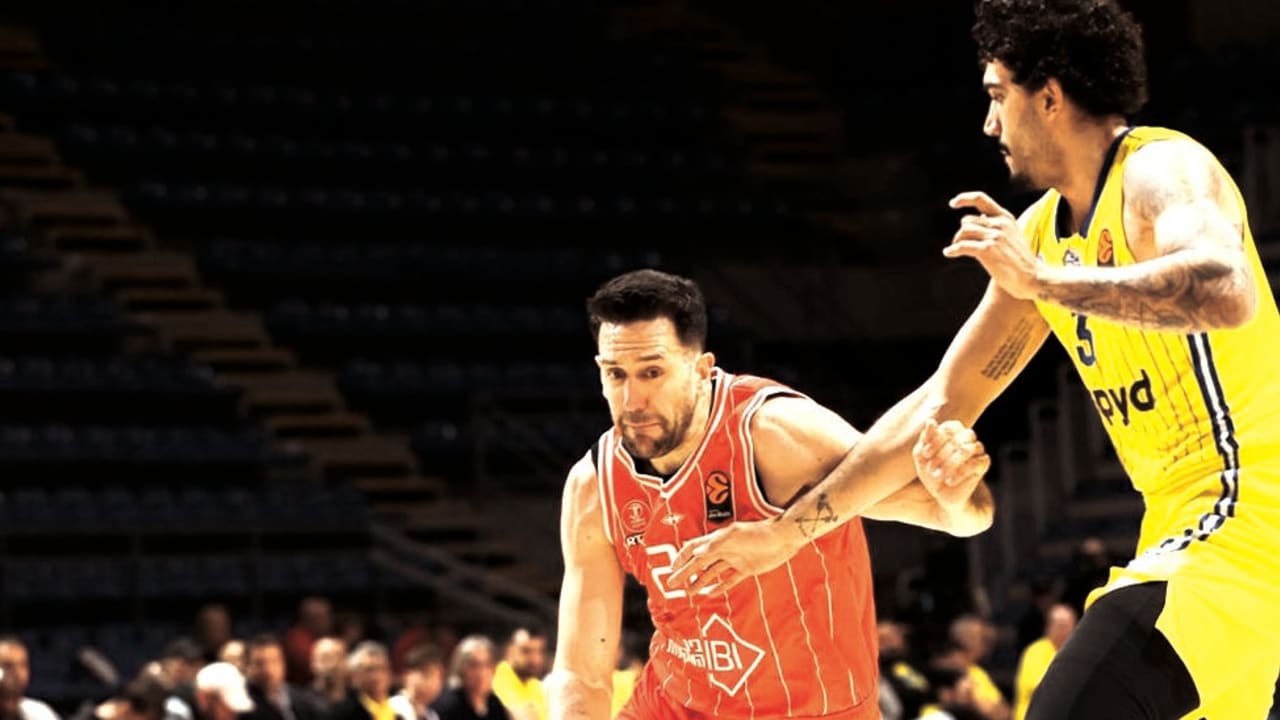
Consistency is the name of the game, and that’s why Hapoel Tel Aviv is in the Euroleague playoffs, and Maccabi Tel Aviv is not.
It’s actually very simple at the end of the day as to how Dimitrios Itoudis was able to guide the Reds to what was their goal for their first season in the Euroleague.
As EuroCup champs, Hapoel was given a one-year temporary license, so to speak, to the Euroleague, and anything beyond that was not guaranteed unless the Reds advanced to the playoffs, which they ultimately did to secure their place in the 2026/27 season of the continent’s premier competition.
The formula may have seemed simple, but the actual implementation was certainly not. However, the 38-game season is a marathon and not a sprint, and if you’re going to be consistent enough throughout the campaign, then the goal should be hit, and that was the case for Ofer Yannay’s club.
There was a game plan in place from Day 1, but that Day 1 wasn’t the start of the season, but way before that when Itoudis made his grand entrance back in the fall of 2024. From that point on, the Greek tactician began to put the wheels in motion for how the club would reach its goals and succeed where many others had not.

It was about building a team that could compete with the big boys of the Euroleague, not just the EuroCup. That meant some players would be held over from his first year, but better ones needed to be brought in during the offseason to ensure that the trip to the Euroleague would not be just a one-and-done adventure.
From there, it was about managing a squad that at times seemed unwieldy with so many players – almost 20, in fact – along with the constant questioning of the composition of the 12-man team that would play regularly in 38 contests. The questions were primarily around the Israelis and why their minutes were paltry compared to the rest of the squad, even if they were registered to play. How many minutes the Israelis played always seemed to be at the tips of everyone’s tongues, and most recently, that amount has been slim to none.
Indeed, Itoudis cut down his rotation the past few weeks since Hapoel moved its operations back to Sofia due to the outbreak of the war in order to do what he was brought in to do – namely, ensure another year playing the likes of Barcelona, Real Madrid, Panathinaikos, and Olympiacos.
The Reds started the season off strong with an 8-2 record in their first 10 games, and that set the tone for what was a very successful regular season, which still has one more game to go. The second round of 10 games saw Hapoel go 6-4, while the third group of 10 was an even 5-5, with a rough streak of five losses in a row, which took place ahead of the State Cup break.
This coming Friday night, Hapoel will visit Monaco for a chance to earn home-court advantage in the quarterfinals. But with or without playing at their adopted Bulgarian home, the Reds will no doubt be seen as the blueprint for success in a team’s first season in the Euroleague.
Maccabi suffers in brutal season
Meanwhile, over at Maccabi, the club suffered all season long from a brutal start to the campaign, going an abysmal 2-8 over the course of the opening 10 games.
With that type of record, coach Oded Katash’s fate was in the balance, and the atrocious start almost saw him sent packing. However, instead of dismissing the coach, he was able to get the team to start playing catch-up. Over the next 20 games, Maccabi went 12-8 to get the yellow-and-blue into the postseason race for a Play-In spot.
Ultimately, the damage had already been done early as Maccabi needed to dig, dig, and dig some more to get out of a hole that had left it all the way at the bottom of the 20-team standings. The club looked discombobulated as it was pretty much a new group of players with very few holdovers from last season, and Maccabi paid a very steep price for that. In addition, the roster was very thin without any extra fat, or in this case, extra players, and if one or two were out injured, it left the yellow-and-blue exposed.
Maccabi began the final stretch of eight games 4-0 and in prime position to snag one of those Play-In places with four games to go, which included a double week of Baskonia in 17th place and Paris in 15th place. Maccabi basically did the unforgivable against two teams that they should have picked up wins on the road – it lost both contests. Add to that a derby defeat to Hapoel Tel Aviv with one game to go against 18th-place Bologna, and the season was done.
Katash was extremely disturbed and distraught following the losses and blamed things that were not related to basketball as to why the team played so poorly in the first two defeats, where they didn’t play a lick of defense. Part of that falls on the bench boss and part on the players.
Following the Baskonia loss, it was announced that Katash had inked a three-year extension, which is good news for continuity. But it’s clear that Maccabi needs to make sure it has the right players in place going forward for next season in order not to have such a painful start to the campaign. Without the horses, the yellow-and-blue will not be in the race yet again, and that is something Claudio Coldebella, the team’s general manager, will need to address as soon as possible.
Maccabi, the Israeli team that has been synonymous with the Euroleague, took some serious hits this year as Hapoel was able to have a much more successful season, and that all had to do with consistency from the get-go and having a plan in place. If Maccabi wants to compete in the same league as Hapoel next season, it must follow a similar path; if not, there will be yet another difficult year abroad ahead.
See more Israeli sports coverage at www.sportsrabbi.com/en