Abraham Joshua Heschel says that Jonah praises God but doubts Him.
Follow us on Google ‘Jonah and the Whale’ (1621) by Pieter Lastman(photo credit: WIKIPEDIA)ByRABBI RAYMOND APPLE
Jonah is a strange book. What attracts most people is its theatrics, especially the big fish. On Yom Kippur afternoon the story gets a somnolent congregation giggling. Hardly anyone thinks that it is more than a story. Few ask the deeper questions. Stephen Rosenberg calls it “a political allegory related to the trials and tribulations of the northern kingdom of Israel.”
There are social history aspects too, ranging across side issues of like fishes, ports and cities.
The important thing, though, is Jonah the human being. Ascribed by the Talmud (Bava Batra 15a) to the men of the Great Assembly, the book may be autobiographical, but we can’t prove it. Is Jonah a prophet? II Kings 14:23-25 says, “Jeroboam the son of Joash king of Israel restored the border of Israel, according to the word of the Lord God of Israel, which He spoke by the hand of His servant Jonah the son of Amittai, the prophet.” If Jonah’s father, Amittai, is the prophet, we would like more information about him. If it is Jonah who is the prophet, he certainly bears a prophetic message – but he constantly fights against it.
Yonah probably means a dove, a ditherer. Possibly his name is from y-n-h, to oppress, or a-n-h, to mourn, a verb found in the Dead Sea Scrolls. Perhaps the root is a-n-a, indicating anguish and fear. It might be a theophoric name incorporating the name of God: it commences with Yo, like Yo’el (Joel) or Yo’av (Joab) or with Yeho like Yehoram or Yehoshafat.
Seder Olam calls Jonah a disciple of the prophets – i.e. not a full prophet but a prophet on the way. There are stages in the prophetic life which he hasn’t yet worked out. Rashi sums up his concern: “If these heathens repent, it will be due to me that Israel will look guilty, because they spurned the words of the prophets.”
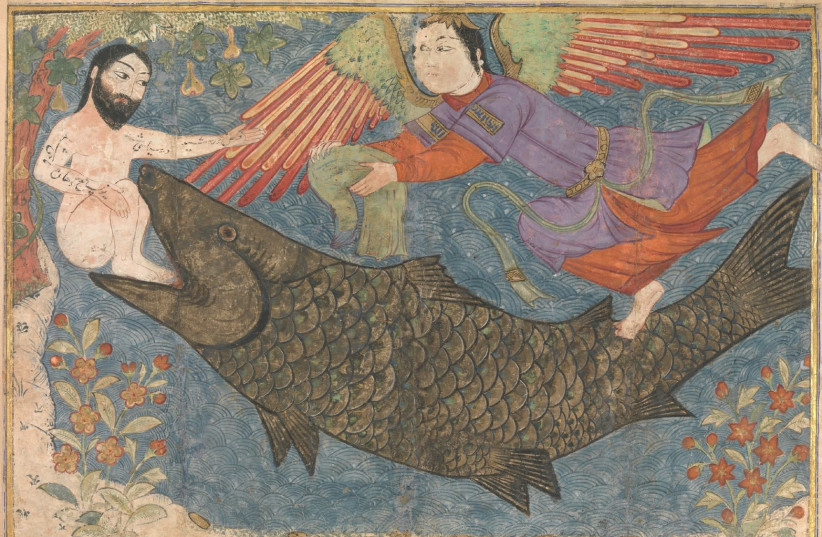
‘Jonah and the Whale’ in the ‘Compendium of Chronicles’ (c. 1400), Metropolitan Museum of Art. In contrast to Hagar, Jonah ran away from God to a distinct and intentioned location. (credit: Wikimedia Commons)
It seems that author has plucked a minor figure called Jonah from II Kings and built a midrash around him, which became an independent book. The real Jonah might be a prophetic apprentice, a nobody turned into a somebody.
There is an odd poem in chapter two of Jonah. James Watts says, “The relation between the narrative and the psalm has been studied and discussed more than any other psalm in a narrative context.” This is my translation:
Jonah prayed to the Lord from the belly of the fish. He said:
In my distress I cried to the Lord and He answered me.
From deep in the grave I cried; You heard my voice.
You cast me into the deep, into the midst of the seas.
Flowing waters surrounded me,
All Your waves and billows passed over me. I said:
I am cast out from Your presence, I will never again see Your holy temple.
The waters surrounded me to my very soul,
The deep encompassed me, the weeds were wrapped around my head.
I went down to the base of the mountains; earth was barred to me forever.
But You brought me up alive from the grave, O Lord my God.
When my soul fainted within me, I acknowledged the Lord,
My prayer came before You, to Your holy temple.
They that serve empty gods forsake their own good –
But I, I shall sacrifice to You with the voice of thanksgiving,
What I have vowed I shall fulfil: Salvation is from the Lord!
The psalm is a mosaic of phrases that a person in trouble would know. The poem is in the past tense, but Biblical tenses are fluid, and past-tense passages can be prophetic projections. We presume Jonah keeps the commandments, but he does not say so explicitly. He does not mention the Exodus, Biblical heroes, Israel or Jerusalem. He admits to being a Hebrew but we do not know much about his Hebrew identity. He says he worships the God of Heaven but says nothing about the God of Israel. His wish to go to the Temple may be merely idiomatic convention. He does not say “Temple of Jerusalem” or “holy city,” maybe because they are not central to his story. But the issue is not Jonah’s orthodoxy but his ethnicity. He is a nationalist who loves his people but is not certain about whether gentiles have a right to repent.
The psalm lacks humility and repentance. The Midrash Yalkut Shim’oni fills in the gap. It adds a poem of penitence, since people are expected to blame themselves for their misfortune. In the Yalkut poem Jonah says, “I have reached death: give me life”. Everyone can live if they repent. Since Christianity says man cannot repent on his own, was Jonah chosen for Yom Kippur as a Jewish response?
In the Bible version, even when Jonah prays it takes him three days to start. His apparent repentance is a passing episode. The timing of the psalm is a worry. It says it was uttered inside the fish but we don’t get the feeling of a man who is constricted and scared in a fish’s belly. There are many tales of people who were swallowed by marine creatures. Some views say that the fish swallows Jonah straight after he is cast overboard and his time in the water is brief. He cries for help from the raging sea; he is hallucinating about being saved by a big fish.
Jonah is in a bad state. His skin is affected; his mind is in turmoil; he feels his life ebbing. In the end he abdicates; according to Yalkut Shim’oni, he says, “Alright, God, run the world your way,” but he still feels that God should take Israel’s side.
Abraham Joshua Heschel says that Jonah praises God but doubts Him. He says, I would rather die than live. He doesn’t see that God gets no pleasure when the wicked die, that He wants sinners to come to their senses. The book is an assurance that no-one, even Ninevites, are beyond God’s concern. That must be why we read Jonah on Yom Kippur, because sinners earn a new lease of life if they repent and return to God.
The writer is emeritus rabbi of the Great Synagogue, Sydney, and lives in Jerusalem