The balance of power in the Middle East continues to shift, and the prospect of a US-Iran war could further destabilize a region already being pulled into a new order.
For more stories from The Media Line go to themedialine.org
More than two years of war between Israel and multiple regional adversaries, along with a shift in American foreign policy, have reshaped alliances and threat perceptions across the region.
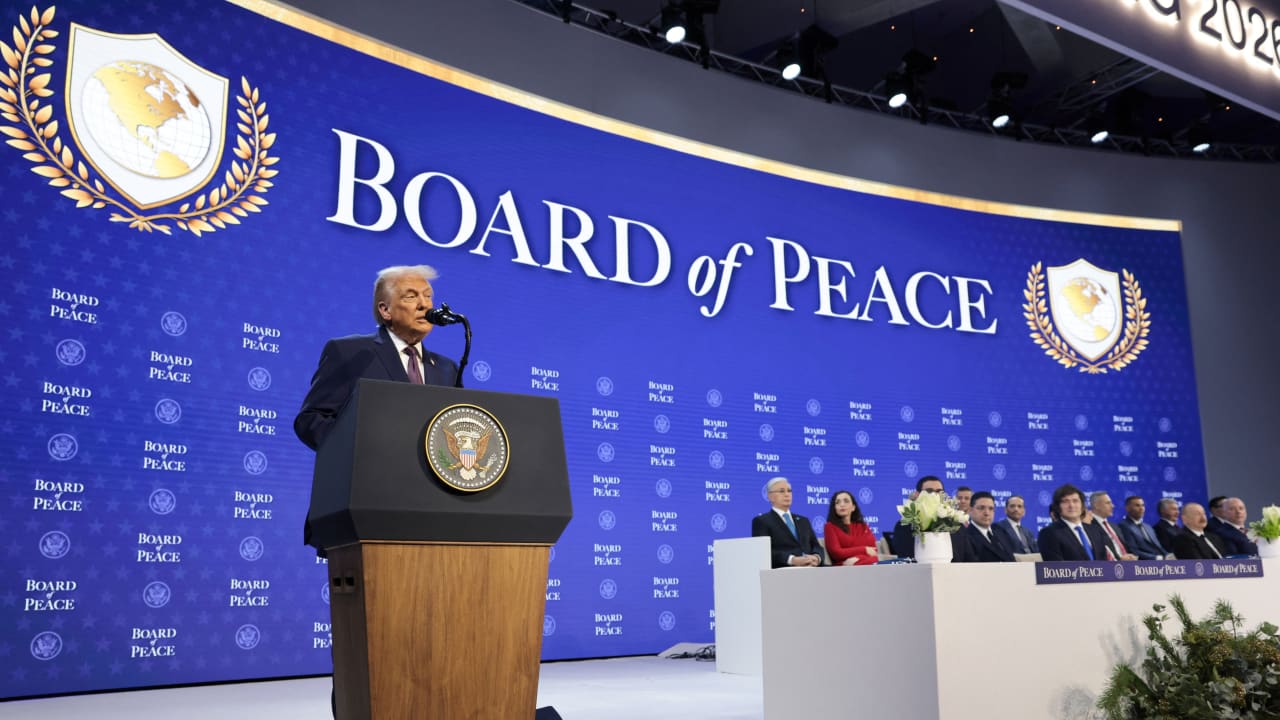
Now, as US President Donald Trump has established the Board of Peace, a new advisory body meant to coordinate diplomatic, security, and economic tools to prevent large-scale conflict while advancing American strategic interests.
The attention has turned to the White House and whether the initiative will change a Middle East already altered by weakened Iranian proxies, shifting alignments, and uncertainty over Washington’s long-term role.
For allies and adversaries alike, the question is whether this framework marks a genuine move that will affect realities on the ground, or whether it is simply a repackaging of American power projection at a moment when regional actors are hedging, rearming, and recalculating red lines amid the risk of a broader US-Iran confrontation.

Saudi Arabia adjusts foreign policy reflecting recalibration
Saudi Arabia, a major regional player and a member of the Board of Peace, appears to be adjusting its foreign policy in ways that reflect the wider recalibration underway.
Once the linchpin of Washington’s Middle East architecture, Riyadh has increasingly pursued a multi-vector approach aimed at reducing overreliance on the United States while expanding strategic autonomy.
That shift is reflected in deeper engagement with Russia, cautious rapprochement with Iran, and a noticeable warming of ties with Turkey after years of rivalry. Relations with China have also warmed, moves widely read in Washington as a deliberate signal.
Taken together, the steps suggest the kingdom wants to be a power broker rather than a follower of American leadership in the region.
“Saudi Arabia is making adjustments to its policy,” Dr. Yoel Guzansky, a senior fellow at the Institute for National Security Studies, told The Media Line. “Some of these moves are more dramatic than others.”
As President Trump has threatened to attack Iran over recent violent crackdowns against anti-government protesters, tensions in the region have risen, and Israeli officials are weighing the possibility that Israel could be drawn into a wider conflict.
On Saturday, Israeli military Chief of Staff Lt. Gen. Eyal Zamir met Adm. Brad Cooper, the head of US Central Command.
The possibility of regime change in Iran has Saudi Arabia closely watching developments. The 12-day war fought between Israel and Iran last summer left Iran severely weakened.
“Israel appears to have strengthened since, and the Saudis do not like this,” said Guzansky. “They want to see a balance of power that does not have any actor, neither Israel nor Iran, too strong.”
A US attack on Iran that cripples the current regime could further elevate Israel’s regional stature and influence.
Guzansky said the motivation behind the changes in Saudi policy may also be personal for Crown Prince Mohammed bin Salman, who appears more confident as he consolidates power at home.
“He also feels Saudi Arabia is not getting the place it deserves in the region,” he added. “It doesn’t want to be a small country in the region but rather claim its rightful place in the regional order.”
Beyond that, a growing rivalry between Riyadh and the United Arab Emirates is pushing the two Gulf powers onto diverging tracks on regional influence, security, and economics.
Abu Dhabi has doubled down on normalization with Israel and continues to project an assertive role from the Red Sea to the Horn of Africa.
Saudi Arabia, meanwhile, is seeking to reclaim primacy through economic centralization, energy leverage, and a more cautious diplomatic posture. The friction remains manageable in public, but it increasingly shapes the balance of power inside the Gulf.
“They have always been geopolitical and economic competitors, but we are seeing an escalation into what looks like an outright conflict,” Asher Fredman, executive director of the Misgav Institute for National Security, told The Media Line. “Saudi Arabia's anti-Israeli and anti-Abraham accords messaging is part of that competition and growing conflict with the UAE.”
Yemen has become a key arena exposing those tensions in a relationship increasingly defined by parallel and at times conflicting interests.
Last month, Saudi-led coalition forces attacked a southern Yemeni target linked to a UAE-connected weapons shipment. The strike marked a serious escalation and pointed to a widening rift between the two Gulf monarchies.
The UAE was the first country to sign the Abraham Accords, a series of agreements sponsored by the US between Israel and the United Arab Emirates, Bahrain, Sudan, and Morocco. Since then, the agreements have been tested repeatedly, particularly by the war that began in October 2023.
Before that war, the goal was to expand the accords to include normalization between Israel and Saudi Arabia. When the conflict erupted in Gaza and quickly spread across the region, many assumed the prospect of normalization was effectively dead. President Trump pushed it back into the headlines, though the crown prince has appeared reluctant to move forward.
Saudi Arabia’s trajectory has complicated expectations around normalization with Israel. Quiet security coordination and shared concerns over Iran persist, but Riyadh has deliberately slowed any public progress toward formal ties, tying normalization to developments in Gaza and the Palestinian issue.
The recalibration reflects regional realities and domestic considerations, as the Saudi leader weighs popular sentiment, ambitions for leadership in the Muslim world, and the risks of being seen as aligning too closely with an Israel still embroiled in conflict under a government opposed to Palestinian statehood.
In the emerging order, Saudi Arabia appears less interested in anchoring itself to a single alliance structure and more focused on maximizing leverage, keeping Israel, the United States, Russia, and Turkey engaged, while treating none as indispensable.
“The logic of normalization is still very strong,” said Fredman. “The problem is public opinion in Saudi Arabia as a result of the war in Gaza, but also, bin Salman is not feeling pressure at this point from the US and doesn’t feel like he has to do it in order to get what he wants.”
Israel’s leadership also appears less eager than it once was.
“It is certainly very important, and Israel would like to see normalization, as there would be a lot of economic, technological, and security benefits,” Fredman explained. “But in Israel’s perspective, it shouldn’t take existential risks in terms of its security to achieve normalization.”
“The Israeli government is also not really looking to promote normalization and isn’t willing to pay the price needed in order to achieve this,” said Guzansky. “This makes it convenient for the Saudis to get close to the Turks, who are also very contrarian to Israel.”
Relations between Israel and Turkey have soured in recent years, with Israeli Prime Minister Benjamin Netanyahu and Turkish President Recep Tayyip Erdogan frequently exchanging harsh rhetoric. Erdoğan has accused Israel of war crimes against Palestinians and compared Israel to Nazi Germany, though the two countries still maintain diplomatic relations.
After years of tension between Ankara and Riyadh, the two sides have moved toward a pragmatic reconciliation grounded in shared interests, trade, and a desire to create a counter-axis to both Iranian and Israeli influence.
“It is very convenient for the Saudis to get closer to the Turks at this point, with the Palestinian issue bringing Turkey and Saudi Arabia closer together,” Guzansky said.
A delicate triangle has emerged, held up by overlapping interests and old rivalries that could quickly reshape.
“Turkey is a growing threat to Israel, with a serious military and growing economic presence,” said Fredman. “Turkey and Saudi Arabia getting closer together appears to be tactical and short-term; there are very deep-embedded rivalries between them and different visions about the Middle East.”
Across the region, governments are rethinking assumptions and adjusting policies. Some of these shifts may prove durable; others may fade as circumstances change. Either way, the Middle East is moving quickly, and the direction of that movement remains uncertain.