
Iranian-Russian cooperation aimed at upgrading Iran’s existing ballistic missile arsenal has recently increased amid the threat of a potential US or Israeli strike, foreign reports have said.
Among other systems, Tehran possesses a missile series with ranges of about 2,000 kilometers that place all of Israel within reach, as well as a missile that carries an especially heavy warhead and is considered among the most accurate in Iran’s arsenal.
Since Operation Rising Lion, Iran has been working intensively to rehabilitate its ballistic missile arsenal on several fronts to ensure its capabilities in a future confrontation.
The reported steps include shifting from liquid fuel to solid fuel to cut launch preparation time from hours to minutes and reduce its intelligence signature, ramping up mass production of Kheibar and Fattah missiles, improving missile accuracy using technological components, and acquiring satellite-based intelligence.
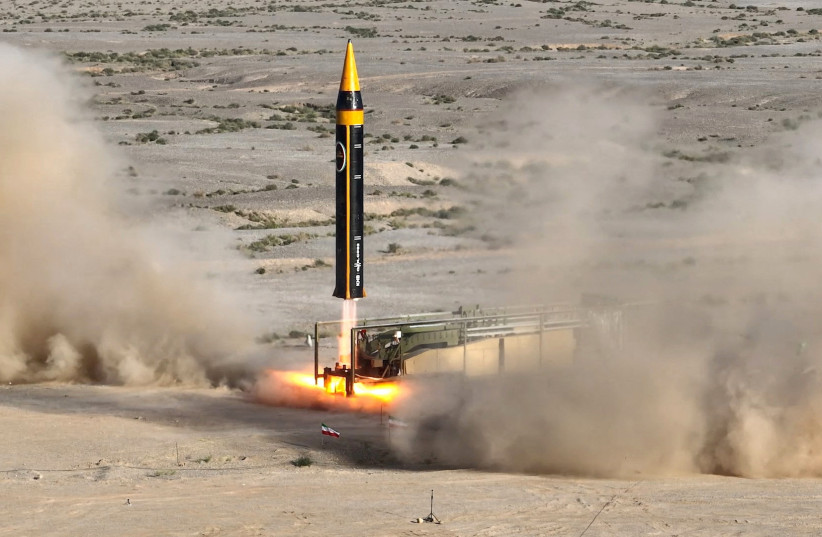
Iranian-Russian cooperation complicates air defense interception
Foreign reports have also pointed to Iranian-Russian cooperation intended to upgrade the existing ballistic missile arsenal in ways that could complicate air defense interception. The reported efforts include integrating new radars, expanding production lines, and moving some of them underground, including underground launch sites.
The missiles that pose a threat to Israel’s home front include the Shahab series, including Shahab-3 and Kheibar Shekan, which is based on North Korean technology and has a range of about 2,000 kilometers, with warheads reported to weigh between 700 and 1,000 kilograms of explosives.
Iran’s Fattah 1 and Fattah 2 missiles are described by Iranian sources as approaching hypersonic capabilities, with sharp aerodynamic maneuverability, including outside the atmosphere, and a warhead of about half a ton.
The Sejjil series is described as a two-stage, solid-fuel ballistic missile designed for short-warning launches from a bunker, with a warhead reported to range from 500 to 1,000 kilograms of explosives.
The Khorramshahr missile, according to Iranian reports, carries an especially heavy warhead, averaging around 1,500 kilograms, and is considered one of the most accurate missiles in Iran’s arsenal.
Social media documentation has shown an Iranian missile bearing the inscription “Death to Israel.”
Regarding ballistic missile launchers, Iran is also working to improve significantly after the heavy damage it sustained in Operation Rising Lion in strikes from the ground and the air.
Mobile launchers, described as mobile missile launch systems, are a central concern for intelligence officials seeking to locate and disable them in real time across Iran before a launch against Israel, alongside efforts to track underground missile sites.