Despite US President Donald Trump’s plans to blockade the Strait of Hormuz and failed attempts to reach an agreement in Islamabad, there was no consensus among experts who spoke to The Jerusalem Post on Sunday as to whether the United States was serious about continuing the war against Iran.
Marc Sievers, a former United States ambassador to Oman who has held numerous positions across the Middle East, suggested that neither the talks nor the ceasefire was a sign that the US was pulling back from the war but rather that Washington was honoring the request of regional partners in trying the diplomatic approach, even if there would be no fruitful results.
Trump said on Sunday that the US Navy would immediately start blockading the Strait of Hormuz, raising the stakes after marathon talks with Iran failed to reach a deal to end the war, and published on social media that the US would interdict every vessel in international waters that had paid a toll to Iran in addition to destroying Iran’s mines.
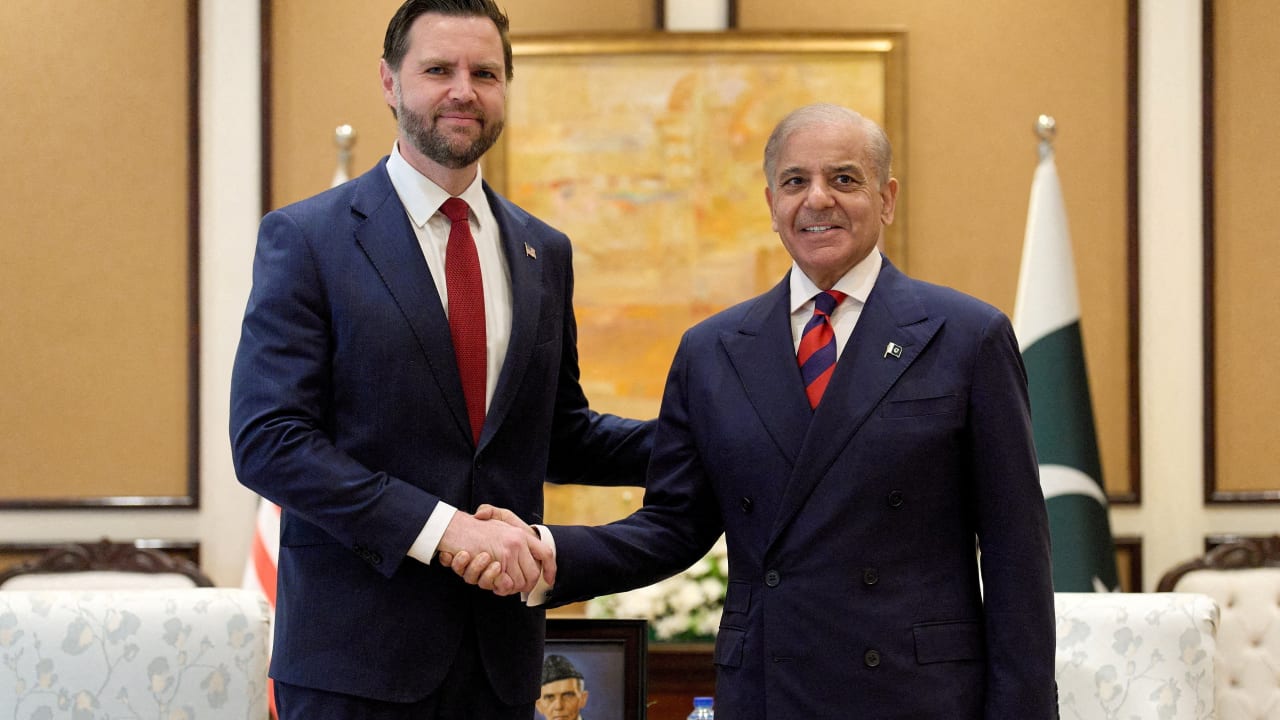
US Vice President JD Vance told reporters before departing from Pakistan on Sunday that it was “bad news” that no agreement had been reached, but it was worse for Iran. This comment, combined with the sailing of two warships through the Strait of Hormuz on Saturday to clear mines and rumors of a multinational naval force, suggested that the US was not planning to back out of the conflict.
Referencing Vance’s comments that the US has “made very clear what our red lines are,” Sievers told the Post that Trump had delivered Tehran an “ultimatum” on uranium enrichment, in addition to reopening the strait, and it was only reasonable to pause attacks while such issues are being negotiated, especially given that Tehran was willing to engage in direct talks.

“We need to see an affirmative commitment that they will not seek a nuclear weapon, and they will not seek the tools that would enable them to quickly achieve a nuclear weapon. That is the core goal of the president of the United States, and that’s what we’ve tried to achieve through these negotiations,” Vance said.
Sievers said he was “fairly certain that at the end of this two-week period – unless Iran violates it before that – there will be a resumption of hostilities if the Iranians have not responded to the paper that Vice President Vance apparently left with them for further consideration.”
A change in Iranian leadership
Sievers noted that, on some level, there has been a change in Iranian leadership. Mojtaba Khamenei has notably less religious authority than his father, Ayatollah Ali Khamenei, who had less religious authority and legitimacy than the original Ruhollah Mostafavi Musavi Khomeini.
With the IRGC and parliamentary speaker Mohammad-Bagher Ghalibaf playing a larger role in leading the country, Sievers said the US may have wanted to see if Tehran was more reasonable in private channels, which “seems to be often the case with Iran.”
Sievers also noted that Trump’s recent statements indicated that he was serious about seeing the battle through.
Vance said Iran had chosen not to accept American terms, including not to build nuclear weapons. “I could go into great detail and talk about much that has been gotten, but there is only one thing that matters – IRAN IS UNWILLING TO GIVE UP ITS NUCLEAR AMBITIONS!” Trump said later.
Military historian Dr. Lynette Nusbacher was less optimistic about the war's continuation, theorizing that Trump had a vested interest in keeping the war on a strict deadline.
“There is little support for this war in the US,” she claimed, adding that the American public could see the material cost of the war, the death of servicemen, and the destruction of expensive equipment, next to the overall continuation of the regime and its attack capabilities.
“For President Trump, the timeline for that victory is fairly strict. The Republicans face elections in seven months, and while Trump can take or leave the Republican Party, he is aware that a Democratic House of Representatives and a Democratic Senate could impeach him and convict him.
Trump needs to be able to claim his win well in advance of that election,” she theorized, adding that Trump wouldn’t care if Iranians concluded that the US was weak if the military withdrew.
If the US prematurely leaves this war, the Jewish Institute for National Security of America warned in a recent report that future conflicts with Iran would likely be more deadly for regional allies. With eroded air defenses, an interceptor shortage, and the potential for military attention to be needed elsewhere, a future war might be more challenging if this one fails to meet its goals.
“President Trump was happy to claim that the US would have won had they not been stabbed in the back by perfidious Europeans or even by perfidious Israelis. He’ll be happy to internationalize the defeat and simultaneously claim victory by pointing at the massive destruction in Iran. What matters to President Trump is making that stick with American voters and not still being in an Iranian quagmire all summer,” she continued.
Nusbacher added that, against the backdrop of Russia’s intelligence sharing with Iran, Trump’s comments on Europe’s lack of involvement to Fox were a “barely veiled threat to switch off Washington’s intelligence sharing with Kyiv.”
“It’s becoming apparent that the US aim was to cause rapid regime change in response to intense air attack: the first-ever war won entirely from the air. Every air power theorist in every air power journal talks about doing it, and sometimes people give it a try.
Once they failed to achieve their aims, the best American response would have been to step back, claim victory by comparing the damage to the regime to the attack on Soleimani, and go home,” Nusbacher commented.
“There is a well-worn path in war where strategic objectives aren’t achieved, and the war carries on because one side, the other side, or both refuse to acknowledge that their best course is to call it a day. They keep on destroying in hopes that by destroying enough, they will find their way to some other kind of victory.”
Addressing Trump’s “textbook” plan to blockade Iran’s blockade of the Strait of Hormuz, she accused Trump of “internationalizing failure.”
Nusbacher said the US was now effectively standing across China’s oil supply and asking Gulf countries to join the blockade after “failing to achieve anything in Iran.”
“China got the Iranians to Islamabad. This blockade of a blockade is Trump telling Xi Jinping to bring the Iranians to a more favorable frame of mind, pretty sharpish. He’s telling China to get the Iranians to give up their uranium, or China will suffer the economic damage of losing their hydrocarbons, their plastics, and their fertilizers,” she theorized.
Jonathan Ruhe, a fellow for American Strategy at JINSA, explained that Trump’s decision to enter negotiations had likely stemmed from achievements the US has made in Iran.
“Trump pursued a ceasefire partly because of what he believed he already accomplished - severely degrading Iran’s leadership, missile, drone, and nuclear capabilities - and partly for what he believed would be too difficult to accomplish militarily, namely reopening Hormuz. Hence, he claimed he got Iran to agree to reopen Hormuz under the ceasefire, and he focused on getting Iran to give up what remains of its nuclear program in the Islamabad talks,” he wrote to the Post.
Retired V.-Adm. Robert Harward, the former deputy commander of US Central Command (CENTCOM), told the Post that he was “proud” that Vance walked from the negotiation table.
“This reinforces the administration's commitment, and the strategic need to ensure a change of government in Iran, as the people of Iran have been willing to die for. The end state must be a government in charge that renounces the Islamic revolution and the policies and programs that were inherent to its existence. Those include not just the nuclear weapons program and the Strait of Hormuz, but termination of their missile and drone programs, and disassociation with the violent radical surrogates they have funded and supported for decades, while respecting and adhering to the pursuit of life and human rights for the people of Iran,” he asserted.