
Tehran has already begun positioning itself to suppress potential domestic unrest and weather the prolonged economic hardship that could result from an extended US blockade or a return to more active conflict with the US, according to international experts. At the same time, reports indicate that Tehran remains open to negotiations, provided any agreement meets all of its demands, including leaving the Strait of Hormuz under Iranian control.
The Institute for the Study of War assessed that hardliners within Iran’s Supreme National Security Council could support a deal with the US, provided it meets Tehran’s terms, notably including continued Iranian control over the vital waterway. The assessment was based on an Axios report, later confirmed by a spokesperson for the Iraqi Kurdistan presidency to Iran International, that IRGC Commander Ahmad Vahidi had maintained indirect contact with the US and preferred to resolve the conflict through negotiations.
Despite this preference, a senior Iranian official told Reuters on Monday that Iran would shift to a “fully offensive” posture after Washington ruled out extending a temporary ceasefire agreement.
“Iranian entities must be prepared to escalate tensions in the Strait of Hormuz and wider region, as Iran will be ready to make decisions and take action on difficult decisions,” the Iranian official said, adding that Tehran would conduct a “timely and precise” military attack to break the US naval blockade if diplomacy failed.
IRGC unlikely to support deal that cedes control of Hormuz
The continued attacks on vessels crossing the Strait of Hormuz without coordinating with Iran’s Persian Gulf Strait Authority suggest that Vahidi would be unlikely to accept an agreement that did not leave the waterway under Iranian control, the institute assessed.
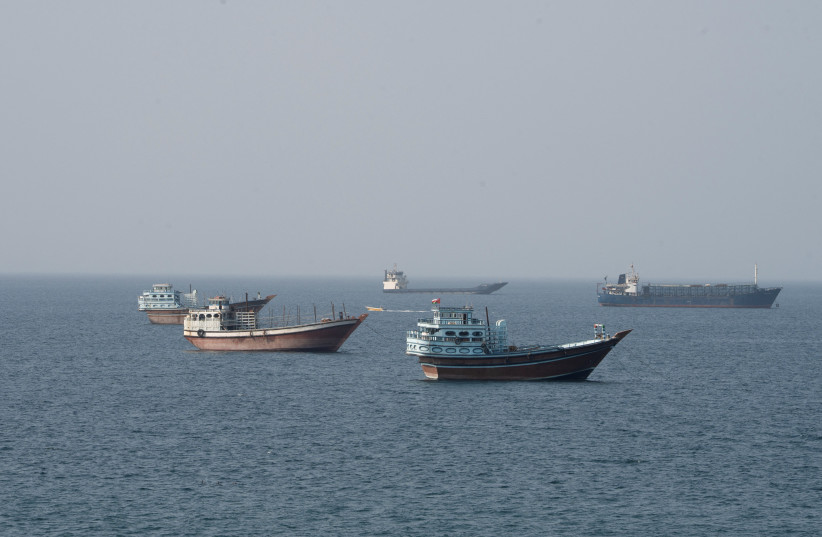
Notably, the memorandum of understanding signed between the US and Iran, which included a 60-day window that expired on Monday, required under its fifth clause that Iran allow safe and free passage for commercial vessels through the Strait of Hormuz during that period. Tehran interpreted the provision as leaving Hormuz under Iranian control, which largely contributed to the agreement’s collapse, and the dispute over control of the waterway ultimately contributed to the renewal of a US blockade that has further strained Iran’s already struggling economy.
Although the economic crisis had already triggered protests in December, which escalated in January into widespread calls to end the Islamic regime’s rule, the institute assessed that Vahidi’s hardline faction was willing to accept the financial consequences of a prolonged blockade, as well as regional instability and domestic unrest.
Human rights organizations reported that upwards of 30,000 people were killed by regime security forces during the January demonstrations, while thousands were arbitrarily detained. The Islamic regime has also continued to execute individuals accused of participating in what it described as foreign-backed riots. Iran’s months-long internet blackout, which further damaged the country’s economy, also made it difficult for international rights groups to monitor the situation, UN officials acknowledged at the time.
Iran’s year-on-year inflation rate remains above 80%, ISNA reported on Saturday. Mehdi Pirsalehi, head of the country’s Food and Drug Administration, said on Sunday that around two-thirds of medicines in Iran had increased in price because of difficulties accessing raw materials and the higher cost of transporting them by air rather than sea. Numerous reports from Iranian diaspora and domestic media have also pointed to a cost of living crisis leaving Iranians unable to afford basic goods and services and the Islamic Republic failing to pay out social welfare benefits.
Iranian First Vice President Mohammad Reza Aref separately said on Sunday that the Islamic Republic needs to confront US economic pressure through proper planning and policies, calling on Tehran to prepare for “worst-case scenarios,” which the institute suggested referenced a return to demonstrations.
Acknowledging that it remains unclear whether Vahidi would make concessions in exchange for economic relief to avoid such a situation, the institute noted that he may instead prefer to further securitize Iranian society and continue investing in land-based shipment routes, despite officials warning that they cannot replace maritime transportation.
Tehran is preparing to resume its suppression of dissent
Roger Macmillan, a security analyst and former director at Iran International, noted that the regime recently appointed Hossein Taeb as commander of the Basij paramilitary force. Taeb previously headed the IRGC’s Intelligence Organization.
Taeb was known for his role in crushing the 2009 demonstrations that erupted after a disputed presidential election. Thousands were arbitrarily arrested, dozens were killed on the streets or in detention, and many protesters reported being tortured, according to human rights organizations.
Like many analysts, Macmillan interpreted Taeb’s appointment as a sign that Tehran is preparing to resume its suppression of dissent.
“Vahidi does not have to choose between holding the line against Washington and crushing dissent at home,” he told The Jerusalem Post. “You need to watch the sequence... This has run before: protests will develop, state media brands protesters ‘rioters’ and ‘terrorists,’ the internet goes dark, mass arrests follow, the judiciary declares zero leniency, and executions are used explicitly to restore fear as deterrence.”
Earlier this week, a high-profile student at Sharif University of Technology was expelled for allegedly hanging a mouse doll from a tree during protests, a reference to the mocking nickname “Moush-Ali,” or “Mouse Ali,” used for then-Supreme Leader Ayatollah Ali Khamenei.
Likewise, the Iranian legal network Dadbaan reported that authorities closed a number of coffee shops and restaurants after accusing them of allowing “gambling, norm-breaking, promoting corruption, and failing to observe Islamic norms,” according to the office of the Public and Revolutionary Prosecutor of Qaenat. The network also reported that women were being denied access to public services for failing to wear the hijab, while the Sunday Times reported that Iran’s morality police were resuming patrols.
Macmillan noted that the stalling of oil exports, along with the Central Bank of Iran’s issuance of the country’s largest banknote in history, were signs that the pause in intense strikes on Iran had not allowed the regime to recover.
“It is running out of road, and it knows it. Every week without a settlement pushes Iranian households closer to the conditions that produced the January uprising. And every week, Vahidi’s newly reshuffled command structure gets more ready to meet them,” he continued. “They have been emboldened by the apparent failure of the US/Israeli bombing campaign to reduce and remove their capability to produce drones [and] there have been reports that they are back to their pre-war stock levels… So they are ready to resume [fighting].”
Macmillan said Tehran was preparing for a prolonged conflict, believing that US President Donald Trump’s low approval rating, interceptor shortages and the approaching midterm elections could give Iran an advantage.