Last Thursday, in a phone interview with Israeli journalist Barak Ravid – Channel 12 foreign affairs reporter and a political commentator on CNN – US President Donald J. Trump told him that President Isaac Herzog should pardon Prime Minister Benjamin Netanyahu (to whom he referred as “Bibi”) immediately.
According to Ravid, Trump said to him that Herzog had “promised me five times that he would grant [Netanyahu] a pardon.” He also accused Herzog of delaying the decision for months, and said the issue had been discussed between the two leaders for nearly a year.
Trump then announced (according to Ravid) that he would make his conversations with Herzog public, while describing the Israeli president as “a disgrace.”
“That president better damn well give him [Netanyahu] the pardon right now – and stop using it as leverage for his own political career.”
The fact that Trump chose an Israeli journalist to pass a rather blunt and callous message to Herzog is curious.
Trump first publicly called for the cancellation of Netanyahu’s trial (which he referred to as a “witch hunt”), or for an unconditional pardon for him, in a Truth Social post in June.

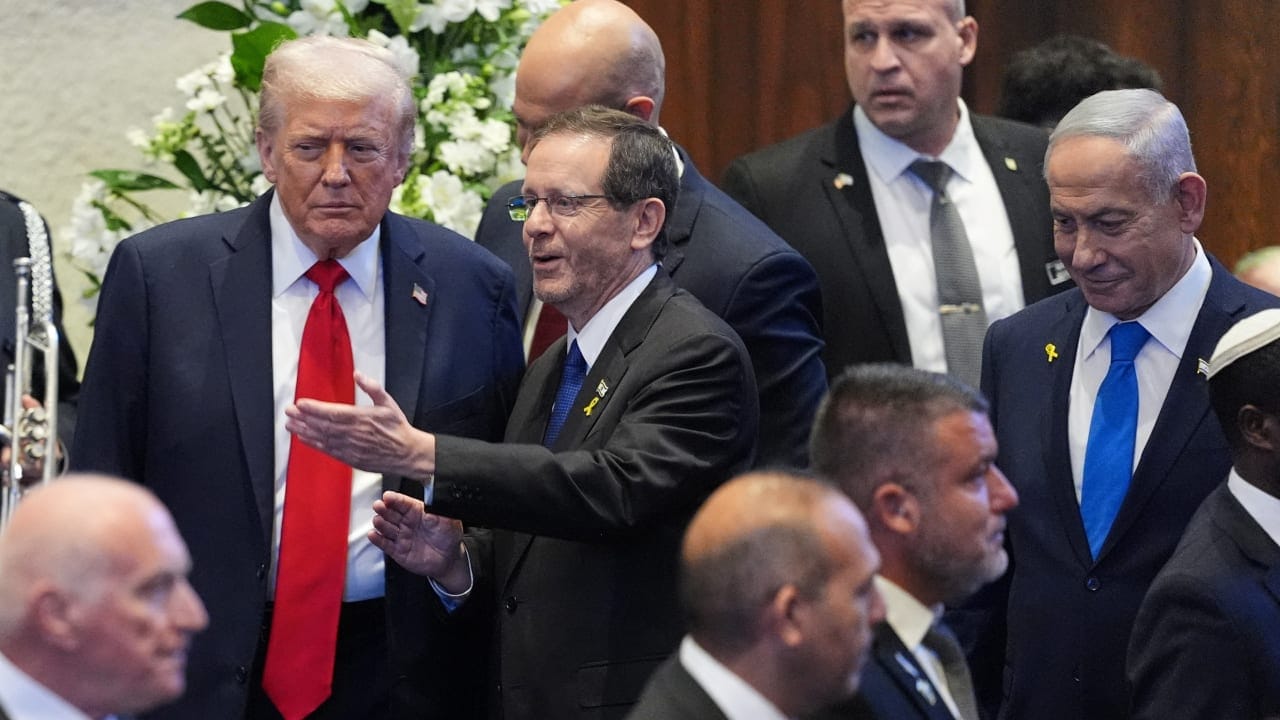
Then, on October 13, during a speech he delivered in the Knesset plenum, Trump turned to Herzog, who was sitting next to Knesset Speaker Amir Ohana to his left, and said: “Why don’t you give him a pardon?” pointing to the prime minister, who was sitting opposite them.
Then, on November 12, Trump sent an official letter to Herzog in which he once again called upon him to pardon Netanyahu, this time referring to Netanyahu’s trial as a “political, unjustified prosecution” – a much more diplomatic definition than “witch hunt,” but nevertheless derogatory.
Incidentally, the attorney-general who decided, back on November 21, 2019, to indict Netanyahu on charges of bribery, fraud, and breach of trust was Avichai Mandelblit, who was appointed to the job by Netanyahu himself. The two could hardly be described, at the time, as political opponents.
In his interview with Ravid last Thursday, Trump pointed out that the added urgency of the pardon resulted from the war, which the US and Israel started against Iran on February 28. “Every day I talk to Bibi about the war. I want him to focus on the war, and not on the f***ing court case. I want the only pressure on Bibi to be the fighting against Iran.”
True, the trial against Netanyahu has been dragging on for much too long, and consumes quite a bit of Netanyahu’s time and attention. The trial opened on May 24, 2020 – almost six years before the joint US-Israel attack on Iran. The main reason why the trial has dragged on for so long has been the delaying tactics used by Netanyahu’s lawyers – in particular, Amit Hadad.
If it weren’t for the delaying tactics, the trial might well have been over by now, or at least after the stage in which the physical presence of Netanyahu himself at its sessions was required.
Is a pardon even possible?
But that bypasses the question whether a pardon is at all relevant, and therefore whether Herzog has the option of pardoning Netanyahu. According to Israeli law, a pardon can only be considered in the case of someone whose trial has ended with a verdict of guilty and is willing to accept responsibility for at least some of the reasons for this verdict having been given by the court in the first place. Netanyahu is not eligible for a pardon by the president because he neither admits any wrongdoing nor expresses remorse. He is eligible for a plea bargain, which involves a give-and-take between himself and the relevant legal authorities.
The one case in which a pardon was given to anyone before he or they stood trial was in 1986, when as president of the state, Isaac Herzog’s father, Chaim Herzog, pardoned then-head of the Shin Bet (Israel Security Agency) Avraham Shalom and his team, who were to stand trial on charges of killing two Palestinian terrorists after they had surrendered, but before they were incarcerated and put on trial. The pardon was given to avoid damage to the Shin Bet. Perhaps if Netanyahu were accused of similar charges, an exception would have been made in his case as well.
Incidentally, Herzog’s office denies that he had ever promised Trump to pardon Netanyahu. Herzog had told Trump’s advisers, Jared Kushner, Steve Witkoff, and Ambassador Mike Huckabee, that he would consider the request in line with legal procedures. At the moment, the issue is being examined by the Pardons Department in the Justice Ministry, which is expected to send its opinion to Herzog in the near future.
The question remains why Trump is going to so much trouble to try to get Herzog to pardon Netanyahu.
Some argue that Trump feels that Netanyahu is suffering from a political witch hunt, turned legal, similar to his own legal travails in the US. There is no doubt that both men are in a similar state of mind regarding all accusations made against them.
Furthermore, although their personal backgrounds and circumstances are quite different, both believe that there is nothing wrong with taking advantage of their positions as president of the US and prime minister of Israel, respectively, for financial and other personal gains for themselves, including holding on to their jobs.
However, for Trump intervening in the internal affairs of other states, including their legal systems, to the benefit of political leaders he favors personally and/or ideologically, is a regular occurrence.
A case in mind is that of former Brazilian president Jair Bolsonaro, who on September 11 was sentenced by the Supreme Brazilian Federal Court to over 27 years imprisonment for attempting a coup after losing the 2022 Brazilian presidential elections. After his return to power, Trump stood by Bolsonaro and even threatened to impose a 50% tariff on Brazilian exports to the US if the Brazilian legal authorities failed to release Bolsonaro. For the time being, Trump’s threats have not caused Brazil’s left-wing regime to give in to his demands.
What will happen here in Israel is yet to be seen. Will Herzog manage to stand up to Trump’s bullying onslaught, at least until after the elections later this year? And what are the chances for Netanyahu politely asking Trump to stop badmouthing Israel’s president for refusing to submit to unfair foreign pressure?
The writer has written journalistic and academic articles, as well as several books, on international relations, Zionism, Israeli politics, and parliamentarism. From 1994 to 2010, she worked at the Knesset Library and the Knesset Research and Information Center.