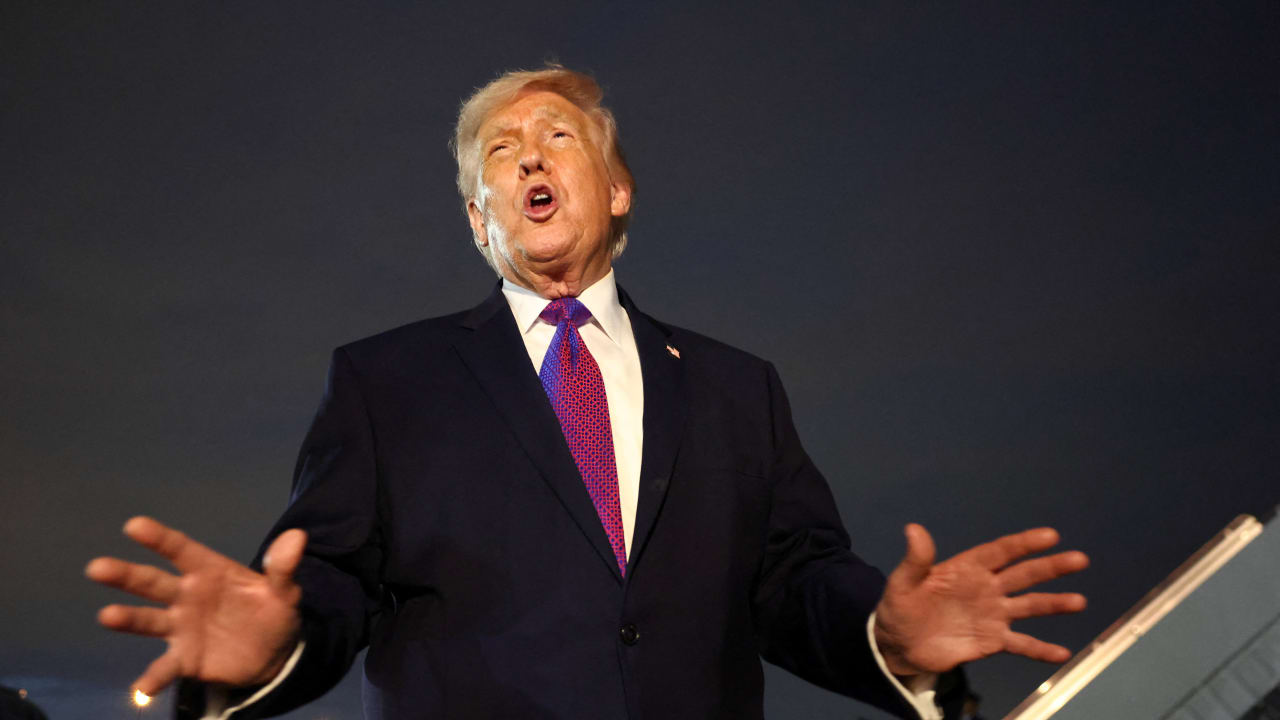
President Donald Trump appears to have taken his war strategy from a fundamental Marxist teaching. Not Karl, but Groucho, who famously said: “These are my principles, and if you don’t like them… well, I have others.”
If you aren’t buying Trump’s reasons for sending the nation to war on February 28, hang on, he has others.
He told German Chancellor Friedrich Merz that his gut instinct led him to give the orders. “I think they were going to attack first,” he said. There is no evidence to support that, or whether the target was the United States or Israel.
That’s just one among many casus belli the president and his advisors cited.
He prefers to rely on his gut and, given his preference for Big Macs with extra fries, that can mean almost anything at any moment.

Lack of clarity regarding the war
As the second week of the war ends, Trump has yet to spell out clearly his reasons for starting it, his strategy for winning, his goals for ending the conflict, or any day-after plans.
Members of Congress say they got no advance briefings, and the president sought no authorization to launch a war as the Constitution requires – not that the Republican leadership on the Hill gives a hoot. He has failed to make his case for the war to the American public in a traditional primetime address. Instead, he relies on sound bites, postings on his own social network – generally after midnight – and sometimes-conflicting statements by aides.
Our allies in the region who have been caught in the crossfire say they got no warning beforehand – a big problem since they’ve been targeted by Iran. Trump later admitted that “probably the biggest surprise” of the war was that those countries would come under attack. European allies were also left out of the loop, which may help explain their reluctance to offer support.
The State Department admitted it did not prepare for the evacuation and return of tens of thousands of Americans eager to leave the war zone. It remains a frustrating and dangerous mess as Iran targets airports around the region.
Six American troops were killed in an unprotected US facility in Kuwait because their post hadn’t been warned to prepare for an attack. Three F-15 fighter jets were shot down by friendly fire from Kuwaiti planes.
Trump’s varying reasons for going to war, in no special order, include the 1979 hostage crisis; stopping Iran from getting a nuclear weapon; destroying any nuclear program (though he “completely and totally obliterated” it last year); shutting down Iran’s terror network; prohibiting it from building intercontinental ballistic missiles; destroying all ballistic missiles (Israel’s highest priority); thwarting “imminent threats” to “the United States, our troops, our bases overseas, and our allies throughout the world”; protecting anti-government demonstrators being slaughtered in the streets; “liberating the Iranian people”; redrawing the borders of Iran; regime change; and bringing world peace.
But not a word about establishing democracy.
Steve Witkoff, Trump’s envoy, had told Fox News the day after the first attack, “If we didn’t do that, they would have had a nuclear weapon within two weeks.” There is no evidence to support that claim, and the administration has walked back from it.
Revenge, not any nuclear threat or terror network, however, may be Trump’s greatest motivation. “I got him [Supreme Leader Ayatollah Ali Khamenei] before he got me. They tried twice. Well, I got him first,” he said.
Khamenei and other senior leaders were killed in the first shots of the war by a joint US-Israeli attack. A Pakistani man had been convicted for his role in an Iranian plot to assassinate Trump in 2024. That was likely in revenge for the president ordering the killing of Iranian Maj.-Gen. Qasem Soleimani during his first term.
Regime change is a moving goalpost. Israel wants it totally, Trump is flexible. Secretary of State Marco Rubio told Arab foreign ministers last week that America’s goal is not regime change, just a different cast of players.
Trump has said he wants to influence the choice of the next supreme leader. The US has a poor post-World War II regime-change track record. Witness Chile, Libya, the Democratic Republic of Congo, Iraq, Afghanistan, Cuba, Guatemala, Egypt, Syria, Albania, Costa Rica, and, of course, Iran in 1953.
Trump muses about a Venezuela-model solution for Iran. Its dictator, Nicholas Maduro, was removed but the regime was left intact with his chosen successor, Delcy Rodriquez, taking over and ceding Trump a chunk of the country’s gold and oil business. Trump, ever the diplomat, posted on Truth Social a meme calling himself “the acting president of Venezuela.” He brushed aside the pro-democracy movement that actually won the last Venezuelan election.
This war was launched while Washington and Tehran were supposedly negotiating a nuclear deal. Each has accused the other of not acting in good faith, and they’re probably right.
Suzanne Maloney, director of foreign policy at the Brookings Institution, has said the talks were primarily a ruse to keep the Iranians off base while the United States and Israel prepared to attack.
On the American side of the table were two inexperienced and over-extended US negotiators – real estate developers Steve Witkoff and Jared Kushner – facing seasoned Iranian diplomats intent on buying time in the hope that Trump would tire of talking while Iran could pass the nuclear threshold and it would be too late to talk, suggested Ali Vaez of the International Crisis Group.
After talking about a four-to-six-week war, Trump said on Monday it could end in just a few days. That’s not because the ayatollahs are running up the white flag but more likely because of his recognition of the spreading political and economic damage his war is doing to the Republican Party.
The president’s approval ratings keep sinking as prospects of a Democratic sweep in November’s congressional elections grow; gas prices are soaring toward $5 a gallon, unemployment and inflation are going up, the Supreme Court forced a retreat in his tariff war, and public anger rages over the brutal immigrant roundup.
Israel's greatest fear may be a repeat of last June’s 12 Day War when Trump abruptly declared the end while Israel thought too much was left undone. Trump even forced Israeli bombers on their way to Iran to turn around so he could declare victory.
The president has said he will settle for nothing less than “unconditional surrender.” He doesn’t define that term by historic tradition but told Axios it means when he decides Iran “’can’t fight any longer.”
After saying the decision to end the war will be made jointly with Israel, he beat a hasty retreat. The decision will be “mutual… a little bit,” and his junior partner Prime Minister Benjamin Netanyahu “will have input.”
That should make Israel and our Arab friends across the region very nervous.
The writer is a Washington-based journalist, consultant, lobbyist, and a former legislative director at the American Israel Public Affairs Committee.