
North American Jewry may be the most prosperous Diaspora community in Jewish history. It has built extraordinary universities, hospitals, foundations, synagogues, schools, and camps, and Jewish families have reached levels of success earlier generations could barely have imagined.
And yet, at this moment of prosperity, it has made one of the most basic acts of Jewish continuity remarkably expensive: raising children inside a serious Jewish life. Collectively, North American Jews are extraordinarily wealthy. Individually, many Jewish families feel they cannot afford Judaism.
In many major American Jewish communities, day-school tuition for three children can run about $100,000 a year. Add camp, synagogue dues, kosher food, and the premium for living near a thriving Jewish community, and the real number can exceed $120,000 a year, or $1.5 million over 12 years.
Cost of choosing a fuller Jewish life
The very wealthy can afford this. Lower-income families may qualify for significant assistance. The people trapped in the middle are the doctor married to the teacher, the lawyer married to the small-business owner, two professionals earning what sounds like an excellent American income until someone asks them to find another $100,000, after tax, every September.
We have, in effect, created a Jewish tax: an additional price attached to choosing a fuller Jewish life.
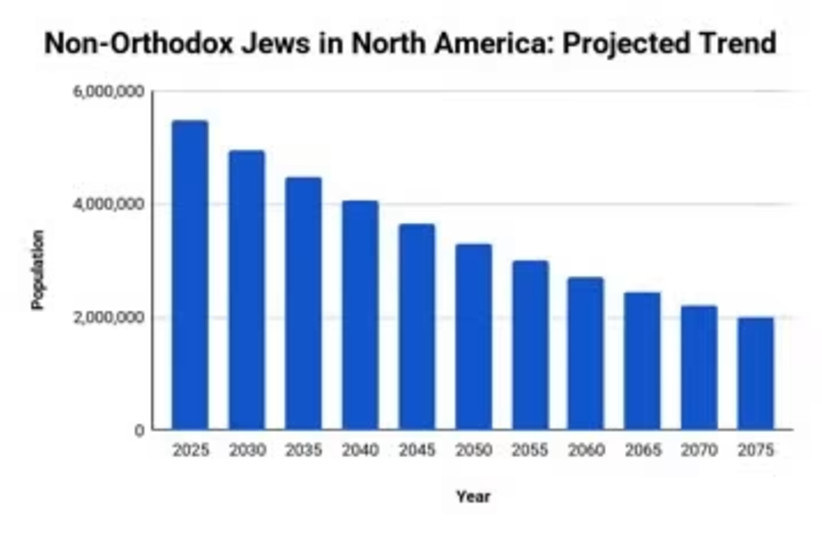
And the math rarely stops at school. The same calculation that pushes a family out of day school often leads a couple to wait longer than they want for children, or makes a thinning connection to Jewish institutions easier to let go of altogether. Cost doesn’t just decide who enrolls. It quietly shapes who marries in, how many children families have, and who stays engaged at all.
No subsidy can manufacture Jewish identity. Family, friendship, community, and belief matter enormously. But saying money doesn’t play a role is simply not true.
In Toronto, after eight years of declining enrollment, a 2017 initiative brought tuition down to C$18,500 from C$28,000, and enrollment nearly doubled. In Seattle, the Samis Foundation broadened its focus to not just the bottom decile but rather to alleviating the “cost of being Jewish” across the economic spectrum. Within five years, enrollment at participating schools grew by anywhere from 35% to 100%.
The effect compounds. My own modeling, based on these results, suggests that if enrollment in Jewish institutions doubled across the Diaspora, the odds that a non-Orthodox child would stay connected to Jewish life as an adult would rise by nearly 14 percentage points. That would mean hundreds of thousands of additional Jews within a single generation. This isn’t only about who signs up for school. It’s about who’s still here decades from now.
The moonshot: A fourth heir
American Jewish philanthropy hasn’t lacked generosity. It has lacked scale.
Imagine a wealthy Jewish couple who spent 40 years building a company, a portfolio, or a career, deciding what happens to that wealth. Normally we think of their children as heirs, and perhaps a charitable gift on the side. What if the Jewish future were treated as a fourth heir? Not another cause competing for a check, but family, with a share of the estate that was never really in question.
When I started calculating what it might cost to change the economics of Jewish continuity, I expected an impossibly large number. It wasn’t. I arrived at roughly $440 million a year to keep serious Jewish education accessible. At a conservative 4% return, that would require a permanent endowment of about $11 billion for Jewish education across the Diaspora. Call it the Fund.
And that’s the floor. A target of $18 billion, generating about $720 million a year, would let the Fund grow, weather inflation and market swings, and extend beyond tuition to camps and the other costs pricing many families out. These are modeled estimates. I built them from the income distribution of Diaspora Jewry and the real cost of schools where Jews live, then checked them against what happened in Toronto and Seattle. The order of magnitude is what matters.
Eighteen billion dollars is an enormous sum. But Forbes Israel’s 2026 list counts 319 Jewish billionaires with a combined net worth of more than $2 trillion. Eighteen billion is less than 1% of that, before counting the generational transfer of wealth coming over the next few decades. It would work like an endowment, not a charity.
Nor is it free tuition. Families would still pay on a sliding scale capped at roughly 15% of disposable income. That’s enough that everyone stays invested, but not so much that cost decides who stays Jewish. The money would go to schools, not parents, and any school that raises tuition to capture a bigger subsidy would lose access to the Fund. It would be underwriting, not a handout.
Scale isn’t only a matter of money, either. A community of millions still behaves like hundreds of communities acting alone. Networks like Prizmah help schools share what works, but a school that learns how another school cracked Hebrew instruction or teacher recruitment often can’t afford to adopt it. A fund at this scale could change that.
A 2,000-year-old Jewish tax
There is an uncomfortable precedent for all of this. Economists Maristella Botticini and Zvi Eckstein studied a remarkable transformation in Jewish history. Roughly 2,000 years ago, education and Torah study became central to Jewish life, and Jewish fathers were expected to teach their sons to read.
It was an extraordinary innovation, but in an agricultural economy, education was expensive. A poor farmer who sent his son to study wasn’t merely paying a teacher. He was losing a pair of hands in the field.
In the centuries that followed, Botticini and Eckstein found that the Jewish population shrank to a fraction of its former size. Their provocative thesis is that a substantial part of this decline came from voluntary conversion by Jews for whom the burden of Jewish education had become too great. It was a Jewish tax, two thousand years before this one. That same commitment eventually became one of the great advantages of Jewish civilization, but only after centuries of decline.
Today we again ask families to make an unusually large investment in passing Jewish identity to their children. The difference is that those farmers were poor, and we may be the wealthiest Jewish community in history. We have the capital to make Jewish education affordable, the technology to spread successful ideas across a continent almost instantly, and the collective purchasing and political power of millions.
None of this is a cure-all. Camps, youth movements, Israel experiences, synagogues, and families all shape Jewish identity. The argument is simpler: we should stop making Jewish life unnecessarily difficult to choose.
Two thousand years ago, the Jewish tax became too high, the Jewish population shrank, and ordinary Jewish families lacked the resources to change the economics.
Today, we don’t. The question is whether, after 2,000 years, we have learned anything.
The views and opinions expressed in this article are those of the author and do not necessarily reflect the views of JTA or its parent company, 70 Faces Media.