
There is no shortage of passenger behaviors that manage to annoy almost everyone on a plane: Those who recline their seat all at once, those who take over both armrests, or those who stand up from their seat the moment the plane attaches to the gate upon landing before permission to disembark has been given, and more. But there is one habit that manages to irritate almost all passengers – and it is also one of the easiest to prevent: Watching videos, listening to music or playing games with an open speaker, without headphones.
For years this was considered simply a basic rule of etiquette on flights. Do not play TikTok videos out loud, do not watch a movie with the speaker open, and do not allow your children's tablet to become the soundtrack for everyone sitting in the next five rows.
Now it seems that United Airlines has decided that the request "Please be considerate of other passengers" is no longer enough.
The rule entered the official contract
The American airline recently updated its "Contract of Carriage" – the legal document that every passenger approves when purchasing a ticket – and added a new clause referring to passengers who play audio content without headphones.
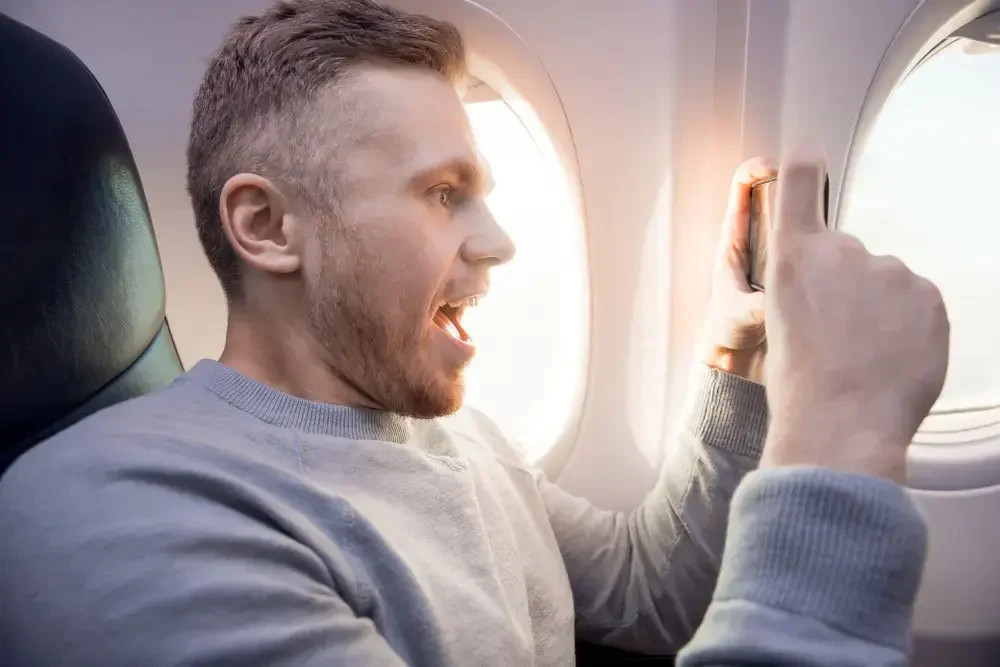
The new clause was integrated specifically under the chapter "Refusal to Transport Passengers," the very chapter that allows the company to prevent boarding, remove passengers from a flight and even refuse to fly them in the future in case of a violation of the rules. The meaning is that the use of headphones is no longer just a recommendation or a request by the flight attendant crew, but an official rule anchored in the company's regulations.
However, this does not mean that a passenger who accidentally played a video for a few seconds will find themselves off the plane. The goal is to provide flight attendants with a clear basis for action in the event that a passenger is asked to stop – but refuses.
A problem that every passenger knows
Almost everyone who has flown has encountered this at least once: A passenger scrolling through videos loudly, a child watching cartoons on a tablet without headphones, or a person playing a game where each sound effect is louder than the last.
In the passenger cabin, which is a crowded and shared space anyway, everyone hears almost everything – from the opening of a snack bag to the conversations of the neighbors. The addition of online videos or loud music is exactly what most passengers would be happy to avoid.

For the time being, it does not look like United intends to start routinely removing passengers because of headphones. It is more likely that the procedure will be gradual: First they will ask the passenger to use headphones. If they do not possess any, the company even offers basic headphones free of charge – as long as supplies last. Only if a passenger insists on continuing to play content out loud even after being asked to stop and offered a solution, will the crew be able to rely on the new regulations to take more severe steps.
United explains that they have always encouraged the use of headphones, but now the rule has received official validity. The timing is not accidental. In recent years, the company has significantly expanded wireless internet services on flights, among other things through the Starlink system, which allows more passengers to watch videos, surf social networks and stream content during the flight. As more passengers use their personal devices, the greater the chance that one passenger's entertainment will become a nuisance for everyone surrounding them.
United went one step further
Most airlines already recommend or require the use of headphones when watching content or listening to music. However, United is one of the first to enter the requirement directly into the enforcement clause of its Contract of Carriage. The meaning is that now it has a clearer legal basis to act against passengers who refuse to comply.
For most passengers, this is a rule that will not affect the flight experience at all – because they use headphones anyway. But for those who insist on playing their videos for the entire passenger cabin, the airline's message is clear: From now on it is no longer just a matter of politeness, but also of official rules.