Settler committee head calls on supporters to come stop court-ordered eviction and demolition of Ulpana outpost.
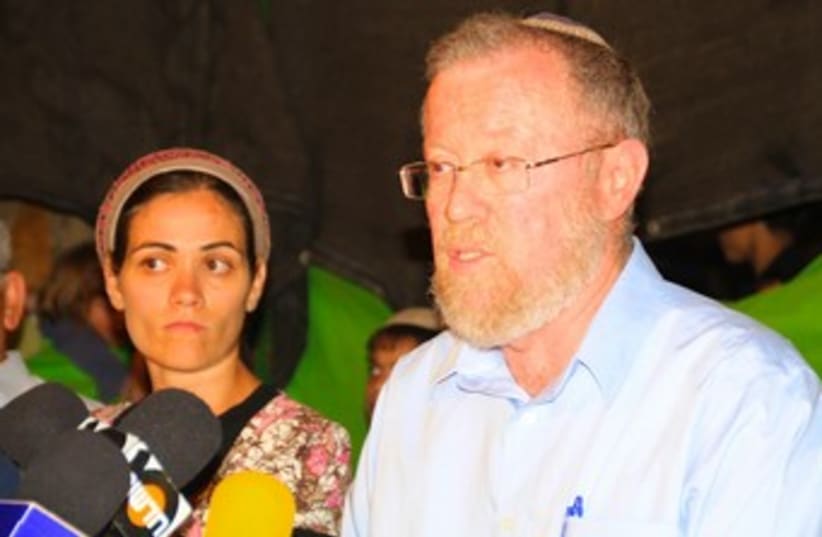
By TOVAH LAZAROFFBeit El Council head Moshe Rosenbaum 370(photo credit: TOVAH LAZAROFF)
Settlers on Thursday night called on their supporters to head to the Ulpana outpost on the outskirts of the Beit El settlement to thwart IDF plans to demolish five stone apartment buildings by July 1.“We have to defend these homes with our bodies,” said Itzhik Shadmi, who heads the Binyamin Citizens’ Committee.“Everyone for whom the nation of Israel is dear, should come here,” he said.“If thousands are here there won’t be any demolitions. This business that it is easy to tear down Jewish homes when thousand of unauthorized [Palestinian] homes are being built nearby in Area C. This terrible discrimination has to be stopped,” he said.Shadmi, along with the Beit El Council head Moshe Rosenbaum and residents of the Ulpana outpost spoke with the media at a press conference they held in a large tent, which was set up outside the homes.Tires stockpiled at Ulpana outpost ahead of planned evictions (Tovah Lazaroff)Some supporters have already set up sleeping tents in the parking lot outside the homes. They have also begun stockpiling tires, which were lined up Thursday night by the walkway in back of the Ulpana structures.At the press conference, settlers warned against a civil war even as they said that they planed to conduct a non-violent protest.The danger of a civil war is the result of the decision to destroy the homes, said Beit El Council head Moshe Rosenbaum.“The person who is responsible for this situation is the one could neutralize this situation. It is in his hands,” said Rosenbaum, referring to Prime Minister Binyamin Netanyahu.“It is the right of the residents and the thousands who support them to sit in their homes and to passively protest this immoral, unjust and inhuman decision, and that is what is going to happen,” Rosenbaum said.He said he opposed violence against soldiers and those who were there would do their best to prevent it.“We are not an army. We are citizens,” Rosenbaum said.Among those who spoke was Menahem Tzur. The Ulpana was built in the memory of his mother Etta, 48, who was killed by members of the Popular Front in 1996 along with his brother Ephraim, 12, as they drove west of Beit El.At the time, Netanyahu, who then in his first term as prime minister, promised to build in their memory on the spot of Ulpana.“The prime minister said then that the response to terror was that on this hill a thousand homes will be built,” said Tzur.“It was the same prime minister who now does not have the strength to stand against his legal advisers who are introducing their own agenda,” said Tzur.“It is very hard for me and my family to watch this,” he said.He rejected calls by Netanyahu and politicians for the Ulpana residents to willingly leave their homes.“There is no such thing as a voluntary evacuation,” he said.“If [the government] desires, it can find a solution,” he added.Yiska Fattal, who has lived in the Ulpana for five years, said that residents have already undergone long difficult months. She is a member of one of 30 families who face eviction.She said it was very disappointing to see politicians who had visited their homes and had promised that nothing would happen, have now retracted those pledges.“We want to see politicians who stand by their word,” she said.The normal lives of those who live in Ulpana have been disrupted, she said.“They want to destroy our homes. We are moving, we do not know when or how. Our neighbors will remain with the ruins,” she said.She and others said they rejected the court ruling that their homes were built without permits on private Palestinian property.The matter, they said, was not adjudicated and all that happened is that the court rubber-stamped the state’s written testimony to the court.Yair Nachliel, the secretary of the neighboring settlement Ofra, said that what happened in Ulpana, would have an impact on other settlements and outposts.“We have to stop it, here and now,” he said.The High Court of Justice is suppose to provide answers in real time, but in reality, there is not even a procedure by which to actually debate the issue of land ownership. “We have a number of petitions in Ofra, that are like this petition,” he said.Fattal added, “We had expected this government to rule with justice.”
if(catID != 151){
var cont = `Take Israel home with the new Jerusalem Post Store