If Hezbollah is responsible for the attacks on Israel over the past days, which at present appears the most likely explanation, the movement is using the Syria-Israel border as a site for attacks on Israeli forces.
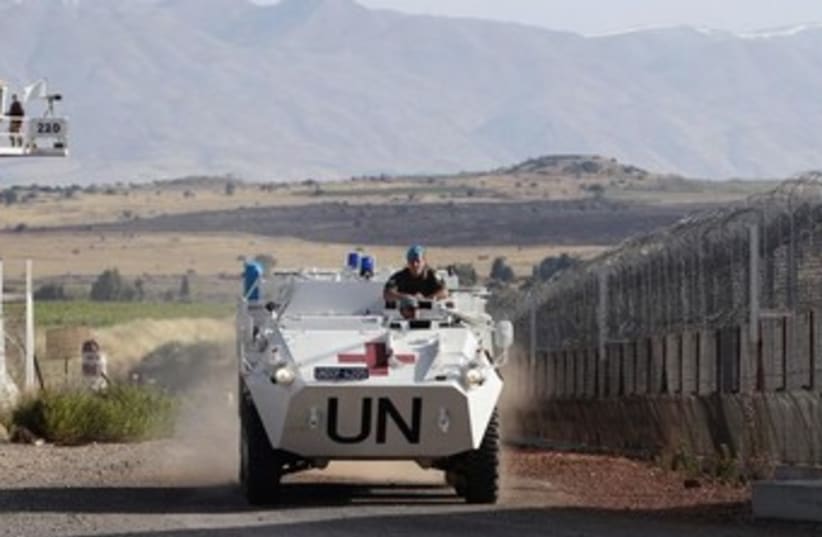
By JONATHAN SPYERUN peacekeeping tank on golan heights 370(photo credit: REUTERS)
This week’s events on the Israel-Syrian border are testimony to the extent to which the effective disintegration of the Syrian state is producing a new security reality in the North.Once, Syrian President Bashar Assad’s regime sought to conduct its business via Israel’s border with Lebanon. The Syrians would seek to place pressure on Israel by supporting paramilitary proxies in Lebanon, which would launch attacks on Israeli forces and communities.At the same time, the direct Syria-Israel line would be kept silent, out of fear of Israeli retribution.The precise reversal of this situation now appears to be the reality.On the assumption of Hezbollah responsibility for the attacks, which at present appears the most likely explanation, the movement is using the Syria-Israel border as a site for attacks on Israeli forces.For both political and military reasons, meanwhile, it prefers to keep the Israel-Lebanon frontier quiet.Hezbollah played a major part in the notable military successes enjoyed by the regime recently – culminating in the capture of the town of Yabrud this week. Yet the Shi’ite Islamist movement is not currently in great shape.It has suffered a major loss to its standing in Lebanon, because of its involvement in the fighting in Syria.Its attempt to portray itself as a pan-Islamic, anti-Israel force rather than a sectarian Shi’ite militia is now severely tarnished. A recent poll by the Pew Research Center found that 59 percent of Lebanese now view the organization unfavorably.Sunni Lebanese are growing increasingly unwilling to accept Hezbollah’s de facto domination of Lebanon. In Tripoli and in Sidon, support among young Sunnis for the Syrian rebels and for Salafi jihadi politics is rapidly increasing.And there are around a million new Sunnis in Lebanon – refugees from the fighting in Syria, whose attitudes toward Assad’s Hezbollah allies can be guessed at.The growth of Sunni Islamist violence in Lebanon means that Hezbollah can no longer guarantee the safety of its own Shi’ite community. A string of bomb attacks in the movement’s Dahiye quarter in south Beirut has led to a depletion of the area population.Some Shi’ite Lebanese now prefer the relative security of their south Lebanon villages close to the Israeli border to remaining in Beirut.For all these reasons, Hezbollah is evidently keen to avoid using Lebanese soil as the launchpad for renewed strikes on Israel.In addition, Hezbollah’s Iranian patrons are also likely to oppose any provocation emanating from south Lebanon. Tehran has invested enormously in replenishing and increasing Hezbollah’s missile capabilities (to 100,000 projectiles, we are told) since the 2006 war. This capability is there to serve Iran’s strategic aims; it is not to be placed at risk for tactical purposes.Nevertheless, Hezbollah had a clear motive for striking at Israel – in response to ongoing Israeli moves to interdict the movement’s attempts to transport sophisticated weapons systems from Syria to Lebanon.The February 24 raid on Janta in the eastern Bekaa was particularly likely to generate a response from the movement, because it took place a few kilometers onto Lebanese soil.This is the most likely explanation for the recent string of attacks. Hezbollah’s apparent attempts at retribution, however, are cautious to the extreme.They are taking place from Syrian soil, not Lebanese. And they are not accompanied by a claim of responsibility. Indeed, the roadside bomb placed in the Har Dov area on March 14 was accompanied by a false claim of responsibility, which some media outlets unwittingly broadcast.This claim, supposedly from the Sunni jihadi Islamic State in Iraq and the Levant (ISIS) group, did not emanate from or appear on any of the sites or accounts officially associated with that organization, according to Aymenn Jawad al-Tamimi, who tracks the activities of ISIS and other jihadi groups.ISIS, in any case, has no history of activity in south Lebanon, no presence in southern Syria, and probably would not have the ability to avoid both Hezbollah and IDF surveillance in order to operate in Har Dov.Israel’s response to the additional explosive device placed on the border on March 18, which injured four IDF soldiers, was of a scale and magnitude without precedent since the beginning of the civil war in Syria.For the first time, major facilities of the Syrian Arab Army were targeted. These included, according to the IDF’s statement, “a training facility, military headquarters and artillery batteries.”Clearly, Israeli defense planners have concluded that forces on the opposite side were attempting to change the rules of engagement.Israel’s response – in a manner familiar on the Lebanese border in the past and in Gaza more recently – is intended to raise the price of increased aggression to a level sufficient to cause the other side to desist from further provocations, without leading to a general deterioration into armed conflict.For many years prior to 2006, Israel’s border with Lebanon was managed in such a fashion – first against the PLO, then from the early ’90s, against Hezbollah. Periodic provocations would result in “rounds” of violence, which would be followed by tense periods of subsequent silence.It appears likely that the border between Israel and Syria is now set to take on these characteristics, after a long period in which only the conventional armies of Israel and Syria faced one another across the border, and paramilitary activity was outside the rules of the game.This is testimony to how much the balance of power in relations between elements of the Iran-led regional bloc has changed. Hezbollah has played a central role in aiding Assad’s recovery. It is now evidently able to demand a return of the favor.Israel, meanwhile, is facing a complex new reality in the North. While the claim of ISIS responsibility this time was almost certainly false, there are al-Qaida type elements among the Syrian rebels and their Lebanese supporters who seek to reach the border and commence action against the Jewish state.Fighting against these elements are the Shi’ite jihadis of Hezbollah, and various other components of Iran’s regional bloc.The task facing Israel at present is to neutralize or deter both of these warring forces, while at the same time avoiding if possible being drawn into a direct, unlimited conflict with either. It remains to be seen whether this week’s response will be sufficient to bring the current “round” to a conclusion, or whether Hezbollah and Assad’s army will seek a further exchange of fire.At present, the former looks most likely. But with the Syrian state in ruins, al-Qaida- associated jihadis trying to reach the border, and the power balance between Assad and Hezbollah severely shifted, a new reality in the North has been born.The Israel-Syria border is now an active conflict zone once more.
if(catID != 151){
var cont = `Take Israel home with the new Jerusalem Post Store