When it comes to outposts, Israel is talking the talk, but not walking the walk.
By TOVAH LAZAROFFmaoz esther outpost 248 88 ap(photo credit: )
Outpost removal is one of the few West Bank topics on which Israel and the US have seen eye to eye for at least the last six or seven years. But in practice, outside of a few highly publicized outpost removals, little has changed on the ground as new caravans and permanent homes continue to sprout.
To understand the world of outpost-ology, one almost needs an informal lexicon of terms and phrases. Below is a guide to help make sense of the statements and terms used by politicians and the media.
Unauthorized outposts: These are the fledgling communities that dot the hilltops of Judea and Samaria, built anywhere between 1991 and 2004 and never legalized by the government. Small in size, generally numbering anywhere from half a dozen to 100 people, they are composed of caravans (modular construction), but often have paved roads, bus stops, synagogues and playgrounds. Increasingly permanent buildings have replaced modular construction, although there are still plenty of caravans on the hilltops. There are even some outposts, such as Bruchin, where the bulk of the homes are made from stone and look like those you would find in any settlement.
Illegal outposts: These are built partially or entirely on privately owned Palestinian land.
"Run and grab hilltops": Ariel Sharon said this in 1999 when he was still seen as the father of the settlement movement. His statement was meant to encourage the construction of outposts, and left the impression that settlers were racing through the hilltops randomly placing caravans anywhere they felt like it in defiance of the law. In fact the bulk of the outposts were intended to be the start of well planned and well thought out communities created under the auspices of the Council of Jewish Communities in Judea, Samaria and the Gaza Strip as well as the regional councils.
Many of them are satellites of existing settlements or in some cases were the start of what settlers hoped would be new neighborhoods in existing settlements. In some cases the outposts were constructed as a protective and security measure at dangerous junctions in the West Bank where terror attacks had occurred. In other cases they were placed at sites of attacks in memory of the victims. Many of them were built with government support to the combined tune of more than NIS 70 million.
The settlers' leaders believed that in helping to create these outposts, they were doing things the way they had always done them, which was build first, get the permits later. But in the 1990s, when some 50 outposts were created, the government vastly reduced the instances in which it was willing to grant retroactive permits. By the end of 1999, it had stopped authorizing new settlements altogether, leaving many of the outposts in a state of limbo. In some cases they had many of the initial permits, but lacked the final ones.
By the end of 2004, when it became clear that no such permits were forthcoming and the government stopped funding them and did more thorough job of cracking down on the creation of such hilltop communities, the formal settler leadership stopped building new ones. But in many cases they continue to service the outposts by allowing their residents to enjoy the benefits of the nearby settlements and providing the outposts with utility services and garbage collection. Outpost residents have also continued to expand and built their communities.
The Sasson Report: At the government's request in 2005 attorney Talia Sasson compiled a report on the outposts, which the cabinet accepted that March. She found that there were 105 unauthorized outposts, 15 of which were on private Palestinian land, 39 on mixed state and Palestinian land and 26 on state land. While her list carries a lot of legal weight, it is not the sole measure of what an outpost is or how many there are. Peace Now, which monitors settlement activity, has a fairly extensive database on the outposts. It also lists about 100 outposts, but some on its list are not on Sasson's. Their dates also differ. Some of the outposts, whose evacuations made headlines in the past year, such as Federman Farm in Kiryat Arba, appear on neither list.
The Defense Ministry also has its own list. At the end of May, Defense Minister Ehud Barak told the Labor Knesset faction that there were 87 outposts. In spite of repeated queries from The Jerusalem Post, the ministry has never corrected that statement, which was distributed to journalists in writing. It has not offered an explanation as to why its number differs from the Sasson Report accepted by the government, or if measures are being taken to legalize a number of outposts on the list. The Civil Administration, for example, is now debating a master plan for a new neighborhood in the Talmon settelment, which if approved would legalize the outpost which exists there.
What Israel promised America: The 2002 US backed road map, which Israel accepted in 2003, obligated the government to remove all outposts built after March 2001.
Sasson calculated that there were 24 such outposts, and the cabinet in March voted to remove them. Peace Now lists 47 such outposts. When the Defense Ministry talks of removing outposts, it uses most of Sasson's list, but has dropped a few and added some of its own to get to 26. Since 2005, so much focus has been placed on the number 26 that it may be overlooked that, if those are removed, there will still be 79 unauthorized outposts.
"Outposts will be dismantled": Barak said this after Prime Minister Binyamin Netanyahu's first trip to Washington in May. His words made headlines and left the impression that action was finally about to be taken with regard to the unauthorized outposts. He spoke as if this was the first time that the government was going to take the matter in hand. In 1999, he made similar statements when he was prime minister. In fact, the defense ministers of every government since then - Binyamin Ben-Eliezer, Shaul Mofaz, Amir Peretz and again Barak - have issued stern warnings about how they imminently planned to take down outposts. Barak, Ben-Eliezer and Mofaz removed many empty outposts but few populated ones. Some of them were rebuilt, and in other cases new ones were built in other locations, so that the numbers remained the same.
An outpost deal: In the late spring of 2006, negotiations began between the government and the settlers to hammer out a deal for the voluntary evacuation of outposts. Over time, the talks evolved into a deal to relocate some outposts to existing settlements and, where possible, to authorize others in their current location. To date the only significant step that has been taken as a result of these talks is a deal by which Migron, the largest outpost with 322 people, would be relocated to the nearby settlement of Adam within the next two years.
Amona: In late January and early February 2006, security forces and settlers clashed at the Amona outpost outside of Ofra, which was built in 1995. Hundreds of teens and young adults camped out there to prevent security forces from destroying nine permanent homes, which had just been completed and had never been inhabited. Some 86 policemen and soldiers were injured in the clashes, as were at least 150 activists.
Media images of soldiers swatting at unarmed activists with batons and riot gear, as well as shots of settlers teens hurling larges stones and cinder blocks off the rooftops, have impacted any discussion of outpost evacuation, as settlers and security forces try to avoid an Amona 2. Viewers may have been left with the impression that the entire outpost had been destroyed. In fact the caravans where some 43 families live were untouched and these families have continued to live in Amona.
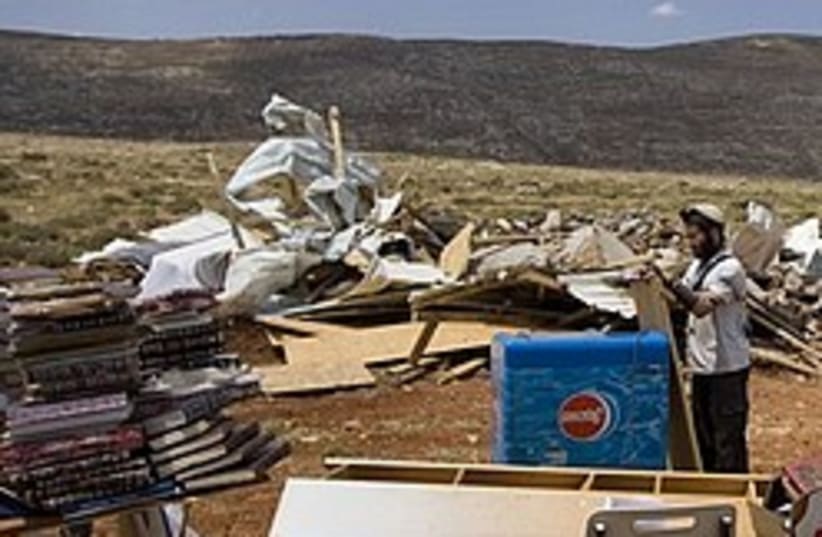
New outposts: These outposts are not formally outposts, not in the eyes of many settler leaders and not in the eyes of the US. In the last two years, right-wing activists have tried to create new outposts in some dozen or so locations throughout the West Bank. These fledgling encampments differ from the more veteran outposts in that they are created outside the auspices of any settler council. The well-recognized caravans and modular homes have been replaced by wooden shacks that can be put up in an afternoon. The emphasis in these cases is on inexpensive construction that can almost immediately be replaced.
Security forces have evacuated and destroyed many of these sites multiple times, only to find that they have been rebuilt within days. These actions do not bring Israel any closer to meeting its pledge to America, which remains that list of 26 outposts.
if(catID != 151){
var cont = `Take Israel home with the new Jerusalem Post Store