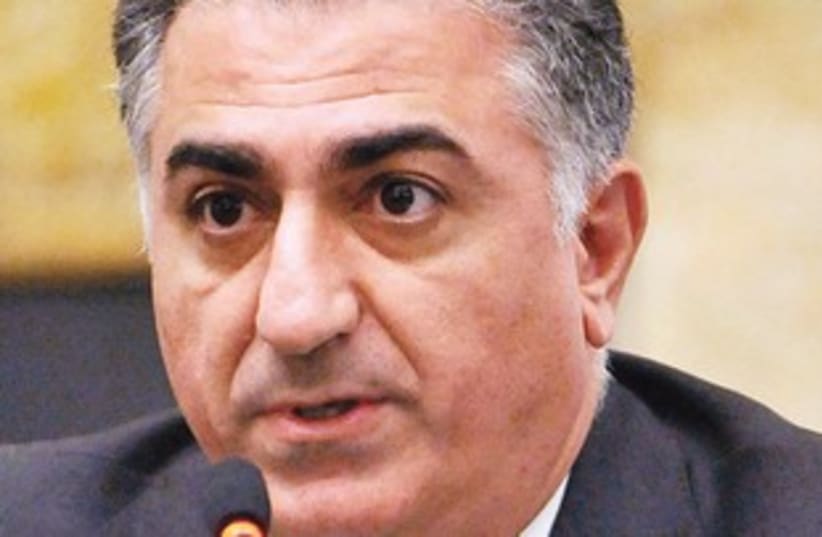
Crown Prince Reza Pahlavi says Iran’s freedom movement is ready to change the regime, but it needs support, not a bombing campaign.
By FELICE FRIEDSON THE MEDIA LINE NEWS AGENCYREZA PAHLAVI 311(photo credit: tbfoundation)
CROWN PRINCE REZA PAHLAVI is of the bestknown Iranian personalities, standing in sharp distinction to the Islamic Republic’s bellicose president and ayatollah. Pahlavi is the son of the late Shah of Iran and has lived in the United States since the revolution in 1979. He’s known as an advocate of the principles of freedom, democracy and human rights.This interview was conducted earlier this week by phone.The Iranian government says it has as much right as any other regime to have nuclear power – even nuclear weapons. How should the international community be responding to that statement? The matter is quite complex, but let’s go back to the period before the revolution. At the time, Iran was a country that had already embarked on the pursuit of nuclear energy. Having signed the Nuclear Non-Proliferation Treaty, we had gained the ownership of ten percent of shares in a company called Eurodif, which was going to supply Iran with the rod to fuel our two initial nuclear reactors that had started construction – my point being that at the time, nobody questioned the sovereign right of the Iranian nation to have access to nuclear technology.What has changed is that since the revolution, we have had for 30 years and counting, a regime that has been at the top of the list of the world’s sponsors of terrorism, radicalism and extremism; constantly making violence in the Middle East and beyond, with very dubious intentions in terms of where it really wants to take the path of its nuclear research.From all indicators, there is very little question that if the regime was, from the very beginning, transparent and honest about its true intentions, it would not have been so much trying to conceal or hide its intentions.We have to understand why it is that such a regime would like to have access to nuclear weapons well beyond having the right to nuclear technology.Iran insists it only seeks domestic nuclear power.Does Iran intend to create nuclear weapons; and if so, how far away from being able to do so do you think the Iranian regime is? Well, this is an expert analysis that is required in terms of how far up the ladder of getting closer to the imminent ability to actually manufacture nuclear weapons the regime is. Because it’s not just a matter of enrichment, as you know. It’s a matter of delivering mechanism; ballistic technology; trigger mechanism; and a whole bunch of other things that go into it. Experts vary in terms of the time line of how close the regime is to it. But irrespective of the time line, it is the intention that we have to be quite wary and concerned about. In that sense, clearly, if there was no sense of emergency and alarm, the whole world would not be talking about this constantly, the issue making the headlines in just about every newspaper around the planet.Is Mahmoud Ahmadinejad a mad man? I don’t think he’s a “mad man.” He’s an individual who is very committed to his view and ideology. There’s almost a sort of apocalyptic mentality that reigns here and he’s not alone in it. Unfortunately, there are a few people who may sign up for that kind of a point of view.The problem is that we have this kind of regime represented by such individuals who have taken, first-andforemost, the Iranian people hostage for the past 30 years and who are completely uninterested about the state of our own citizens. They are only interested to use Iran as a base from which to launch what was from the very beginning the exploitation of a theocracy and Islamic ideology across the planet as a challenge to the rest of the world.How seriously should we be taking him (Ahmadinejad)? I think you should take him very seriously. The last time the world was not quite sure about the final threat was at the time of Hitler in Nazi Germany and we know the rest of the story. If we look at these kind of regimes that have been completely merciless vis-à-vis their own population; who have been brutally shooting our youth on the streets simply because they ask for their freedom; and are willing to stop at nothing to intimidate the whole world to submit to their demand, I think we should take it very seriously.Here in the West, we hear about young Iranians rejecting the Khamenai-Ahmadinejad regime. Could another revolution be possible? It’s already happening. If you look at the way society in Iran has reacted for years – and not just because of what happened last summer – but particularly as a result of what happened last summer during the election fiasco.Today, you see a generation of young Iranians who are committed to fight even if it means risking and losing their lives to ultimately get rid of this regime and achieve full freedom. This is no longer a debate over more moderation or for awhile being fooled by the idea that there is any reform possible by this regime – not only from the domestic perspective but from the international perspective.Today, the fight is led by people who are committed to a campaign of hidden resistance. The discipline of nonviolence has been for the most part observed by the protesters and I think at the end of the day, this movement could culminate into something that could be a wellorganized or orchestrated campaign of resistance: perhaps even labor strikes that could in fact bring the regime to its knees and ultimately cause its demise.This is the best way for Iran to not only achieve its goal of freedom, which would immediately have a positive impact and ramification not only in our area, but on the rest of the world. It is the ultimate guarantee by bringing in democracy and secularism as a means to preserve our cultural and religious identities and to guarantee self-determination and human rights. Iran is a country that has always and throughout its glorious history been contributing to world civilization as opposed to a clerical regime that is asking for its demise under a very utopian ideology that only a few at the top believe in, and not the rest of the population.There are some who argue that sanctions could have a negative backlash. One example that is given is that students seeking to study abroad – including in the United States – won’t be able to do so. In the long run, do you think it’s a good idea for young Iranians to be exposed to the West? I’m glad you asked this question. First of all, clearly, it’s a little bit like tuna fishing and when you want to do tuna fishing, you get some innocent dolphins that are caught in the net. The problem with sanctions is that it sometimes could have counter-effects. For example, not only the issue of restrictions on students coming abroad to study, but even to take an SAT or Kaplan exam, or be able to send money back home to help fellow Iranians: all of this is subject to restrictions because of the current policy of sanctions.Now, I’m not suggesting that sanctions are not effective to some extent. If they are targeted smartly, sanctions, yes, could end up hurting the regime somewhat, particularly in the short term. However, I do have an issue with the policy of sanctions as an end in itself. The only way that actual pressure could be levied against the regime is ultimately to bring the element of pressure from within Iran against the regime, mainly from the hands of the people themselves, as opposed to relying solely on external measures of pressure such as the current economic sanctions.Let us not forget one thing: empowerment at the end of the day will render society better-equipped to fight the regime from within. But reliance on sanctions only will render a weakened society which will find it much more difficult to resist because you are not also really weakening the regime at the very end. Each instrumental coercion will have an easier time facing a helpless society than it will facing a better organized, better structured and better supported population.I recollect that when we sat on a panel together at a Global Leadership Conference, you talked about the fact that the young students were able to glean a lot of information and education by being educated abroad and many of these were those who were in the revolution. So having said that, by being counterproductive, won’t these sanctions boomerang? Well, as I said, there is a whole wealth of assets and information that could be at better disposal of all those in the country who are struggling for their liberty and for their rights. People who have access to a variety of human or other resources abroad to connect with activists at home obviously reinforce the hand of the people. So if you restrict the people more than you restrict the regime, that will obviously be counterproductive.That’s why we have to be very careful when we implement sanctions to make sure they target the regime and the regime only, with minimal damage and cost to the nation itself. It has to be carefully reviewed and assessed; and not only “one glove fits all.” Every country has its own traditions and specifics, particularly a complex country like Iran.American policy through the past two administrations calls for nations to choose sides – with either Western-led moderates or Iran’s axis. Is this policy feasible?I would verbalize it in a different way. Is the choice between forms of regimes – democratic regimes that is, that we find often in the free world, particularly in the West – a path through which Iran can find its salvation? Here I understand fundamentally that some of the values that are embedded in Western society – liberty, equality, freedom of speech, freedom of religion, freedom of assembly, media, labor unions, human rights, a democratic establishment, a checks and balance system, a separation of religion from government – are opposed to any system that is based on an ideology that is totalitarian or that is against fascist or discriminatory vis-àvis a great portion of its own citizens. Obviously, if you give that choice to people, the choice is clear. I think that is the choice that the Iranian people today are faced with and it goes without saying that obviously they are up for the former rather than the latter if given the opportunity.Some see the Saudis as reaching out to Teheran.Recently, Saudi Foreign Minister Saud Al-Faisal told a French paper that Iran deserves to be treated as a leading force in the Middle East and Iran’s foreign minister has said that conditions are now ripe for expanding and boosting ties and cooperation with Saudi Arabia.Do you see this and why now? If you ask me how respective governments in the Middle East have to react to or anticipate various scenarios in the months or years to come, what it really boils down to is an assessment of whether or not they are playing with fire. What has been clear all these years is that the regime from the get-go was antagonistic; was trying to and continues to try to foment instability – ultimately to force the region to succumb to some kind of a modern-day Shiite caliphate under Iranian regional hegemony; all of it perhaps backed by the very deterrent we talked about at the beginning of the interview: forcing the world to submit to that as a fait accompli. I find it a little bit difficult for a lot of people to sort of agree to some kind of a fait accompli and say, “Well, there’s no way we can change the course of events and Iran will undoubtedly under this regime demand to have its way.”The question is the regime that is in Iran – the regime that has now taken our country hostage and is willing to do anything for its own survival – and not to be confused with Iran as a country.Will this tip the balance of the region toward Iran? Again, if indeed the regime’s survival is what is willingly or unwillingly prolonged as a result of regional inaction or indifference; then clearly there will be some degree of balance tilting towards Iran. But understand one thing: contrary to what the country wants to project, its internal fragmentation continues to increase.Despite the fact that the regime is trying to tighten its screws; and despite the fact that the regime is increasing its violence against its own people in an attempt to intimidate them into submission; and despite the fact that the regime is spending millions and millions of dollars financing its own war machine at the expense of hungry people or workers who haven’t been paid their salaries for months, Iran continues to finance groups like Hizbullah in Lebanon and other places. And despite all of this, there’s more disenchantment within the ranks in the regime.There are more indications of defections from within some of its coercive forces, all of which indicates a very delicate and fragile situation within the regime that has not been so vulnerable ever since its creation. That is, I think, an opportunity – not only for the people, but I think in a way for the rest of the world. If we miss this opportunity and allow this regime to regroup and continue on its path, then we have with our own hands contributed to the regime’s survival and then we have to live with the consequences.Is Israel capable of launching a formidable attack on Iran’s nuclear program? I think this would be a very disastrous event if it were to occur. I have long stated that I think this would be a lose-lose proposition by and large, especially when there’s a much better alternative in play, which will be much less costly and far more legitimate than trying to bring any change as a result of any kind of external measures, particularly of the violent and military kind.You have in place the best natural army in the world: namely, the Iranian people themselves, who have bravely fought this fight for years, without any help or support from anyone in the international community.Today, they are already committed to that struggle and I think this is a much better way to put pressure on the regime and abide by international rules. It’s a much better way to help the Iranian people bring about whatever changes they want in Iran and nothing is being done about this while everybody contemplates striking the country just because they don’t have faith in diplomacy, which was doomed from the very beginning.I think there’s still a chance for a lot of serious fundamental change that will bring an end to all the threats if Iran wants to change from this regime to a democratic nation. If it invests time and effort in helping the movement of the young people in Iran today and be supportive of their demands; be supportive of what they want; engage them after 30 years of limiting engagement to only members of the regime and its representatives.I don’t think that’s far too much to ask for those of us who are fighting for freedom.What I am saying is that in my opinion, not using this opportunity and going straight to conflict would be historically criminal. That option has to be given its chance but the time is limited and the window of opportunity is now. I hope that many key governments will decide to commit some of their policies to give a chance for this movement to succeed before jumping to conclusions that the only familiars we’re left with are either capitulation or attacking Iran.Just to follow up on this thought, Admiral Mullen says the military option remains on the U.S. table. As an American and as an Iranian, do you believe this is really an option for the Obama administration? Well, the [Obama] administration has spent, in my view, too much time, in maintaining its extended hand of engagement toward the regime without getting anything in return. Meanwhile, the clock has been ticking. Some countries in the area are becoming more antsy about the imminence of Iran’s ability to be equipped with weapons of mass destruction. Obviously, the rhetoric and language from some key countries would be to mention the fact we are exploring this and this is an option on the table. I could not say otherwise.But that doesn’t mean to me that there is a major change of policy.We need to think a little bit outside the box and perhaps look at other avenues. It’s not limited to the character of this administration because successive, previous administrations have fallen systematically into the same “loophole” – and I’m not even saying the same “trap.” Einstein said, if I’m not mistaken, that “thinking that doing more of the same will produce a different outcome is a sign of insanity.” When I look at the overall diplomacy of the free world, particularly of the U.S., I can only see a repeat pattern of the same attempts made while hoping to obtain a different result. Something’s got to change.What will Iran look like in five years? I hope it will take less than five years to have a fundamental change if our movement is successful and I believe it has every potential to be successful. But as I said and I hate to be repetitive, the time is really now.Because as much as the Iranian people can be empowered, and therefore heartened and therefore optimistic toward their future – and I’m specifically speaking about today’s generation – these are tomorrow’s leaders in Iran. These are the kids, the daughters, the sons of a previous generation who are left there to fight and fend for themselves with no possible help so far available to them and yes, they are resilient in their struggle.This could turn quickly to cynicism and deception if they think the world has abandoned them. Remember what the slogans were on the streets of Teheran one year ago. There were signs in different languages – in English, in French – and this was not for some Iranians practicing their language skills among themselves.They were clearly aimed at the West. And among those slogans were “Obama, Obama, are you with us or with them?” That warrants a response. We have yet to hear that response. That means Iranians could turn more radical as a result of their deception; as a result of their cynicism; and that doesn't bode well, not only for Iran but for the world. And it will be a testimony to the fact that no real help is ever given to nations that want to struggle for liberty because perhaps there are some other interests that no one really wants to talk about. If that is not true, then we need to see a genuine attempt to help the society.We are not asking the world to determine our fate—that is the business of the Iranian people alone. All we are asking is that today it is time to engage with the people of Iran; with the freedom movements; with those who are struggling for their rights for self-determination and liberty.We are fighting against those who have denied us these rights and it's about time that we are heard and have our “day in court,” as the saying goes. This is an opportunity that we are facing right now as I speak to you. It's right in front of us.It's right under our noses literally, and I have yet to see a concrete policy -- whether it's the U.S. government or some of its other allies in the region or in Europe -- that will indicate that beyond attempting a few diplomatic negotiating tactics and besides posturing for the possibility of conflict, there is any real effort made to go beyond the regime and its representatives and try to connect and try to see how they can be of help to the Iranian people without having to attack our country and bomb our homeland.Other than sanctions, what would you suggest? There has to be proactive attempts made in facilitating better communication between Iranians at home; technological support; broadcasting capabilities; some degree of structure and organization within and outside; with the help of Iranians, activists, NGOs, civil societies, members of the Diaspora, political groups and organizations. A lot can be done, but this requires much more focus than simply thinking of the regime and engaging its representatives.FELICE FRIEDSON is president and CEO of The Media Line Ltd., an American news agency specializing in coverage of the Middle East. She can be reached at editor@themedialine.org.
if(catID != 151){
var cont = `Take Israel home with the new Jerusalem Post Store