While their politicians languish in opposition, the community itself will
inch closer to the social mainstream.
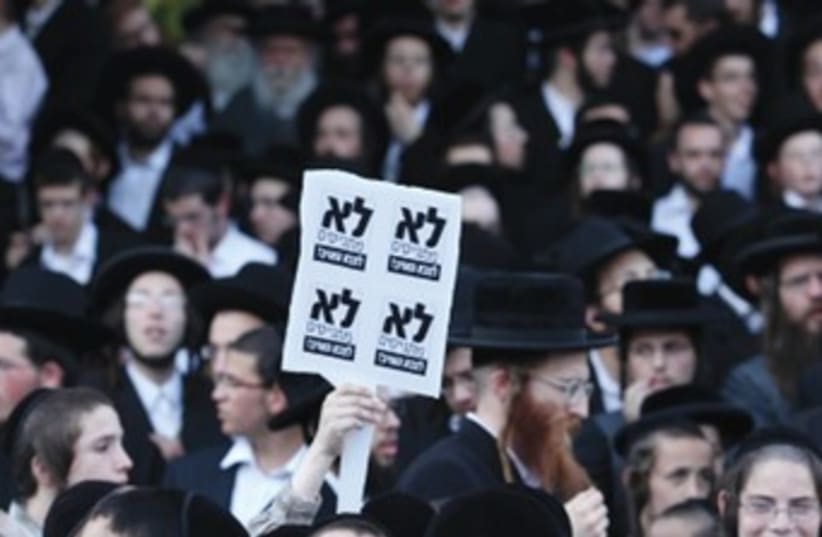
By AMOTZ ASA-ELHaredim protest enlistment 370(photo credit: Marc Israel Sellem)
‘Anyone with eyes,” warned a group of rabbis in a public statement at the turn of the 20th century, “will recognize that Zionism is more ruinous to the Jews than all the false messiahs who arose in our nation.”Having spent much of the 19th century fighting the Reform movement, ultra-Orthodoxy later detected a new enemy, Zionism, which it chose to fight with equal zeal.The great Talmudic authority of the generation, Rabbi Chayim Halevi Soloveitchik of Brisk, warned “the Jewish masses” to avoid “connecting to what amounts to religion’s destruction and an obstacle to the house of Israel” while, on the hassidic side of the shtetel, Rabbi Sholom Dovber Schneersohn – the fifth rebbe of Lubavitch – wrote that even if the Zionists had been observant, and even “had there been room to believe they will achieve their aim, we should not listen to them in this matter of bringing about our redemption by ourselves” because the Talmud forbade the Jews to abandon exile by the force of their arm, and the Jews’ “real hope” is that “our redemption will be brought about by God himself.” (S.Z.Landa, Y. Rabinovitch (Eds.), Or Li-Yesharim (Hebrew), Warsaw 1900) This spirit of defiance survived the Holocaust and also Israel’s emergence. Ultra-Orthodoxy avoided joining coalitions, and to this day its Ashkenazi lawmakers refuse ministerial appointments because that would imply they recognize the secular Jewish state.Still, ultra-Orthodoxy has come a long way since its original anti-Zionist broadsides – so much so that the compromises it made with Zionism since Israel’s establishment are now expected to produce a social crisis, which will then be followed with even greater accommodation.THE CRISIS will arrive in the wake of the next government’s fiscal constraints and the ultra-Orthodox factions expected return to the opposition.A harsh budget cut is imperative because the outgoing government has accumulated a 4.2 percent-of- GDP budget deficit. Prime Minister Binyamin Netanyahu and his prospective coalition partners are all economic conservatives who agree this deficit must be quickly erased. This means slashing from this year’s budget NIS 10 billion and NIS 20b. from next year’s.While parts of this cut will affect defense spending, public-sector wages, transportation projects and assorted tax breaks, other cuts will target budgets that over the decades became a staple of ultra-Orthodox life.Plans include slashing child allottments from their current level of NIS 7.5b. by some 30% and even sharper cuts in the annual NIS 1b. budget for yeshiva support. In addition, the new coalition will likely trim budget transfers to ultra- Orthodox boarding schools and make a slew of benefits – from mortgage assistance and reduced healthcare fees to lower property taxes and kindergarten tuition – conditional on its recipients going to work.On top of this will come a renewed drive to pass legislation for drafting most conscription-age ultra- Orthodox men – if even gradually, not necessarily to the IDF, not at age 18 and not for a full three years.Understandably, all this is causing panic among ultra-Orthodox politicians. Reports this week that Rabbi Ovadia Yosef asked to be taken to meet Labor leader Shelly Yacimovich in order to persuade her to join the coalition instead of Yair Lapid, have underscored a sense of emergency in the face of a civic onslaught that might undo years of political gains.While such alarmism is exaggerated, ultra-Orthodoxy indeed arrives now at a turning point in its relationship with the Jewish state; it is one that its leaders cannot evade and their followers should not fear.THE GREAT turning point in ultra-Orthodoxy’s relationship with the Jewish state came in 1977, when what then was called Agudat Yisrael struck an alliance with the newly elected Menachem Begin.The modest arrangements of the previous three decades, whereby several hundred yeshiva students’ military service was deferred, gradually became thousands and then tens of thousands of deferrals.Ultra-Orthodox politicians served those years as chairmen of the coalition and the Knesset Finance Committee, positions in which they began to create the system of benefits and tax breaks that is now threatened by the approaching budget cuts. It was ultra-Orthodoxy’s New Deal – a pact with the Zionist devil that allowed maximum fiscal benefits with minimum civic contribution, whether as soldiers or taxpayers, as most ultra-Orthodox men were encouraged by their leaders to study rather than work.During the New Deal’s first seven years, ultra- Orthodoxy comprised only 5% of the electorate.Then, in 1984, Shas entered the scene, gradually adding thousands of non-Ashkenazi families into that New Deal. Meanwhile, the ultra-Orthodox electorate trebled and now represents more than one million Israelis, whereas in the state’s first years it numbered some 50,000.With such dramatic growth of the voluntarily underemployed population that benefits from the working public’s tax money, ultra-Orthodoxy’s New Deal could not last forever.A decade ago, this New Deal reached crisis when Ariel Sharon left both ultra-Orthodox parties out of his government. The centrist Shinui Party managed to get the Religious Affairs Ministry shut down while then-finance minister Netanyahu cut child allotments deeply.Yet that exclusion was largely circumstantial.Asked why he left Shas and United Torah Judaism out of his coalition, Sharon explained that the economy, which at the time was in deep recession, demanded harsh measures that the ultra-Orthodox would have opposed. In addition, he said he thought Israel needed to attract one million immigrants within a decade, and ultra-Orthodox understanding of Jewishness would weigh on this aim as well.Sharon did not say, but everyone knew, that in addition to these considerations he had been infuriated by Shas’s vote the previous year against his budget while they sat in his coalition.Such, in sum, were the circumstance a decade ago. Since then, however, two more developments entered the scene and dramatized ultra-Orthodoxy’s political predicament.One happened in the Supreme Court, the other down in the street.THE SUPREME Court’s ruling last year that letting ultra-Orthodox men work without serving was unconstitutional meant that what until then was a political bone of contention now became a legal mess as well.Before then, as thousands took to the streets to protest the cost of living, it became clear that the middle class was no longer prepared to abandon its pocketbooks to the politicians’ devices. Though the demonstrators did not focus on the ultra-Orthodox role in this, the recent election demonstrated that many linked their economic disgruntlement to ultra-Orthodoxy’s New Deal.Meanwhile, even as they weighed economically on the middle class, ultra-Orthodox leaders routinely insulted modern- Orthodoxy religiously – for instance, when Rabbi Ovadiah Yosef said that voting for Bayit Yehudi’s Naftali Bennett was tantamount to heresy and when UTJ’s newspapers referred to respectable rabbis like Haim Druckman without referring to them as “rabbi.” More substantively, as modern- Orthodox rabbis see it, ultra-Orthodoxy wrested and debased religious Zionism’s dearest institution, the Chief Rabbinate, besides taking over most religious councils and city rabbinates.In sum, the forces ultra-Orthodoxy provoked over the decades – and now faces – are social, economic, political and religious.It adds up to a groundswell. And since their politicians are practical people, they can be expected to eventually face this challenge with surprising pragmatism.Yes, there will be a great deal of acrimony in the 19th Knesset, but in its aftermath ultra-Orthodoxy will be even closer to the social mainstream than it already is.ULTRA-ORTHODOX LEADERS have long understood that their constituents can no longer live off of the handout system that emerged gradually since 1977, back when the budgets at stake, and the number of their beneficiaries, were but a fraction of what they later became. That is why they have quietly approved, and now also encourage, the establishment of vocational schools and colleges where ultra-Orthodox men and women study free professions, like law, accounting, and computer programming.Now, political pressure and fiscal constraints will force thousands more to seek ways to join the workforce. The result will be a voting by the feet, and all this while new legislation will lead a growing number of young ultra-Orthodox men to the military, police, fire brigades, or assorted venues of national service.Ultra-Orthodoxy began as a reaction to the rise of the Reform movement, and then developed as a reaction to Zionism.Opposition to Reform remains unflinching, but with Zionism a great accommodation has long been under way. It began a century ago, with the usage of Hebrew despite previous rabbinical prohibitions. It then continued with ultra-Orthodox rabbis signing the Declaration of Independence and fielding candidates to the young Knesset, a compromise that was later followed with the New Deal whereby ultra- Orthodox politicians effectively joined Israel's leadership.The next phase, whereby ultra-Orthodoxy joins the social mainstream, will take decades to mature, but as will become apparent during the nineteenth Knesset's term – it is already well under way.www.MiddleIsrael.comThe writer is a fellow at the Shalom Hartman Institute.
if(catID != 151){
var cont = `Take Israel home with the new Jerusalem Post Store