Letter from America: A surprising ‘October surprise’
Rather than a pre-emptive strike on Iran, the curve ball before the US elections proved to be a natural disaster.
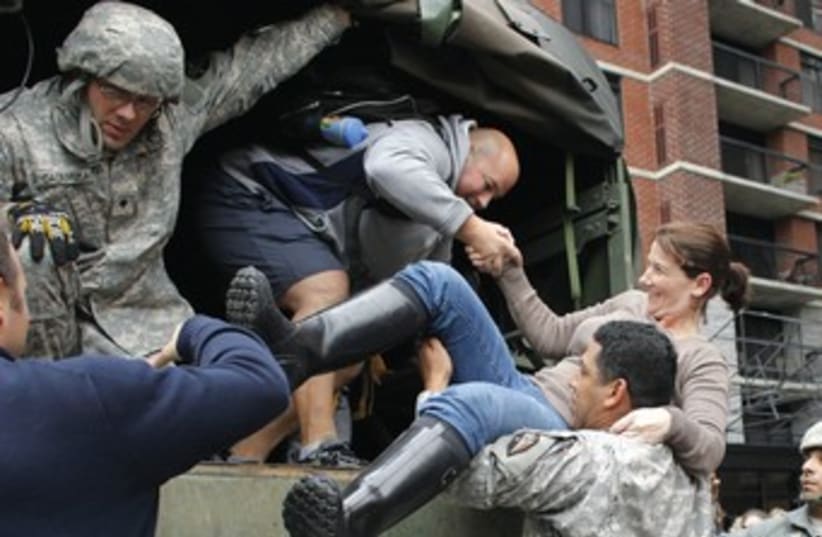
By HILARY LEILA KRIEGER, JPOST CORRESPONDENTUS soldiers help rescue New Jersey residents from storm 370(photo credit: Eduardo Munoz/Reuters)
WASHINGTON – Anticipating the home stretch of the US presidential campaign, pundits repeatedly bring up the threat of an “October surprise,” generally referring to a crisis that breaks in the last few weeks of the campaign to throw a wrench in the works.In the 2012 race, those pundits often speculated whether that October event would be an attack by Israel on Iran, a strike that would elicit a counterattack by Iran and force a response from the United States, possibly embroiling American troops in the region in further hostilities – and dramatically affecting Americans’ view of the world and their leaders.But Israel bowed out early on, with Prime Minister Binyamin Netanyahu announcing at the UN in September that Israel’s timeline for military action on Iran wasn’t this fall, as had at one point been hinted at, but next spring or early summer.Republicans also tried to turn the Benghazi terror attack, which killed four American diplomats including a US ambassador, into a similar table-turning development. But the incident took place in September, dissipating its impact, and didn’t compel enough attention from voters to override the sorry state of the US economy as the issue utmost in their minds.But what the Middle East failed to provide, Mother Nature compensated for.The October surprise ended up being a natural disaster which battered the northeastern United States and devastated lower Manhattan, including the site of the last catastrophe to strike at the heart of America’s largest city – Ground Zero, home to the Twin Towers terror attack.The hurricane, which poured down on the East Coast and the edges of the Midwest from Monday through Tuesday morning, disrupted campaigning near and far. Early voting and canvassing in the affected states were suspended, viewership of election ads dropped and both US President Barack Obama and his Republican challenger Mitt Romney cancelled events in key swing states.So far the political questions raised by such an incident – Was this caused by global warming? Has the government adequately prepared for disasters? – have, ironically, been muted.But that doesn’t mean there hasn’t been a significant political impact, as October surprises are supposed to have – even one that could potentially be felt at the voting booth next Tuesday.Romney had been on a smooth roll after getting a boost from the first debate, which helped him in polls across the country. Obama had been struggling to regain his lead, to slow the tide turning toward Romney so that it didn’t overwhelm him on Election Day, November 6.But this week, Romney couldn’t be seen as too critical of the executive branch at a time of emergency or too garishly campaigning as millions of Americans suffered.Romney eventually settled for holding rallies to raise donations for the victims of Sandy, but Obama was given a much more advantageous set of political (if not environmental) circumstances: He got hours of free TV showing him acting, well, presidential.There was the White House press conference where he offered reassurance and spoke of national unity, there were the repeated briefings with agencies and local politicians coping with the disaster, and there were the tours he took to inspect the damage first-hand.The storm has given Obama the opportunity to exercise the full advantage of being the incumbent, of rising above the day-to-day political tussle and just reminding voters that they know what they are getting, and what they are getting is someone who can lead at a time of national disruption.For Obama, it particularly plays to his strength.He does not excel in the traditional political arenas of shaking hands and kissing babies, of the routine political pavement pounding that is usually undertaken to earn votes. Instead, he does best when he is perceived as standing above the fray, as being an inspiring figure as opposed to a salt-of-the-earth politician.The week’s developments might not be decisive, and it’s always hard to assess exactly what makes the difference in the final analysis. But as with that first debate, Hurricane Sandy changed the orientation of the race – and this time with a lot less time remaining for a course correction.The concept of an October surprise lived up to its name. Instead of the anticipated categories of disruptive incidents – particularly a foreign intrusion – an unforeseeable event, officially categorized by insurance companies as an “act of God,” brought its force to bear on the campaign. Now it’s only a matter of waiting for Tuesday’s outcome.
if(catID != 151){
var cont = `Take Israel home with the new Jerusalem Post Store