The tragedy of the Carmel fire allowed Athens to prove that friendship is tested most in times of need.
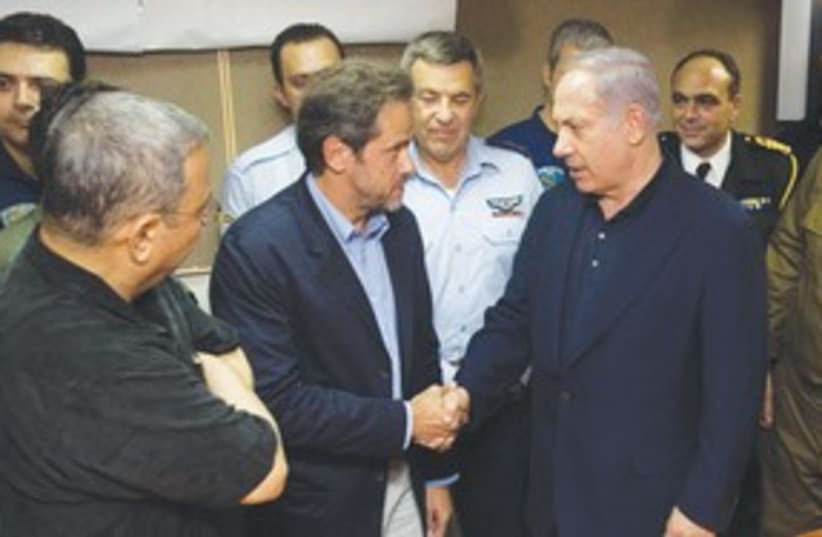
By JONATHAN BECKNetanyahu Greeks 311(photo credit: Associated Press)
Early Friday morning, fire-fighting planes and firefighters began pouring in from countries around the world, answering Prime Minister Binyamin Netanyahu’s call for help in fighting the largest forest fire it had ever known. Only hours before, the blaze claimed the lives of more than 40 people, most of them Prisons Service employees in a bus that got trapped in the flames.The first arrivals were toy-like yellow planes, sent from Greece. They flew low over the Mediterranean, scooping up seawater. Then they moved inland, pouring the water over the flames.Impressed by the speed of Athens’s response Netanyahu told reporters he “knew that the Greeks were our friends, but I didn’t realize what good friends they were.”He then phoned Prime Minister George Papandreou to thank him personally. These planes – later dwarfed by the Russian Ilyushin and the American Boeing Supertanker – were immensely useful because in the time it takes to fill up the belly of one of the massive ones, they can make several sorties.The tragedy allowed the Greeks to prove that friendship is tested most in times of need. And prove it they did.This friendship has been cultivated at high gear over the last year, prompted by Papandreou’s change of attitude compared to previous Greek governments. It also reflects a close personal friendship that started casually when the two prime ministers dined at a Moscow restaurant in February.Papandreou met Netanyahu when the financial crisis his country is still recovering from was at its media height. Greece was the bad boy of Europe. It needed to regain its prestige, and it needed to do it fast. And in the world of international politics, nothing does that better than putting one’s name on Israeli-Palestinian negotiations, advancing them, starting them, restarting or resetting them – get the Jews and the Arabs to talk peace and the world will applaud.Truth be told, Athens has a good starting point.Unlike Western EU members or the US , it has a lot of street-cred in the Arab world, cultivated over many years and consecutive pro-Palestinian, anti-Israeli governments.And while Arab countries tend to be careful and calculating when forming alliances with non- Muslim countries, Israel happily welcomes new or strengthened alliances, especially in the immediate neighborhood.The past year has seen an extraordinary flowering of ties, a love affair of sorts. The PASOK-led government of Papandreou is certainly friendlier than previous Greek administrations, but Israel also had a good reason to improve relations, namely the rapidly deteriorated ties with Turkey.The flotilla incident on May 31 worsened an already weakened relationship with Ankara, whose leadership, weary of obstacles the EU poses on its path to membership, seemed to deliberately downgrade ties with Israel and move eastward. Whether this was a calculated move meant to make the EU welcome it into the club for fear of “losing Ankara to the Arabs’” or a genuine ideological position of Recep Tayyip Erdogan’s government remains to be seen; regardless, the country was an ally of Israel for years and ties were strong in both defense in commerce not so long ago.It is reported that IAF jets flew through Turkish airspace en route to bomb a fledgling Syrian nuclear reactor three years ago, and the air force held regular training sorties in Turkish skies, often side by side with Turkish pilots. Ankara no longer allows such maneuvers.Israel relies on air power for its defense and lacks the necessary airspace for training. The invitation to use Greek skies was therefore enthusiastically welcomed.But both Greece and Israel have much more in mind than defense cooperation; Athens would love to see commercial ties develop on both a private and national scale, and looks admiringly at Israel’s achievements in satellite technology, agriculture and desalination (a hot issue on the agenda of a country also experiencing the woes of global warming).And while Israeli businessmen may be wary of investing in Greece, the country would welcome a flow of foreign capital – including shekels – into its tourism industry and in other fields.Papandreou visited in late July. Netanyahu visited Greece less than a month afterward. Since then the top tier of the Greek Foreign Ministry, including Minister Dimitris Droutsas, his deputy Dimitrios Dollis and the secretary-general Ioannis Zeppos, visited in October. Other visits included Tourism and Culture Minister Pavlos Geroulanos and the police chief Eleftherios Ekononou.Following Netanyahu’s visit, Maj.-Gen. (res.) Amos Gilad, head of the Political and Security Bureau at the Defense Ministry, visited Greece in early October, followed later that month by Minister Bennie Begin and in early November by Deputy Defense Minister Matan Vilna’i. Greek Minister of National Defense Evangelos Venizelos has an outstanding invitation from his counterpart Ehud Barak.RECENTLY THE Greek government initiated a series of meetings with high-ranking officials for a group of Israeli journalists to showcase the high gear bilateral ties have entered. In two separate discussions, Papandreou and Droutsas elucidated in what fields the new cooperation between Athens and Jerusalem can help both countries and the region.Papandreou admitted that Turkey’s behavior served as a catalyst for the rise in ties but emphasized that, for the benefit of the whole region, Greece would be pleased to see Israel’s relations with Ankara restored.“I think we have seen a potential which is there and which was not positively exploited in our relationship,” he said. “It does happen that this took place now, with your difficult relationship with Turkey. We need to create, and I think this is Israel’s point of view, a wider understanding in the region of cooperation...tensions, whether they be from one side or another, or a third country, are generally counterproductive. I would see it positively that Turkey and Israel get their relationship back on track.”Papandreou even tried, unsuccessfully, to bring Netanyahu and Erdogan together to hold a tripartite meeting. The three were meant to meet on the sidelines of a summit of the Mediterranean Initiative on Climate Change held in Athens on October 22, but Turkey canceled its participation.Both Papandreou and Droutsas said Greece’s policy toward Israel was perhaps influenced by Turkey but certainly not dependent on what eventually transpires between Jerusalem and Ankara. Droutsas assessed that Israel’s focus on ties with Turkey before relations deteriorated may have stood in the way of strengthening ties with Greece, a move, according to him, begun in 1999, the last time PASOK held the reins.“In the past, in the time span 1999 to 2004, we didn’t see these spectacular, if you like to call them that, results – why? Because at that time, Israel was much more focused on its relations with Turkey. I think this is a fact,” Droutsas said.“But I’m going to be very clear on that we do not pursue and we are not exercising this policy vis-à-vis Israel and the strengthening of relations because of Turkey. It is for us a strategic approach. It’s a strategic relationship we are developing with Israel, but this is not to be interpreted as a tool against Turkey. We don’t see ourselves as a replacement for Turkey, and I don’t think Israel sees Greece as a replacement for Turkey.”Momentarily ignoring the Turkish thorn in Greece’s own side – the occupation of northern Cyprus – Droutsas even went as far as hinting at a future tripartite cooperation.“Imagine: You have three very important countries of the region, cooperating closely together. At least in theory, this seems to be the right recipe for stability in the region,” he said.AND THEN, of course, Greece has its eyes on a place in the list of mediators between Israel and the Palestinians.Before Papandreou’s government came to power, Jerusalem had absorbed criticism from many Greek governments and was wary of the Greeks’ friendliness to its enemies. In parliament there is a room with memorabilia from previous prime ministers.The glass cabinet dedicated to Papandreou’s father Andrea shows the man photographed with Muslim leaders, a who’s who list of Israel’s enemies, including former PLO chairman Yasser Arafat and Libyan leader Muammar Gadaffi.Papandreou junior wants to leverage those historical ties for Israel’s – and Greece’s – benefit.“With our good relations [to the Arab world] we want to see how we can facilitate a strong move toward peace and cooperation... [During my recent visit to Israel,] I also went to Ramallah and talked to the leadership there. Anything you think we can do or, and I said this to the leaders of the region, anything we can help with, we’ll be glad to do so,” he said.He said Greece had an interest in seeing the peace process progress since “the Middle East problem started as an issue between the Palestinians and the Israelis, but it is also taking on a religious dimension now which is much more dangerous and, I would say, much more contagious also.”Papandreou mentioned his country’s history to explain why Greece may be more sensitive to Israel’s dilemmas. “We live in a region which has lived through splits and wars and ethnic strife, in the Balkans for example, in Cyprus.... so we know what conflict is. We know the difficulties, but we also know the positive side when we get beyond these problems. From our experience, we’re not coming into this from a sense of lack of understanding what conflicts mean.And we don’t come with a magical solution,” he said.Droutsas characterized Greece’s ties with the Arab world as “long-standing relations of mutual respect and confidence. This is something I do not deny; I don’t want to deny it, it is important and good.” He said he felt those ties were “Greece’s added value for this goal we are talking about, creating peace and stability in the region.”He rejected outright the notion that strengthening ties with Israel is a zero sum game vis-à-vis the Arabs.“In our approach, this kind of thinking – you are either with one or the other, if you look more to one side, you abandon the other side – is not the right one.“Strengthening relations for Israel, becoming, for Israel, an entrusted partner, a collocutor – this is for us the key word. Greece is a member of the EU, let us not forget this. The EU can play an important role for the whole region. Greece is the member state of the EU which is [geographically] closest to the region; we have more understanding of what is going on. This is why feel we are also better accepted by the actors in the region as a collocutor.”In late September, Syria became the 129th country to recognize the territory Greece refers to as the former Yugoslav republic of Macedonia by its official name, the Republic of Macedonia. Greece rejects the name, fearing it implies territorial pretensions toward its northern province of the same name. In his mid-October tour of the region, Droutsas also visited Jordan, Egypt and Lebanon; Syria was left off the itinerary.The foreign minister admitted that Greece’s improving ties with Israel affect its traditional Arab allies, as the diplomatic jab of Syria recognizing Macedonia demonstrates.“I would not be very credible if I said those who have problems with [our ties with Israel] accept it without saying anything. Of course we can see, we can hear that some [in the Arab world] are looking into what’s going on very carefully, they’re asking themselves where this can lead to.”But he rejected the notion that Greece may reevaluate relations if Arab countries make their ties conditional on severing ties with Israel.“We will put all our efforts into avoiding anybody placing any kind of ultimatum...but I think it would not be wise or serious for me to talk about such theoretical scenarios,” he said.Even more than Papandreou, Droutsas emphasized Greece’s potential to assist in the peace process, but was very careful to avoid making statements that could be perceived as patronizing or imposing.“We as Greece certainly know our – let me use this word – our limits. We want to contribute; we don’t want to impose. I’m a realist.If we wanted to impose something, I’m not sure whether we would be able to. We also don’t want to create the image that some other EU partners are creating, that the EU is coming now and is offering all its wisdom. I have made this very clear in all my talks during my recent visit to the region, to our Israeli friends, to our Arab friends, that this is not the role we are envisaging for Greece. We are not coming and saying, well, better you do this and do that.“I know Israel is very sensitive about that.In my talks I got the impression that Israel thinks it is not very wise to have too many cooks in the kitchen and I know that this goes especially for the EU. Again, our attitude is: The EU can help, it can be constructive, but I fully take the point, nobody should try to impose.“Why do I dare to think that I can sound convincing about this? Because Greece has its own problems with Turkey, we have the Cyprus issue. We know what Greece’s approach to Cyprus issue is. Let the Greek Cypriots and the Turkish Cypriots decide freely, without pressure, without artificial timetables, blah blah blah blah – let them decide freely about their future. This is what we strongly believe. Help is always necessary, it is valuable, but it should be help and assistance, it should not be imposing.This is why we think that we sound convincing when we say this, because we have our experiences with this, of others trying to be helpful by imposing things.”Droutsas said that during his visit here he was educated on the subtleties of the peace process and that his new understanding can be useful in getting the two sides back to the table.“I will say this openly: There is not much of an understanding in the international community and certainly within the EU about the position that Israel is expressing during this time. This is a fact. We understand much better the internal situation in Israel, regarding for instance the issue of the settlements. I understand out of these talks that this is an issue of high political sensitivity in Israel, so we have to take this into consideration.“We are in a position to convey those sensitivities also to our other collocutors in the EU and yes, also to the Arab world. If you see [the issue of the settlement freeze] just as an outsider, then the Palestinian position sounds logical. But when you look a little bit deeper, into the Israeli soul if you want, then it is a deeper problem.”He added that this did not mean Israel had a Greek carte blanche of support and that Athens would automatically back every Israeli decision.“If Israel or if the Palestinians can make convincingly the point, they will also get the support of the international community.So if Israel has a point vis-à-vis the Palestinians, Greece will not hesitate to say, ‘Yes, Israel is right.’ But if we see that the contrary is the truth, Greece will also not have a problem to tell its partner Israel, ‘Let us sit down and let us talk openly: There is a problem in the position you are taking.’” CAN GREECE then make progress where so many others failed? It offers Israel its love, but avoids what US officials somewhat euphemistically refer to as “tough love.”And it certainly has years of dealing with Arab leaders who are traditionally suspicious of the Americans, the Obama administration’s declarations of evenhandedness notwithstanding. Not a sure bet then, but it’s always nice to make new friends. As the Carmel fire underlined, you never know when – or why – you might most need them.Herb Keinon contributed to this report.
if(catID != 151){
var cont = `Take Israel home with the new Jerusalem Post Store