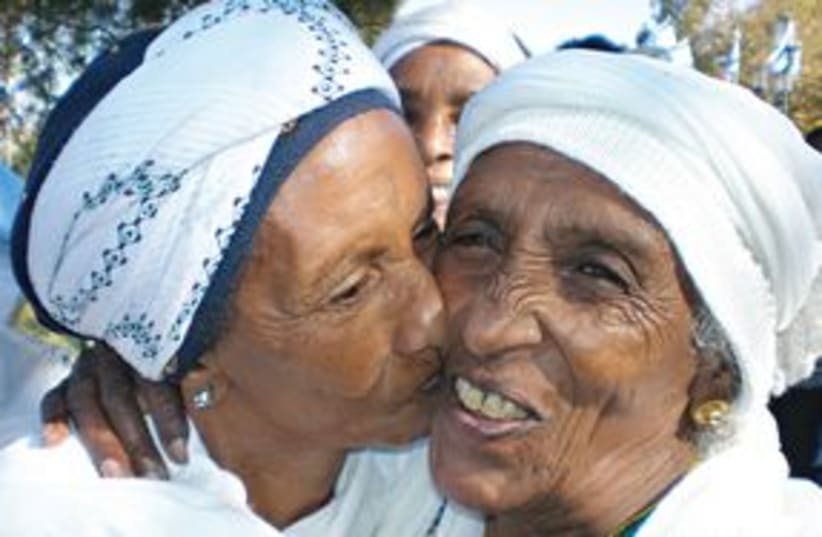
Eretz Yisrael has become an incredible melting pot. Within its tiny borders, Jews from every conceivable national origin have found a safe place of refuge where they can express the fullness of their particular flavor of Judaism. Perhaps the most dramatic example of this would be our Brothers and Sisters from Ethiopia.The Ethiopian Jews, known as the Beta Israel, have become one of the most visible, and sadly, misunderstood Jewish communities of all. They have an incredible story to tell, and a cuisine that is second to none.The Beta Israel can trace their origins back to antiquity. Their oldest oral traditions claim that their ancestors migrated from Israel to Egypt after the destruction of the First Temple in 586 B.C.E. After a few hundred years, the community migrated further south after Egypt was conquered by the Roman Empire. They eventually came to the land known as Ethiopia.Another tradition, described in the Kebra Negast (Book of the Glory of Kings), claims that the Ethiopians are the descendants of Israelite tribes who came to Ethiopia with Menelik I, the reputed son of King Solomon and the Queen of Sheba. Not only did Menelik I bring Judaism back to Ethiopia, but tradition holds that he also brought the Ark of the Covenant as well. Though the Bible in no way supports these claims, this tradition is very strongly adhered to by Ethiopian Jews, as well as Christians (there is a church in Ethiopia that claims to posses the Ark of the Covenant) and Rastafarians (who claim that their messiah, the Emperor Haile Selassie (reigned, 1930-1974) was a direct descendant of Menelik I).There is a third tradition which claims that the Beta Israel is the remnant of the Lost Tribe of Dan who fled the civil war in the Kingdom of Israel between Rehoboam and Jeroboam. This too has been a very popular tradition from the ninth century onward. Whatever the actual truth, it is clear that the Beta Israel have been identifying themselves as Jews for a very long time.The Beta Israel became a mighty nation. They were at one time kings who ruled over their own Jewish Kingdom, known as Gondar, on the Northern shores of Lake Tana in what is now Ethiopia. Their power and splendor rivaled that of their Christian and Muslim neighbors in the Ethiopian Empire. After many invasions by the forces of the Ethiopian Empire, the Jewish Kingdom was eventually conquered and their Autonomy ended in 1627 C.E.Life for the Beta Israel in the Ethiopian Empire was hard. The Jewish religion was forbidden, and many Jews were forcibly converted to Christianity or killed. Nonetheless, the community secretly continued its practices, though they had to be changed a bit. Eventually conditions improved and skilled Jewish craftsmen served the Emperor. However, their social status was extremely low. Persecutions continued right up to modern times, and coupled with extreme poverty and famine, the Jews of Ethiopia found themselves in dire conditions.Everything came to a head in the 1970’s and early 1980’s when there was open hostility toward the Jews by the Communist Derg government and a great famine raging in the land. The Jews wanted to emigrate to Israel, but were not allowed to leave. There were many covert waves of immigration to Israel, especially during Operation Moses (1984), Operation Joshua (1985), and Operation Solomon (1991). Today, the Beta Israel population of Israel numbers more than 120,000 souls. The Cuisine of this fascinating community differs very little from Ethiopian Cuisine as a whole. The flavors and spices are the same, but of course Kashrut governs how things are to be eaten. The Jewish community does not eat the many raw meat dishes that are well known in Ethiopia. It also traditionally has no stricture against combining milk and poultry. This is a result of its evolution outside of early Rabbinic Judaism. The combination of milk and meat is strictly forbidden.The Beta Israel strictly observes the Sabbath, and as a result they have their own version of the Great Sabbath Meal which is the hallmark of authentic Jewish Cuisine. The dish is called Doro Wat, and it is actually the national dish of Ethiopia. It is a spicy chicken stew flavored with chilies and exotic spices, simmered for many hours, and garnished with hard cooked eggs. This dish is a great alternative to the weekly Cholent, and a great way to familiarize oneself with our Ethiopian Brothers.Doro Wat (Ethiopian Chicken Stew)Serves 5• 1 whole chicken cut into 10 pieces ( 2 legs, 2 thighs, 2 wings, 2 breasts cut in half crosswise)
• 2 tablespoons lemon juice
• 1 teaspoon kosher salt
• 1 cup water
• ¼ cup olive oil
• 3 yellow onions, finely chopped
• 4 garlic cloves, finely chopped
• 1 tablespoon fresh ginger, grated
• ½ cup tomato paste
• 1 teaspoon to 1 tablespoon berbere spice blend to taste (recipe follows)
• ½ teaspoon turmeric
• ½ teaspoon ground fenugreek
• ½ teaspoon ground coriander
• ¼ teaspoon ground black pepper
• ½ teaspoon ground cardamom
• 5 whole large eggs
• 1 cup chicken stock or water
• Kosher salt to taste