US, UK, France, Germany ban air freight from Yemen
Al-Qaida in Yemen suspected of sending cargo bombs reportedly destined for two Chicago synagogues; two women arrested; UK: Plane may have been target.
By HILARY LEILA KRIEGER, APYemen Bomb 311(photo credit: Associated Press)
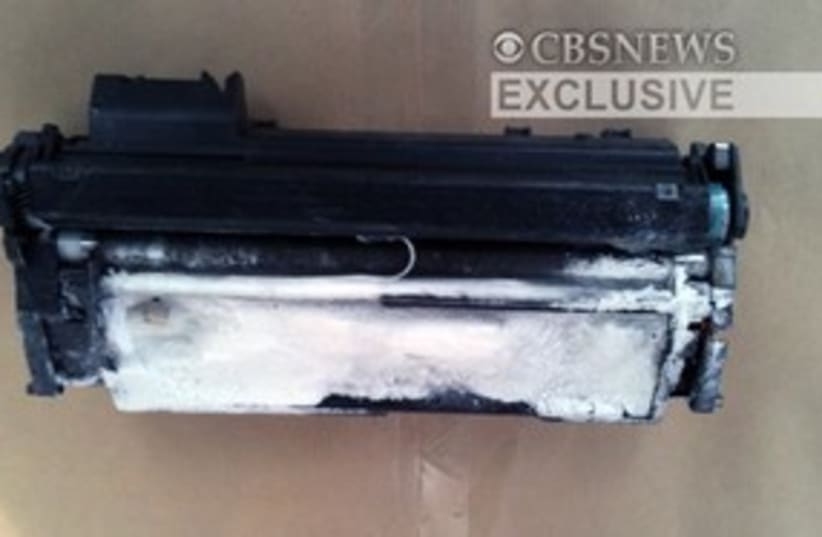
The US, UK, France and Germany have all banned unaccompanied air freight from Yemen at their respective countries' airports following the discovery of two packages filled with explosives- laden bombs, it was reported early on Sunday. The restrictions are said to also include the movement of people and cargo from Yemen.The packages were sent from Yemen and intercepted early Friday morning by authorities in Dubai and England.RELATED:Obama: 'Terrorist threat' on Jewish targets thwartedUS Jewish groups told to be on high alert after terror plotUS President Barack Obama on Friday afternoon described the incident targeting “Jewish places of worship” as “a credible terrorist threat against our country,” and raised the prospect that al-Qaida was behind the attempted terrorist attack without directly blaming the organization.“Although we are still pursuing all the facts, we do know that the packages originated in Yemen. We also know that al- Qaida in the Arabian Peninsula, a terrorist group based in Yemen, continues to plan attacks against our homeland, our citizens, and our friends and allies,” said Obama, who was due to travel to Chicago on Saturday night for a campaign rally.He declared that the US would “spare no effort in investigating the origins of these suspicious packages and their connection to any additional terrorist plotting.”The two packages were identified on cargo airplanes, with one found in Dubai and the other at the East Midlands Airport in North West Leicestershire, England, after US national security officials became concerned about a threat emanating from Yemen.Obama on Saturday called British Prime Minister David Cameron and Saudi Arabia’s King Abdullah to discuss the thwarted attacks, saying that the terrorist efforts “underscore the necessity of remaining vigilant against terrorism.” The president received a briefing from his national security adviser, John Brennan, before campaigning in three states ahead of Tuesday’s elections.“The forensic analysis is under way,” Brennan said.“Clearly from the initial observation, the initial analysis that was done, the materials that were found in the device that was uncovered [were] intended to do harm.”While Obama didn’t specifically accuse Yemen’s al-Qaida branch, Brennan called it the most active al-Qaida franchise and said anyone associated with the group was a subject of concern.That would include the radical US-born Muslim cleric Anwar al- Awlaki, who now is in hiding in Yemen. He has been linked in the attempted Christmas bombing plot to blow up an airliner over Detroit and has inspired other terrorists with his violent message. Also hiding in Yemen is Samir Khan, an American who declared himself a traitor and helps produce al-Qaida propaganda.Brennan acknowledged that “we don’t want to presume that we know the bounds of this plot” and that all possibilities were being investigated.He thanked Britain, the UAE and Saudi Arabia for helping disrupt the plot.Brennan noted that the federal government has been in touch with US local authorities to make sure local institutions have been secured.'Mother and daughter detained by Yemeni authorities'Yemeni authorities reportedly arrested a mother and daughter Saturday and searched for other suspects linked to al- Qaida’s Persian Gulf faction in the plot.Officials said the women were detained as part of a widening search for people believed to have used forged documents and ID cards in the plot thwarted Friday.The dragnet in Yemen and the results of a preliminary investigation into one of the bombs in Britain reflected the seriousness of a plot that investigators said bore all the hallmarks of al-Qaida.Yemeni officials said the suspects were believed linked to al-Qaida in the Arab Peninsula, the group’s affiliate in the Persian Gulf.Yemen’s president, Ali Abdullah Saleh, told reporters that the US and the United Arab Emirates had provided information that helped identify the woman as a suspect.Two security officials told The Associated Press the woman was arrested in the al-Rawdah district near the airport in San’a, Yemen’s capital.“According to our information, a woman has sent the packages through the agents [companies],” Saleh said in his briefing.One of the Yemeni officials, a member of the country’s anti-terrorism unit and close to the Yemeni team probing the case, said the other suspects had been tied to al-Qaida’s faction in Yemen.Several US officials said they increasingly are confident of the involvement of al-Qaida’s Yemen branch, the group behind the failed Detroit airliner bombing last Christmas. A Nigerian-born passenger tried to set off a bomb packed with PETN, an industrial explosive that was the same potent ingredient used in the mail bombs found Friday. But the suspect’s underwear detonator failed to operate properly.US officials said al-Qaida’s explosives expert in Yemen, Ibrahim Hassan al-Asiri, was the likely suspect behind the bombmaking.Asiri helped make the bomb used in the Christmas attack and another PETN device used in a failed suicide attack against the top Saudi counterterrorism official last year, officials said.FBI Special Agent Ross Rice in the bureau’s Chicago office told The Jerusalem Post that “Since two of the suspicious packages that were intercepted were addressed to religious institutions in Chicago, all churches, synagogues and mosques in the Chicago area should be vigilant for any unsolicited or unexpected packages, especially those originating from overseas locations.”Jewish institutions in the Chicago area heightened security after being informed of the situation.Michael Kotzin, executive vice president of the Jewish Federation of Metropolitan Chicago, said he was in touch with Jewish institutions throughout the city to make sure they were aware of the situation and were taking the necessary steps.“We’re taking the appropriate precautions,” he said. “It’s good that we know what to do and now we’re going to do it.”“These warnings and apparent threats against Jewish institutions come as no surprise,” said William Daroff, who heads the Washington office of the Jewish Federations of North America, pointing to the many times Jews and Jewish institutions have been targeted in the wake of 9/11.Daroff said the federal government is well aware of the threats and has provided substantial assistance to protect the Jewish community.Of the $99 million allocated by the Department of Homeland Security since 2005, “the vast majority, unfortunately due to the high threat level, has flowed into Jewish institutions to enhance their physical security,” he said.The plot sent tremors throughout the US, where after a frenzied day searching planes and parcel trucks for other explosives, officials temporarily banned all new cargo from Yemen.Yemeni authorities are checking dozens more packages in the search for the terrorists who sent the bombs.A Yemeni security official said investigators there were examining 24 other suspect packages in San’a.Authorities were questioning cargo workers at the airport as well as employees of the local shipping companies contracted to work with FedEx and UPS, the official said.A preliminary investigation in the UK found that the mail bomb found inside the cargo plane could have exploded, British Home Secretary Theresa May said on Saturday.May said the plane carrying the package from Yemen may have been the target, and if the bomb had detonated, the explosion could have brought down the aircraft.“But we do not believe that the perpetrators of the attack would have known the location of the device when they planned for it to explode,” May said.“At this stage we have no information to indicate another terrorist attack is imminent.”In Dubai, where one of the two bombs was found in a FedEx shipment from Yemen, police said it contained a powerful explosive and bore the hallmarks of al-Qaida.The white powder explosives were discovered in the ink cartridge of a computer printer, said a police statement carried by the official state news agency WAM.The device was rigged to an electric circuit, and a mobile phone chip was hidden inside the printer, the statement said.The police said the bomb was prepared in a “professional manner.”Yemen promised to investigate the plot.The US has FBI, military and intelligence officers stationed in the country to conduct an inquiry.There are only a handful of international shipping locations in the impoverished Arab nation, but US officials worried that record keeping would be sparse and investigators would have to rely more on intelligence sources to identify the would-be bombers.In San’a, there was no visible security presence on Saturday at the UPS and FedEx offices, which are located on the same street.An employee at the UPS office said they had been instructed not to receive any packages for delivery for the time being.No explosives were found on an Emirates Airlines passenger jet that was escorted down the coast to New York by US fighter jets on Friday.The Homeland Security Department said it was stepping up airline security, but White House spokesman Robert Gibbs said Americans did not need to change their travel plans.After a day of searches in Philadelphia, Newark and New York City, no explosives were found inside the United States, though the investigation was continuing on at least one suspicious package late Friday night.Intelligence officials were onto the plot for days, officials said.The packages in England and Dubai were discovered after Saudi Arabian intelligence picked up information related to Yemen and passed it on to the US, two officials said.Most of the officials spoke on condition of anonymity, citing the ongoing investigation.US intelligence officials warned last month that terrorists hoped to mail chemical and biological materials as part of an attack on the United States and other Western countries.JPost.com staff contributed to this report.
if(catID != 151){
var cont = `Take Israel home with the new Jerusalem Post Store