Ahead of Baghdad talks, IAEA chief flies to Tehran
Israeli officials continue warning world not to be taken in by Iranian ploy to buy time; P5+1 talks to take place on May 23.
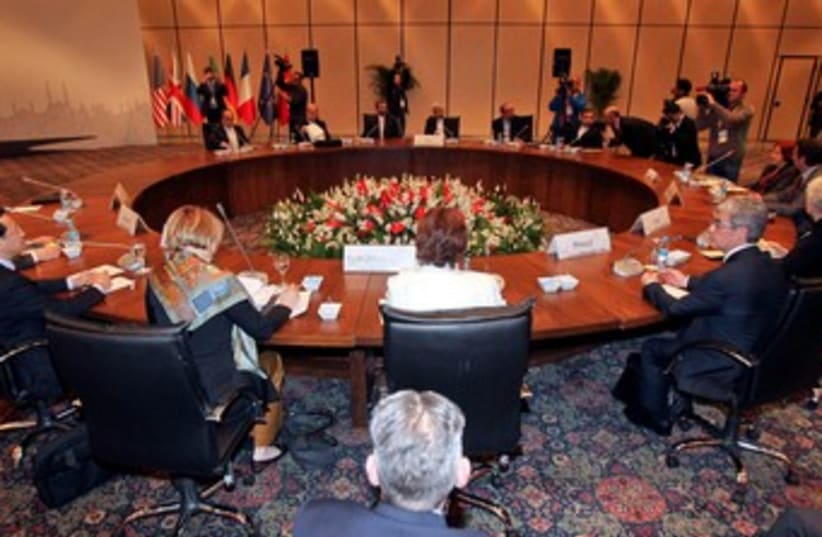
By REUTERS, HERB KEINONIran nuclear talks in Istanbul 370 (R)(photo credit: REUTERS/Tolga Adanali/Pool)
The UN nuclear supervisor flew to Tehran on Sunday looking for a deal to inspect suspected weapons sites – a potential breakthrough that Iran may hope could persuade the West to start lifting sanctions.But though International Atomic Energy Agency (IAEA) chief Yukiya Amano scheduled Monday’s talks with Iran on such short notice that diplomats said agreement on new inspections may be near, few see Tehran convincing Western governments to ease back swiftly on punitive measures when its negotiators meet big power officials in Baghdad on Wednesday.Senior officials in Jerusalem, meanwhile, cautioned the permanent members of the UN Security Council and Germany (P5+1) due to meet with the Iranian negotiators, against falling into an Iranian trap to buy time.While Israel was waiting for the outcome of the talks, Foreign Minister Avigdor Liberman said Sunday, “we don’t see any willingness from the Iranians to give up their nuclear ambitions.”Liberman, speaking at a press conference in Jerusalem with visiting US Secretary for Homeland Security Janet Napolitano, said that for the Iranians, the talks were a means of deception and a ploy to buy time.“I don’t think that there are any illusions in the international community regarding the Iranian program and their willingness to give up on their military nuclear program,” he said.Nevertheless, Liberman added, Israel would follow the talks carefully and then establish a position.Strategic Affairs Minister Moshe Ya’alon said that if the Iranian government were faced with the dilemma of its own survival or the nuclear program, it would opt for its own survival.“But it is not yet faced with that dilemma,” he declared.Ya’alon said the Iranians were still looking for room to maneuver, and that the international community must be aware of Tehran’s willingness to “sacrifice a pawn to save the king.”Vice Premier Silvan Shalom also expressed skepticism, saying amid optimism in the West that the Iranians were beginning to move, that “it is hard for me to believe that Iran has made a 180º turn in its position.”Shalom said he was a big believer in sanctions, which he said had worked both in South Africa and Libya. “I think it is still too early to celebrate, and there is a need to continue with the sanctions, which have the potential to defeat the Iranian regime.”Amano is scheduled to meet Iran’s chief nuclear negotiator, Saeed Jalili, on Monday, two days before Jalili sits across a table in the Iraqi capital from Catherine Ashton, the senior EU official heading the P5+1 delegation.By promising cooperation with UN inspectors, diplomats say Iran might aim for leverage ahead of the broader negotiations. Western sanctions on Iran’s energy exports, and threats by Israel and Washington of possible military action, have pushed up world oil prices.The IAEA said only that Amano and Jalili would discuss “issues of mutual interest.”Western diplomats say Amano would only make a rare visit to Tehran if he believed a framework deal to give his inspectors freer hands in their investigation was within reach.“We regard the visit by the agency’s director-general as a gesture of goodwill,” the Iranian student news agency quoted Iranian foreign minister Ali Akbar Salehi as saying on Saturday.He hoped for agreement on a “new modality” to work with the UN agency that would “help clear up the ambiguities.”The nuclear watchdog wants access to sites, officials and documents to shed light on activities in Iran that could be used to develop the capability to make nuclear weapons, especially the Parchin military complex southeast of Tehran.Two meetings between Iran and senior Amano aides in Tehran in January and February failed to make any notable progress. But both sides were more upbeat after a new round of talks in Vienna last week, raising hopes they were making headway.Yet while an Iranian agreement on a so-called “structured approach” outlining the ground rules on how to address the IAEA’s questions would be welcome, it remains to be seen how and when it will be implemented in practice, Western officials say.“We’ll see if the Iranians agree to let the agency visit Parchin. I have my doubts, no matter what any agreement says on paper,” said one Western envoy ahead of Amano’s visit to Iran and the meeting with world powers.Such a deal would also not be enough in itself to allay international concerns.The world powers want Iran to curb uranium enrichment, which can have both civilian and military purposes.“We are not going to do anything concrete in exchange for nice words,” another diplomat said of the Baghdad meeting, the arrangement of which stemmed from a P5+1 meeting with Iran in Istanbul last month that ended over a year of not talking.“Presumably we will get a flavor of what the Iranians are prepared to do,” the diplomat said. “It sounds like they are interested in making progress.”Another Western diplomat said: “Cooperation with the IAEA is important, but it takes some time to yield results. What we need now, with the situation in the region, are urgently concrete steps. So our talks will focus on something that can be implemented very quickly.”In Baghdad, the powers’ main goal is to get Iran to stop the higher-grade uranium enrichment it started two years ago and has since expanded, shortening the time needed for any weapons bid.Iran says it needs the uranium enriched to a fissile concentration of 20 percent for its medical research reactor.An adviser to Iran’s Supreme Leader Ayatollah Ali Khamenei said there were hopes the Baghdad meeting would be successful.But Iran will not “tolerate any pressure, and it decides about its destiny in the nuclear issue with full authority,” Mehr News Agency quoted Ali Akbar Velayati as saying.The IAEA wants Iran to address issues raised by an agency report last year that revealed intelligence pointing to past and possibly ongoing activity to help develop atomic arms.Iran says the intelligence is fabricated, and has so far resisted requests for inspectors to visit Parchin.Western diplomats say they suspect Iran is cleaning the site to remove incriminating evidence, a charge Tehran dismisses.“I hope Amano asks for his people to see Parchin,” one Western diplomat said.“But it seems a wild guess to me.”Diplomats say the six powers will probably aim to extract an offer from Tehran to implement some limited curbs and begin a long-term process of gradual concessions from all sides.Their hope is that economic sanctions that Western nations have imposed in the last year, targeting Iran’s vital oil revenues and ability to trade with international partners, will be enough to force Iran to take that first step, one diplomat said.Immediate confidence-building measures that Iran could offer are “not all that complicated,” said former senior US State Department official James Dobbins, now with the Rand Corporation’s International Security and Defense Policy Center.“It is essentially, ‘Stop enriching to 20%, ship out what you’ve already done...and then let’s last start talking about more comprehensive measures,’” he said.
Click here for full Jpost coverage of the Iranian threatBut European diplomats say any corresponding changes to their further oil embargo plans are out of the question for now.“The EU oil sanctions are a very big card and a very big step,” one said. “Just because they have been applied last doesn’t mean they will be the first to be taken off.”
if(catID != 151){
var cont = `Take Israel home with the new Jerusalem Post Store