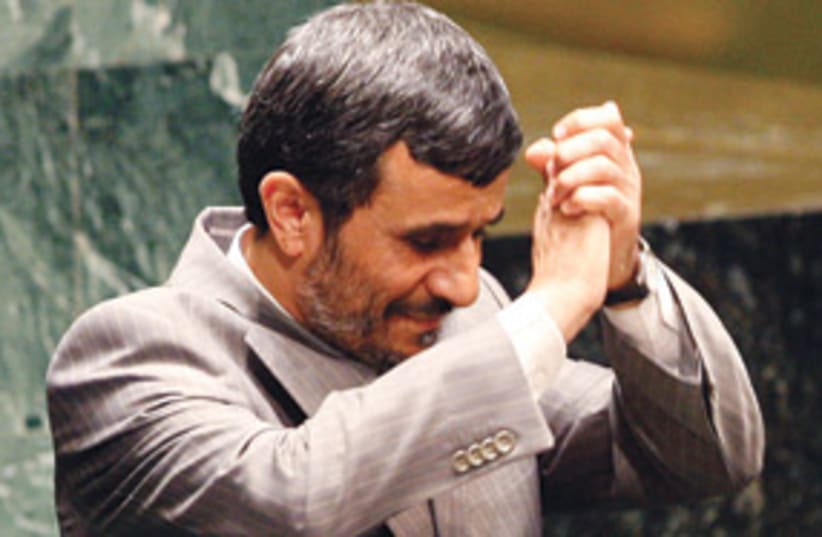
Unbridgeable gap emerges between Ahmadinejad, clergy and business sector.
By MEHDI KHALAJIahmadinejad hand clap 311(photo credit: AP)
During an August 9 visit to Syria, Ali Akbar Velayati, influential adviser to Iranian Supreme Leader Ali Khamenei, stated that Iran was ready to negotiate with the United States regarding its nuclear program. Last Wednesday, however, Foreign Ministry spokesman Ramin Mehmanparast announced that Iran had no plans for bilateral negotiation with Washington. These and other conflicting signals point to deep internal divisions among former allies in Iran’s hardline camp. Such divisions are part of a longstanding pattern in the Islamic Republic: As soon as one faction seizes power by cutting out its opponents, it splits into warring parties.Ahmadinejad’s disputes with old conservatives Having surprised observers last year with the Green Movement protests, Iran will likely surprise them again soon with a bitter dispute among the hardliners, who have already divided into two main factions: old conservatives and new conservatives.Until recently, the groups remained united because they saw the reform movement as a serious threat to the regime.Yet Khamenei now believes that the regime’s oppressive machinery has successfully managed the postelection crisis.As a result, the unbridgeable gap between President Mahmoud Ahmadinejad’s circle and traditional power centers such as the clergy and bazaar has become apparent.Several recent episodes have highlighted this fissure:Hardliner clerics At the recent Grand Conference of Iranians Living Abroad, presidential chief of staff Esfandiar Rahim Mashai emphasized how much the government wanted to work with Iranian emigrants, depicting them as part of the “Iranian school” that can help defeat the West’s plans.In response, Ayatollah Muhammad Taqi Mesbah- Yazdi, Ahmadinejad’s former main booster among the clergy, stated, “We did not sign a brotherhood contract with [just] anyone. If somebody deviates from the right path, first we advise him, and then we beat him with a stick.”Such criticism reflects how Ahmadinejad has already destroyed his last bridge to the clerical establishment.Mesbah Yazdi also argued that the next political crisis in Iran may emerge from people who currently seem loyal to the regime – implicitly fingering the president’s circle as the Islamic Republic’s next potential threat.The bazaar Prominent businessman Habibollah Askar-Oladi criticized Mashai’s comments as well, stating, “America may want to pay these people [like Mashai], and if they are not already paid [then] they are [America’s] unpaid servant.”In addition, the bazaars in Teheran and several other large cities were recently closed for several days in protest of Ahmadinejad’s steep tax increases on merchants.The judiciary and parliament Ahmadinejad has publicly bashed the judiciary for its treatment of journalists who support him. This week, judiciary chief Sadeq Larijani fired back: “We expect the president to use a well-founded and polished rhetoric and established expressions and also be correct and fair.”Majlis members have been similarly outspoken about both Ahmadinejad’s policies and his language. As one legislator put it, “using slum-dweller vocabulary and being alien to the diplomatic rhetoric damages the country.”Elsewhere, Ayatollah Ahmad Jannati, a significant conservative figure and secretary of the powerful Guardian Council, has criticized Ahmadinejad for purging government staff and excluding former conservative members.Ahmadinejad’s strategy: Create his own political identityThe embattled president has long attempted to draw a distinctive line between himself and the old conservatives who helped Khamenei come to power 21 years ago. To do so, he needed a new constituency drawn from social strata that have been neglected or excluded by the classic conservatives.This need forced him to chose nationalism as his main political discourse and marry it with apocalypticism.The apocalyptic side of this coin was intended to attract radicals in the Revolutionary Guard and other military, political and economic organizations – mostly religious-minded individuals connected to government either directly or indirectly.The nationalistic discourse was meant to conquer the hearts of the young generation and of secular elements holding valuable capital such as wealth, Western business or political connections, or intellectual credentials.These mostly left-wing elements are not necessarily fond of the Islamic Republic, but they take pride in Iran’s defiant nuclear policy as well as its anti-Israeli and anti-American stances.Both apocalypticism and nationalism have an anticlerical tendency, manifested in Ahmadinejad’s decision to ignore Shi’ite jurists’ advice on many issues. Examples include appointing women as cabinet ministers and gathering Iranian emigrants at an expensive conference where female participants did not show respect for the Islamic dress code.Most of the president’s critics in the government believe that if he showed faithfulness to Khamenei and ran the country according to the supreme leader’s advice, most of the current problems would vanish. But Ahmadinejad wants to assert himself and forge his own distinct rhetoric, identity and constituency.He therefore welcomes a battle with old conservatives who also benefit from Khamenei’s support and have a long history of consolidating his power.As for why Ahmadinejad feels the need for such independence, one must keep in mind how he came to power in the first place: by attracting the lower classes and promising them economic prosperity and punishment of government corruption.Yet more than five years later, and despite the highest oil prices in history, Iran’s economic situation has only worsened. The president hopes to save his political future with a mixture of apocalypticism and nationalism, along with demagogic economic policies and vulgar political rhetoric.Whatever its strategy, Ahmadinejad’s faction will face colossal difficulties during next year’s parliamentary elections.As in the past, he will likely court ordinary Iranians who have been left behind by classic conservatives over the past 30 years. He may also attempt to convince government radicals that he, not Khamenei, would be their last refuge in the event of political turbulence.His policy of giving the Revolutionary Guard as many economic advantages as possible should be read in this light.Stalemate and chaotic behavior The two warring factions are currently in a stalemate: the old conservatives control two branches of government (the judiciary as well as the Majlis and its associated Guardian Council), while the more powerful executive branch is in the hands of new conservatives led by Ahmadinejad. Neither faction seems capable of eliminating the other from the political scene, but each can impede the other’s initiatives – such as sabotaging each other’s efforts to reach the international community and resolve the nuclear crisis.Accordingly, both factions will likely continue to emphasize their ideological and political differences – a seemingly strange strategy considering that both want to preserve the Islamic Republic’s basic power arrangements, which, as shown by last year’s protests, most Iranians reject. Yet intense factional infighting has characterized the republic since its infancy, and the current confrontation is no exception.With Ahmadinejad and his rivals disagreeing on where national interests lie, the near term promises more chaotic foreign and domestic policymaking from Teheran.Mehdi Khalaji is a senior fellow at The Washington Institute, focusing on the politics of Iran and Shi’ite groups in the Middle East.
if(catID != 151){
var cont = `Take Israel home with the new Jerusalem Post Store