After ruinous tornado, rabbis head to Joplin to help
"One of the greatest things we can do is reach out to small Jewish communities in Joplin and across the country." - Rabbi Brian Stoller
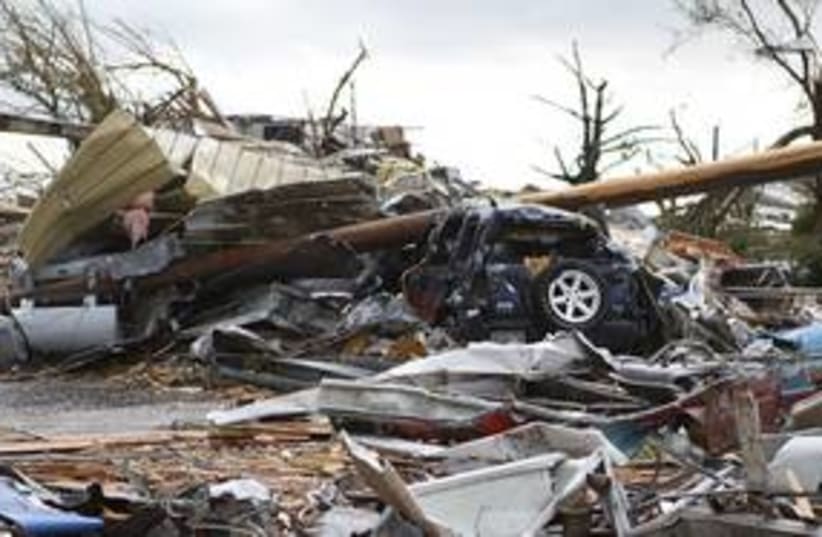
By JTAMissouri Joplin tornado_311(photo credit: REUTERS)
NEW YORK – When a tornado devastated the small city of Joplin, Mo., in late May, the city’s lone synagogue was left untouched, at least physically.But then came the flood. Not as water, but in the form of phone calls from across the United States from rabbis asking how they could help.RELATED:Jewish organizations help search for missing JewsUS tornado death toll up to 123, many still missingWhile the United Hebrew Congregation has a part-time student rabbi who visits the community every other weekend, Ariel Boxman, who attends the Hebrew Union College-Jewish Institute of Religion in Cincinnati, the Reform shul has no full-time spiritual leader. So Boxman, who was going to be away for the summer, came up with an idea: Each of the rabbis seeking to help could come to the community for a Shabbat.“A rabbi was scheduled to visit the community almost every weekend,” she told JTA. “People needed some sort of stability in the face of the destruction that surrounded them. Shabbat is something people are used to, it’s familiar. People come together and relax, and" with so many visiting rabbis, “the congregation didn’t have to worry about lay leaders.”
The rabbis are leading Shabbat services, helping out at aid distribution centers and counseling congregants. They’re also working with local volunteer organizations like AmeriCorps to help the residents of Joplin get back on their feet. All the rabbis, who have come from as far away as Florida and Pennsylvania, are past student rabbis in Joplin, and they have received warm welcomes from their former congregation.The visiting rabbi program faced certain challenges. There were scheduling complications, and volunteer rabbis must pay their own way or raise funds for the trip from their home synagogues.Rabbi Brian Stoller, who came to Joplin from Chicago for a weekend in late June along with nine of his congregants, said it’s well worth the effort.“Going forward beyond relief efforts, one of the greatest things we and other congregations can do is reach out to small Jewish communities in Joplin and across the country,” Stoller said, “and build a relationship that helps bring those communities into the fold.”Stoller said he realized how significant their visit was when they held a morning minyan in Tornado Alley along with a local Jewish man named Paul Teverow who had lost his home in the twister. Tornado Alley was the name given to a path of land the tornado had razed.“After having been in the city and driven around, we thought it would be appropriate and very spiritually moving to pray in the heart of it,” said Stoller, who served as Joplin’s student rabbi from 2005 to 2008.The group stood in an open area in the middle of Joplin praying among mounds of trash. After the service, Teverow walked the minyan over to his house, and the group helped Teverow’s wife sift through the debris for family heirlooms and valuable possessions.“The outpouring of help has been incredible and moving,” said Teverow, who survived the twister by taking shelter in an interior closet, only to emerge to find that his home’s exterior walls had collapsed.In addition to help from the rabbis, the Union for Reform Judaism provided summer camp scholarships for three Jewish kids from the community and established a relief fund that distributed $45,000 to Joplin. Of that sum, $15,000 went to the shul, $15,000 went to a food bank called Ozarks Food Harvest, $10,000 went to the Boys & Girls Club of Southwest Missouri, and $5,000 went to the Spirit of Christ Metropolitan Community Church, a gay-friendly church of about 30 members.While thankful for the outside help, Teverow said Joplin residents’ own kindnesses toward each other were what most impressed him. Shortly after the tornado passed, he said his wife saw a woman on Main Street who had been able to salvage only the clothes on her back and a couple of other items from her home give a pair of sneakers to a barefoot girl stepping through the broken glass and rubble.“It was an especially striking but, as I saw over the next few days, pretty typical example of what Joplin residents were prepared to do for their neighbors,” Teverow said. “I was astounded by the generosity and resilience I saw in the aftermath of the tornado.”One congregant who had been in her apartment when the tornado struck saw the building collapse around her; eventually she was able to extract herself from the rubble. A couple of days later she returned to the destroyed building looking for her two cats. The woman heard faint meowing from underneath the rubble. She found both cats injured but alive.The woman “just broke down crying in my arms,” recalled Boxman, the student rabbi. “Now that she had found these living things, nothing else mattered.”Though the synagogue building was untouched by the tornado and none of Joplin’s Jews were among the estimated 159 people killed in the May 22 tornado, many of Joplin’s Jews were left with destroyed businesses or homes.That’s where the distribution centers came in. Donations poured into Joplin from around the world, and while the centers had more than enough supplies, they desperately needed volunteers to sort through the items.Stoller, who volunteered at a distribution center run out of a church, said residents’ needs ranged from the basic to the hard to find. One couple that had been sleeping on the floor for several nights got a mattress from the distribution center; a young mother found shoes for her son. The distribution center workers were even able to locate a walker for a boy who otherwise wouldn't have been able to get around.The volunteer rabbis said helping Joplin is about more than physical aid; it’s about connecting Joplin’s tiny congregation of about 50 to the larger Jewish community. Joplin’s community is relatively isolated, most congregants are over 50 and there are only four children enrolled in Hebrew school. There are concerns about finding jobs and housing for synagogue congregants, as well as worry that the tornado’s economic impact will prevent more Jews from moving there.“The assistance we have received so far tells us that we’re not so isolated a Jewish community as we had imagined,” Teverow said. “We are indeed part of a wider community of Israel that can provide some of the advice and resources we need to meet these challenges.”
if(catID != 151){
var cont = `Take Israel home with the new Jerusalem Post Store