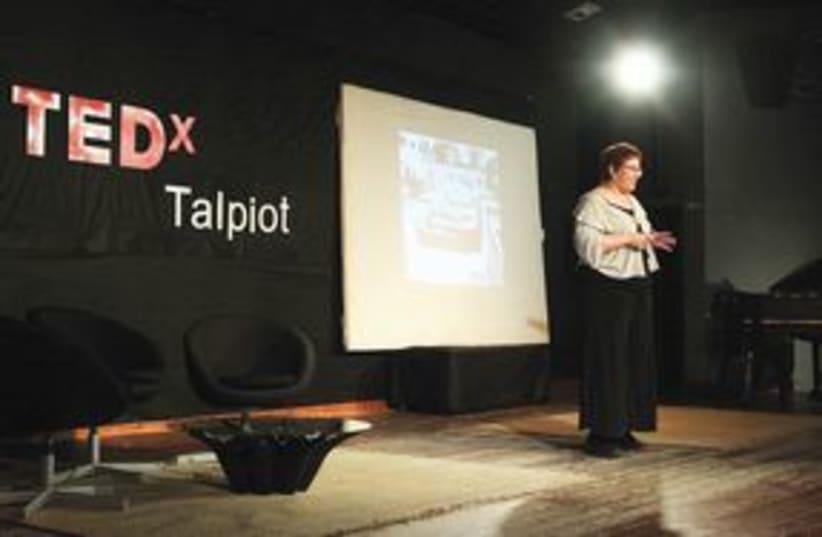
Apolitical conference in J'lem? Initiative to increase activity of international phenomenon TEDx, launched here recently, gathering steam.
By BARRY DAVISTED lecture(photo credit: Courtesy)
Storytelling has long been a Jewish trait and while, as a nation, we don’t do particularly well in the world’s sports arenas, we could possibly talk the pants off the hind legs of any animal.Yoni Litt may have reasoned that, if you’re going to share your insights with the people around you, you may as well do it to a high standard and at a respectable forum. TED would certainly answer to the description of the latter.TED – an acronym for “Technology Entertainment and Design” – began about 25 years ago in California with 400 people in attendance, according to the London-born Jerusalemite Litt. Since then, he says, it’s grown into an annual hub of 1,500, with tickets selling for $6,000 apiece by invitation only.“They were bought by a not-for-profit organization in 2000, and since then one of their missions has been to open up their content,” Litt adds. “They release talks on their website, which is the way most people I know have gotten to know TED – me included – then, about 18 months ago, they opened a program called TEDx.”TEDx is basically a format for farming out the TED brand name and staging TED-like events all over the world. Litt decided that our fair city should join the list of global conference locations and, earlier this month, he staged the first session of the Jerusalem version, called TEDx Talpiot.“TEDx conferences are organized on a local basis with a license from TED, with their guidelines,” Litt says.Sounds like a great idea. After all, TED has become a trademark for prestigious informational events with an ever-growing star-studded roster which, to date, has featured the likes of celebrated author and satirist Douglas Adams, Duke University Israeli-born professor of psychology and behavioral economics Dan Ariely, award-winning nature photographer James Balog, Irish illusionist Keith Barry, World Wide Web inventor Tim Berners- Lee, U2 rock group front-man Bono and Avatar director James Cameron, to name but a few.One of the principal benefits of holding TEDx conferences around the world is self-evident. Local events can tackle topics that are relevant to the locale.“People can take this anywhere they want, and apply this idea in their local setting which, of course, also means addressing local issues,” adds Litt, noting, however, that the latter is not necessarily the be all and end all.“It’s more about getting local people to be part of this, the local stars. It does not have to be a matter of addressing local issues. One of the main guidelines is no politics, no religious agenda and no selling from the stage of commercial goods. That takes things to a different place.”In this country, as we all know, it is difficult to avoid getting dragged into a contentious political vortex, regardless of intent.“We are looking for what connects people, the highest common denominator,” Litt says. “Politics, religion and other similar areas are usually places where people feel apart from each other. The idea here is to spark discussion and to talk about things that have meaning, also beyond the local setting, which also have some sort of universal meaning.”When he told people about the apolitical agenda of the TEDx conference in Jerusalem, Litt did not always get an encouraging response. “People told me ‘good luck’ and said that everything here was politics. But I found there is a place where you can put it aside and people can really meet.”Then again, looking for topics that bring people together does not always mean skirting around potential minefields. “The easiest thing is sometimes to say, look, we’re not going to touch difficult stuff. It is a challenge, to know how to get into difficult issues.”TEDx Talpiot got off to a flying start at the Hebrew University’s Mount Scopus campus on November 11 with an impressive speaker lineup. The English-language lecturers included Oren Harman, who holds the graduate program chair in science, technology and society at Bar- Ilan University and spoke on “The Evolution of Altruism;” Alyn Hospital director Maurit Beeri on “Why Fixing Babies Requires More than Good Medicine”; Avshalom Elitzur of Iyar, The Israeli Institute for Advanced Research in Natural Sciences with a talk on quantum physics called “Too Beautiful Not to Be True”; and Zvia Agur, founder and president of the Institute for Medical Biomathematics, who spoke about “Developing Virtual Patients that Can Guide Medicine.”The Hebrew section of the program featured inventor Etty Katz, founder of the Ananim learning institute, who spoke on how creating personal symbols can reveal unknown paths for learning, and leading experimental filmmaker Yosef Dadoune, who presented a talk entitled “Vision of Film. Architecture. Desert.” Musical entertainment was provided by classical pianist Diana Livshitz.Litt and his small team invested much time and energy into putting TEDx Talpiot together after obtaining the requisite license from the California-based organization.Their endeavor was helped by a string of cosponsors, including ROI Community for Young Jewish Innovators, Hillel Center for Jewish Life Hebrew University, Tzeirim Bamerkaz and Leadel.net.ROI director Justin Korda says he was happy to jump on the TEDx bandwagon. “TED is an organization we have been looking at in the last couple of years,” he says.“It does similar things to us, and we learn from them. It is a matter of gathering influential people together and making the most of the time available.”Korda is also enthusiastic about holding future TEDx conferences in Jerusalem.“Jerusalem is a very strategically valuable place for this kind of gathering,” he says, even taking into consideration the complex nature of life here. “Challenges and opportunities are two sides of the same coin. Challenges are opportunities to bring together stakeholders in a positive atmosphere, and to share ideas across sectors and between different people.”The TEDx concept seems to be gathering momentum here. A TEDx Tel Aviv conference was held in Jaffa in April and, a couple of weeks before the TEDx Talpiot conference, a similar event, called TEDx Holyland, took place at the American Colony Hotel in east Jerusalem, which featured Israeli and Palestinian women and focused on the empowerment of women.“The fact that you had Israelis and Palestinians talking on the same stage and sitting in the same room, and were all listened to by each other – that has got to be a good starting point,” says Litt.For now, Litt is looking to get the content from TEDx Talpiot on the Web and is hoping to hold another conference in Jerusalem next year.“Ideally, I’d like to see about 25 TEDx events a year happening all over Israel. It’s going to be a lot of work but it will be worth it.”
if(catID != 151){
var cont = `Take Israel home with the new Jerusalem Post Store