Some of the protests are organized by Hamas, who had thus far refrained from criticizing Morsi's new Egyptian government.
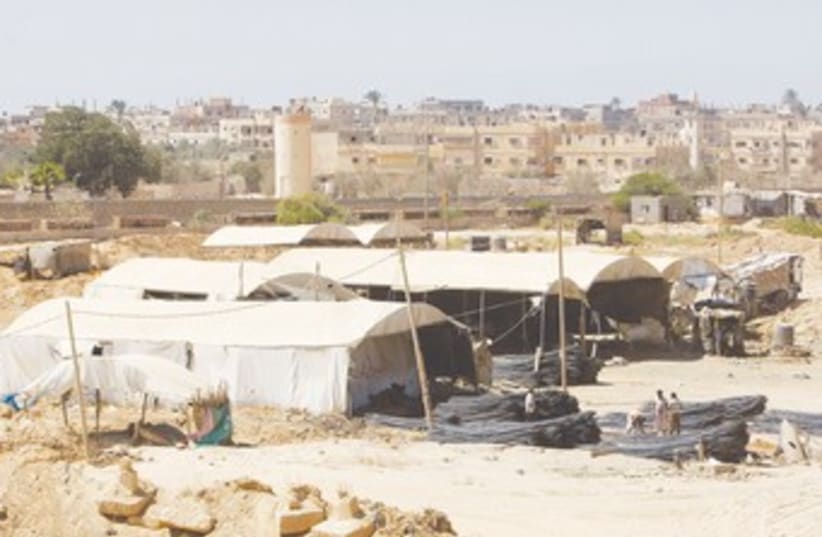
By KHALED ABU TOAMEHGazans collect metal smuggled through tunnels 370 (R)(photo credit: Ibraheem Abu Mustafa/Reuters)
For the first time since the election of President Mohamed Morsi, Palestinians in the Gaza Strip have staged demonstrations against the demolition of tunnels along the border with Egypt.Some of the protests were organized by Hamas, whose leaders had thus far refrained from criticizing Morsi and the new Egyptian government.The protests are seen as the first sign of tensions between Hamas and the Egyptians since the ouster of president Hosni Mubarak in February 2011.In recent weeks, Egyptian security forces have destroyed dozens of tunnels that Hamas and many Palestinians used to smuggle goods and people across the border.The move came after unidentified terrorists killed 16 Egyptian border guards in their military base in Sinai during Ramadan.“Oh, people and president of Egypt, until when will you continue to impose a blockade on the Gaza Strip,” read a placard carried by one of the protesters during a demonstration near the border with Egypt.Another placard read: “We call on the Egyptian leadership not to close the tunnels without finding an alternative.”Yusef Farhat, a senior Hamas representative in Rafah who participated in the protest, said Palestinians were very disappointed with Morsi’s failure to end the blockade.“The Gaza Strip was hoping that the Egyptian revolution would break the blockade,” Farhat said. “We were hoping that the revolution would end the suffering of the people in the Gaza Strip, which began under the former [Mubarak] regime.”He said the closure of the tunnels has created severe shortages in fuel and basic goods in the Gaza Strip.The health sector has also been suffering from shortage in medicine and medical equipment as a result of the new measures taken by Egypt.Farhat warned of a “popular explosion” in the Gaza Strip and said the Egyptian authorities would have to bear the consequences.The ongoing blockade, Farhat said, would also hamper efforts to rebuild houses that were destroyed or damaged during the IDF’s Operation Cast Lead in 2008-2009.Qatar recently pledged more than $200 million in aid to help reconstruct the houses and develop the Gaza Strip.Farhat said the Hamas government was prepared to close down the tunnels when and if there is an alternative to ease the suffering of Gazans.Hamas officials have been trying to persuade the Egyptians to agree to the establishment of a free trade zone along their shared border, but to no avail.The PA in the West Bank has expressed strong opposition to the idea, out of fear that it would turn the Gaza Strip into an independent entity and would strengthen Hamas.Sheikh Ahmed Masmah, a Hamas operative in Rafah who participated in another protest against the closure of the tunnels, urged Morsi and the Egyptian government to “have mercy” on the Palestinians living in the Gaza Strip. He also appealed to all Islamic countries to intervene to help the residents of the Gaza Strip and end the blockade.Musa Abu Marzouk, deputy head of the Hamas political bureau, said that contrary to what many think, relations between his movement and Egypt have not changed significantly since Morsi came to power.Abu Marzouk said that many Hamas members who were being held in Egyptian prisons were released long before Morsi’s election.He confirmed that the Egyptians “had some reservations” about the establishment of a free trade zone along their border with the Gaza Strip, but did not elaborate.Another Hamas official, Esam Yusef, warned that the Gaza Strip “will die if the Egyptian authorities continue to destroy the tunnels.”He appealed to Morsi to reopen the Rafah border crossing on a permanent basis to help solve the crisis.Yasser Othman, the Egyptian envoy to Ramallah, criticized the protests against his country.He said that Egypt was expecting the Palestinians to take to the streets to praise the Egyptian authorities for easing restrictions.Othman said Egypt has decided to increase the working hours at the Rafah border crossing, which is now even open on weekends. The tunnels were closed for security reasons aimed at restoring law and order to Sinai, he said.
if(catID != 151){
var cont = `Take Israel home with the new Jerusalem Post Store