US, Russia at odds in Syria talks over Assad's fate
Syrian rebels take helicopter base in first seizure of a regime military air base.
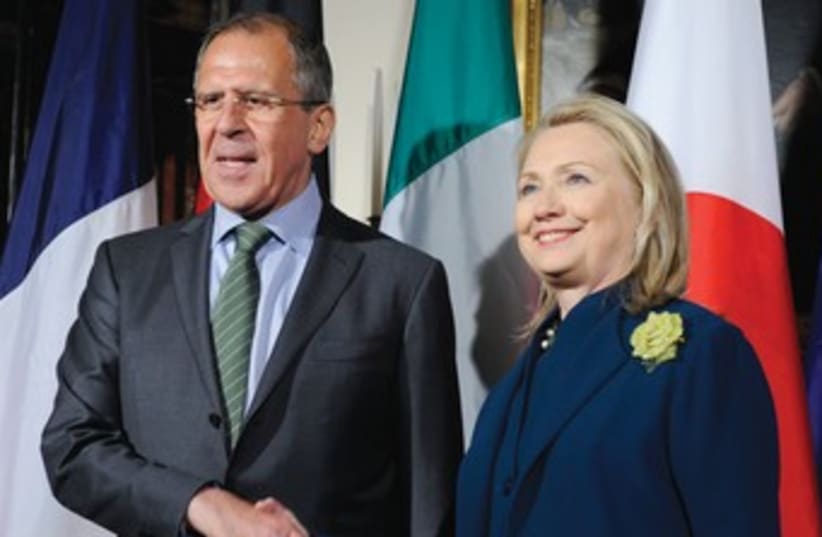
By REUTERSHillary Clinton with Russian FM Sergei Lavrov 370 (R)(photo credit: Mike Theiler/Reuters)
Russia and the United States remained deadlocked Friday on the fate of Syrian President Bashar Assad, as international mediator Lakhdar Brahimi met senior officials from both countries in Geneva in a bid to find a political solution to Syria's civil war.Meanwhile rebels seized control of one of Syria's largest helicopter bases on Friday, opposition sources said, in their first capture of a military airfield used by Assad's forces.The United States, which backs the 21-month-old revolt, says Assad can play no future role, while Syria's main arms supplier Russia said before the talks that his exit should not be a precondition for negotiations.Syria is mired in bloodshed that has cost more than 60,000 lives and displaced millions of people. Severe winter weather is compounding their misery. The UN children's agency UNICEF says more than 2 million children are struggling to stay warm.The capture of Taftanaz air base, after months of sporadic fighting, could help rebels solidify their hold on northern Syria, according to Rami Abdelrahman, head of the pro-opposition Syrian Observatory for Human Rights.But Yezid Sayigh, at the Carnegie Middle East Centre in Beirut, said it was not a game-changer, noting that it had taken months for the rebels to overrun a base whose usefulness to the military was already compromised by the clashes around it."This is a tactical rather than a strategic gain," he said.In Geneva, UN-Arab League envoy Brahimi's closed-door talks began with individual meetings with US Deputy Secretary of State William Burns and Russian Deputy Foreign Minister Mikhail Bogdanov. He later held talks with both sides together.A US official said negotiations would focus on "creating the conditions to advance a political solution - specifically a transitional governing body".Six months ago, world powers meeting in Geneva proposed a transitional government but left open Assad's role. Brahimi told Reuters on Wednesday that the Syrian leader could play no part in such a transition and suggested it was time he quit.Responding a day later, Syria's foreign ministry berated the veteran Algerian diplomat as "flagrantly biased toward those who are conspiring against Syria and its people".Russia has argued that outside powers should not decide who should take part in any transitional government."Only the Syrians themselves can agree on a model or the further development of their country," Foreign Ministry spokesman Alexander Lukashevich said.But Syrians seem too divided for any such agreement.The umbrella opposition group abroad, the Syrian National Coalition, said on Friday it had proposed a transition plan that would kept government institutions intact at a meeting with diplomats in London this week. But the plan has received no public endorsement from the opposition's foreign backers.Click for full JPost coverageWith no end to fighting in sight, the misery of Syrian civilians has rapidly increased, especially with the advent of some of the worst winter conditions in years.Saudi Arabia said it would send $10 million worth of aid to help Syrian refugees in Jordan, where torrential rain has flooded hundreds of tents in the Zaatari refugee camp.A fierce storm that swept the region has raised concerns for 600,000 Syrian refugees who have fled to neighboring countries, as well as more than 2.5 million displaced inside Syria, many of whom live in flimsy tents at unofficial border camps.Opposition activists report dozens of weather-related deaths in Syria in the last four days. UNICEF said refugee children are at risk because conditions have hampered access to services.Earlier this week, another United Nations agency said around one million Syrians were going hungry. The World Food Program cited difficulties entering conflict zones and said that the few government-approved aid agencies allowed to distribute aid were stretched to the limit.The WFP said it supplying rations to about 1.5 million people in Syria each month, far short of the 2.5 million deemed to be in need.
if(catID != 151){
var cont = `Take Israel home with the new Jerusalem Post Store