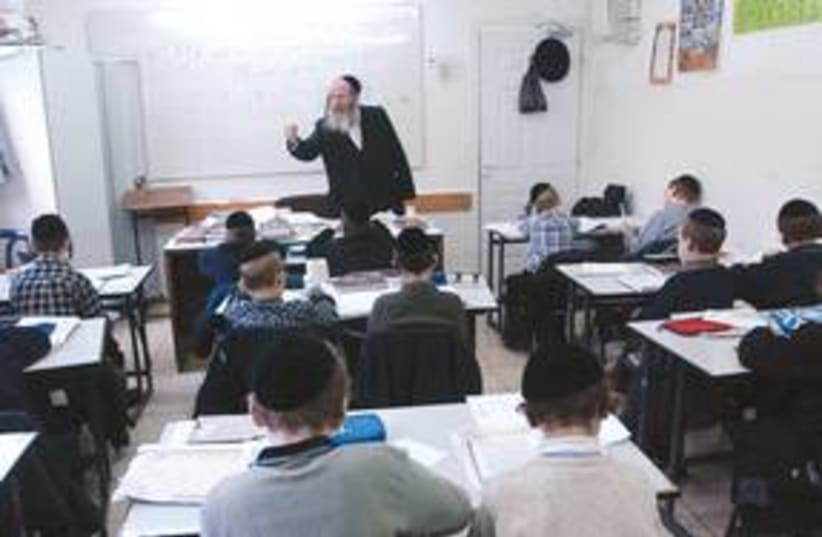
Schools that do not have their students sit for standardized elementary and middle school tests could face budget cuts.
By JEREMY SHARONShas schools 311(photo credit: Ariel Jerozolimski)
The Education Ministry is considering whether to cut the budgets of haredi schools that do not have their students sit for standardized elementary and middle school tests.The ministry’s position was expressed in its response to a petition submitted to the High Court of Justice by the Israel Religious Action Center, or IRAC, the legal arm of the Reform Movement in Israel.The subjects covered by the tests, known as MEITZAV, are Science, Hebrew, Mathematics and English. Children take the exams in grades two, five and eight.The petition, filed in 2007, demanded that all state-funded schools teach the core curriculum subjects and that an efficient system of inspection be established to oversee the process.IRAC discovered in 2007 that there were only two Education Ministry inspectors for the entire haredi school system, and that these schools were not registering their pupils for the MEITZAV exams.The ministry agreed to significantly increase inspection and to begin the process of getting the ultra-Orthodox schools to carry out the tests.In 2010, after little progress was made on these issues, IRAC submitted another petition asking for a High Court injunctions against the Education Ministry to implement its promises.In response, the ministry wrote this month that if the haredi school systems do not agree to have their pupils take the tests by next year, the education minister will consider reducing the state support for their budgets until they reconsider.The ministry added that it was still in dialogue with the haredi school frameworks and that the MEITZAV exams for haredi schools might only be partial and not the full set of tests.There are a number of haredi school frameworks that receive state funds. The “Independent” framework, which has mainly Ashkenazi pupils, and the Shasrun Maayan Hachinuch Hatorani framework, which has mainly Sephardi pupils, teach the core curriculum in full and receive the same level of funding as other state-funded schools.Then there are haredi schools known as “Unofficial schools,” which receive 75 percent of normal state funding and are required to teach 75% of the core curriculum.Finally there are the “Exempt Institutions” which receive 55% funding from the state and are required to teach 55% of core curriculum subjects.In practice, the Unofficial schools and Exempt Institutions that the large majority of Ashkenazi haredi children attend teach barely any core subjects, preferring to teach religious studies instead.The Maayan Hachinuch Hatorani and the Independent framework do teach the core curriculum through all elementary school grades.According to Rabbi Yosef Politi, national inspector of the Maayan Hachinuch Hatorani framework, approximately 130 out of its 150 schools now carry out the MEITZAV tests, which are altered somewhat to ensure that the stylistic content is appropriate for haredi children.Statistics for male pupils in the Independent, Unofficial and Exempt Institutions schools taking the MEITZAV tests are not readily available but are presumed to be very low.Girls in the Independent framework do, however, take the tests since the haredi world does not insist on the same level of religious studies for girls as it does for boys.Attorney Ricky Shapira of IRAC, who has worked on the case, said she was “happy to hear that after so many years the Ministry of Education is beginning to go in the right direction and will reduce the budgets of schools not using the MEITZAV tests,” and said that she hoped the ministry would carry out this policy.She added, however, that it is the “Ministry of Education’s role to inspect the ultra-Orthodox educational institutes and not to negotiate with them.“The tests are carried out in all state educational institutions and nobody thinks to enter into dialogue with them about fulfilling their legal obligations,” Shapira said.
if(catID != 151){
var cont = `Take Israel home with the new Jerusalem Post Store