Above the Fray: Only defeat awaits violence and extremism
The death of bin Laden offers a symbolic moment of opportunity for regional key players to adjust their regional postures and relationships.
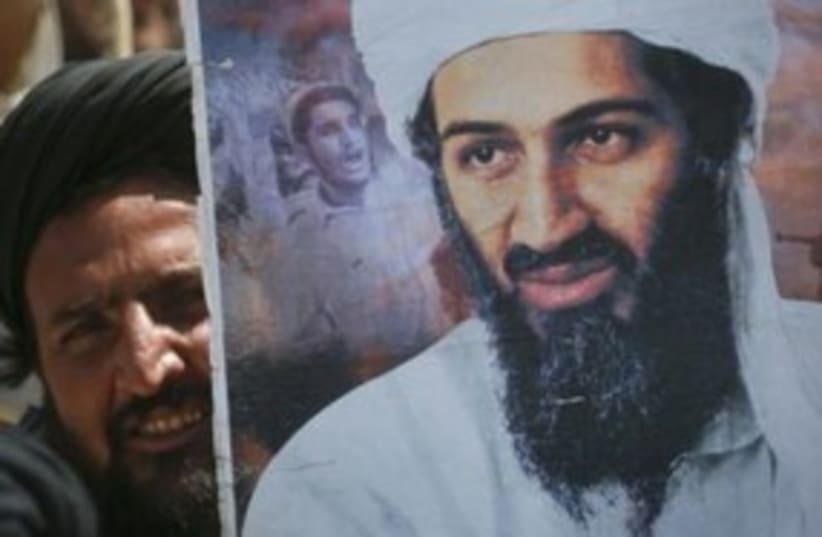
By ALON BEN-MEIRMan holds poster of Osama bin Laden at rally in Pakistan 311(photo credit: REUTERS/Naseer Ahmed)
The death of Osama bin Laden will not change the nature of the threat posed by al-Qaida and its affiliates in the short-term. In fact, bin Laden’s death, coupled with the nationalistdriven – not Islamist-driven – Arab Spring, could lead bin Laden’s followers to enhance efforts to attack Western targets in order to demonstrate that the global jihadist movement remains a potent force.However, as the Arab world’s largely muted reaction to bin Laden’s death attests, the ideology of al-Qaida is waning.The death of bin Laden offers a symbolic moment of opportunity for key players in the region. They should all now utilize this moment to reassess and recalibrate the means by which they pursue their interests, as well as their regional postures and relationships – from the United States and Israel, to Pakistan and the nations of the Arab Spring, to Islamist groups like Hamas.THE IMPORTANCE of the symbolism of bin Laden’s death is perhaps most palpable in the US, where al- Qaida’s mastermind orchestrated attacks that killed more than 3,000 Americans. With any clear notion of “success” in Afghanistan becoming increasingly opaque, the death of bin Laden offers a chance for President Barack Obama to begin to set in motion policies that would draw down the US’s military presence in the wartorn nation, having achieved the war’s most critical objective: decapitating the leadership and effectiveness of al-Qaida and its affiliates. The trove of documents seized at bin Laden’s compound in Abbottabad, Pakistan, is likely to lead to further intelligence and military successes. On the heels of such achievements, Obama can confidently begin to withdraw American troops, but in doing so he must ensure that key components of stability for the territory remain in place. The US should encourage dialogue between Afghan President Hamid Karzai and the Taliban, even as it continues to track down the al-Qaida leaders which the Taliban has aided and harbored.Key to any American withdrawal will be a negotiated agreement with the Taliban, provided the agreement insures that: '• Al-Qaida will not be allowed to operate from Afghani soil; • A basic level of human rights and shared dignity for all people of Afghanistan is maintained; • The integrity, security and stability of the neighboring nuclear armed state – Pakistan – is preserved.That said, the US-Pakistan relationship has been questioned vociferously in the wake of the operation that killed bin Laden. Obama’s recent remarks that he was likely aided by a network of support in Pakistan, and the fact that his compound was found not far from Pakistan’s top military training facility, raises legitimate questions regarding the integrity of Pakistan’s military elites, if not their competence – particularly that of the Inter-Services Intelligence Directorate.The United States is now in a bind. Fail to maintain a close working relationship with Pakistan – including the annual $3 billion in aid supplied by Congress for Pakistan’s military – and withdrawing from Afghanistan will become a much more difficult task. Furthermore, Pakistan’s delicate political stability, and its nuclear arms, demand vigilant US attention to ensure that those weapons do not wind up in the hands of terrorists. However, as the US considers recalibrating its policies vis-àvis Pakistan, officials in Islamabad have a bright spotlight on them today.In an interview in 2008, former Pakistani general and then-president Pervez Musharraf told the television program 60 Minutes: “We are not particularly looking for [Osama bin Laden], but we are operating against terrorists and al-Qaida and militant Taliban. And in the process, obviously, combined, maybe we are looking for him also.”Such unconvincing answers can no longer be acceptable, either to the US or to Pakistan, if their relationship is to endure. Pakistan should recognize the tide in the region is toward Arab nationalism and empowerment, and away from Islamism. To demonstrate that they are doing so, they should make announcements of their own that they have found figures such as al-Qaida No. 2 Ayman Al-Zawahiri and others who are likely in similar hideouts in unsuspecting neighborhoods in Pakistan.The country has legitimate security concerns in Afghanistan, but it must now operate above the fray with the US to bring about a solution to the war in Afghanistan that meets both the American and Pakistani objectives.EVIDENCE THAT bin Laden’s ideology has failed the Middle East is appearing throughout the region. There were sporadic protests against his killing by US forces, but most people were busy in other protests – against their corrupt rulers. It is prescient that bin Laden’s message to the youth – to rise up against the US and Israel and restore Islamic law to the nations of the region – could be so completely ignored. The current Arab Spring has been about rising up against the regional despots who have not provided the kind of opportunity and freedom that the West enjoys, and that bin Laden detested.Today, the people of Syria are demanding change not through the suicide-bombing means of al-Qaida, but by chanting “salmiya” – peaceful – in the streets. Going forward, the reforming nations of the region, and the US, should take lessons from this rejection of al-Qaida’s ideology.As the nations craft new systems of government, they must be focused on genuine political freedom and economic opportunity that restores the dignity for which the protesters yearn. Furthermore, the US must be clear in its support for the development of such policies, and its opposition to the indiscriminate killings carried out not only by Muammar Gaddafi’s forces in Libya, but now by Bashar Assad’s in Syria as well.FINALLY, THE death of bin Laden should send a clear message to Islamists: Violent extremism will not be tolerated in the new Middle East, and no terrorist leader is immune to bin Laden’s fate. In particular, Hamas should be paying attention to this message – and perhaps it is. After bin Laden’s death, Hamas Prime Minister Ismail Haniyeh made headlines by condemning the killing of bin Laden, whom he described as “an Arab holy warrior.”The West’s condemnation of Haniyeh’s statement was swift, particularly as Hamas was intending to sign a unity agreement with Fatah, in a pact that seeks to maintain Western aid for the newly united Palestinian political front.Days later, after the unity agreement signing ceremony in Cairo, Hamas’s Damascus-based chief Khaled Mashaal articulated a much more moderate message, stating, “We are talking now about a common national agenda. The world should deal with what we are working toward now, the national political program... a Palestinian state in the 1967 lines with Jerusalem as its capital, without any settlements or settlers, not an inch of land swaps and respecting the right of return.”However, when pressed on whether an agreement along these lines would be considered an end to the Israeli-Palestinian conflict, Mashaal responded, “I don’t want to talk about that.”If Hamas is to survive as a political entity seeking the national aspirations of the Palestinian people, he will need to answer that question. The transition from terrorist to politician requires a renunciation of violence and the removal of the clause that calls for Israel’s destruction from Hamas’s charter.Last weekend, recognizing that international aid for the Palestinian Authority was in jeopardy if Hamas maintained its hard-line views and support for violence, Mashaal sounded an even more moderate tone, stating, “First allow the Palestinian people to live on their lands freely... to establish their independent state ... then ask the Palestinian people, its government and leaders about their position towards [recognizing] Israel.”In the face of what appears to be a moderating trend within Hamas, the US and Israel should not allow their skepticism to create undue roadblocks to Hamas’s maturation from terrorism to politics. Instead, a wait-and-see policy is in order, one that pressures Mashaal’s Hamas to match his new moderate rhetoric by following in the footsteps of Fatah, permanently renouncing violence as a means of attaining statehood. This would be a first good step toward being taken seriously by the international community.THE PEOPLES of the Middle East understand the power of symbolism. The videos released by the US depicting bin Laden rehearsing video remarks with his beard dyed jet black indicates that he was well-aware of his own selfimage, and the power of demonstrating a symbol of a vibrant jihadist leader. Now, in his death, more potent symbols are being conveyed: violence and extremism fail the people of the region, misread their aspirations for freedom and opportunity, and will ultimately be defeated, regardless of how long it takes.The writer is professor of international relations at the Center for Global Affairs at NYU. He teaches international negotiation and Middle Eastern studies.
if(catID != 151){
var cont = `Take Israel home with the new Jerusalem Post Store