Encountering Peace: Netanyahu: Commit to two states
2013 must be the year when the leaders go beyond themselves, move forward beyond the expectations of their people, far beyond their own expectations of each other and of the possibilities for peace.
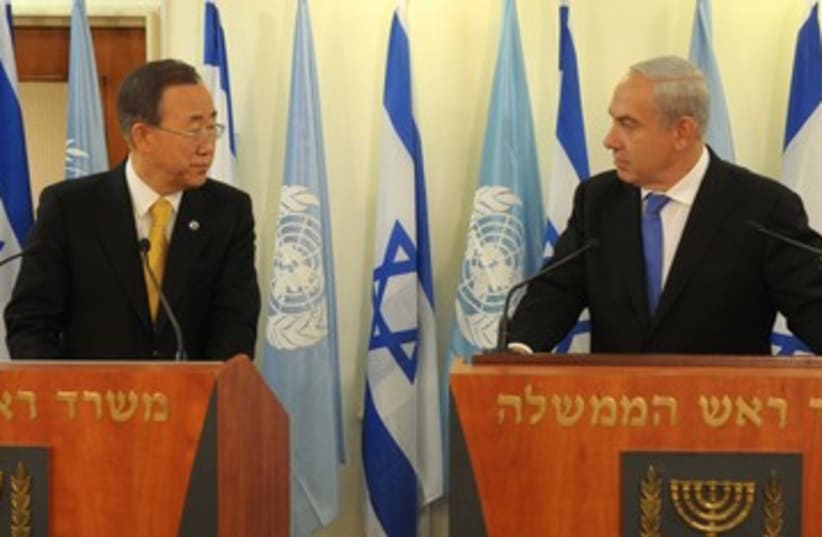
By GERSHON BASKINBan Ki-Moon, Netanyahu 370(photo credit: GPO)
There is no better person to lead Israel to peace than Prime Minister Binyamin Netanyahu.That is not an easy statement for someone like me to write. Netanyahu as the leader of the right wing has the ability to reach an agreement with the Palestinians and gain the support of the majority of the Israeli public.Israeli-Palestinian peace will entail concessions on the positions held by Netanyahu and backed by at least half of the Jews living in Israel.Coming to terms with the parameters of peace for Netanyahu will mean an enormous, heart-breaking struggle with the ideology he has lived with and by his whole life. But peace with our neighbors is the most important long-term achievement an Israeli prime minister can deliver and we need Netanyahu to be the leader to do it.Netanyahu sees himself as a great historic leader of Israel and the Jewish people. He perceives of himself as the inheritor of the legacies of David Ben-Gurion and Menachem Begin. It seems that he has sought to step into those great shoes by taking on the Iranian bomb and Iran’s dream to destroy Israel.His term of office, about to come to an end, can be marked by his drawing of global attention to the Iranian nuclear issue and success in getting an American commitment to preventing a nuclear-armed Iran. In his next term of office he needs to refocus his attention to achieving peace with the Palestinians, because failure to do so would pose existential risks to Israel no less than the Iranian bomb.In order for that to happen, here are some things that must occur: President Barack Obama must tell Netanyahu with determination that the United States is fully responsible for ensuring that Iran will not arm itself with nuclear weapons, regardless of what is required to achieve that end. Iran is for the US to deal with, not Israel.President Obama must then tell Netanyahu that he must dedicate himself to facing the Palestinian issue and come to terms that will enable a breakthrough toward genuine negotiations.Palestinian Authority President Mahmoud Abbas must reach out to the Israeli people and convince them that he is the partner that Israel needs to make peace. Abbas must acknowledge the genuine Israeli concerns regarding his record and his positions. He must be unequivocal in his determination to remove incitement against Israel and Jews from all aspects of Palestinian public life. That determination must be expressed in real actions, not only in statements.He must convince Israelis he is willing to accept all reasonable Israeli security demands that will ensure that the West Bank will not become a base of terrorism for attacking Israel after Israeli withdrawal. He must acknowledge and agree that Jewish holy places that might be in the Palestinian state will be honored and protected and that Jews will always have the right to visit and worship in these places. He should declare that Jews can also live in the Palestinian state and that no harm will come to them.He must clearly state that when an agreement is reached on all of the issues in conflict that it will be the end of conflict forever.Israel’s other neighbors that have peace treaties with Israel should show their support for the two states for two peoples solution. They should provide clear assurances that once the Israeli-Palestinian peace treaty is signed the frozen state of peace will be converted to real peace.That is especially important now that the Muslim Brotherhood rules Egypt and because of the large Palestinian population in Jordan. The leaders of Egypt and Jordan can provide substantial assistance both in the process of negotiations and by providing political support for the Palestinian leadership, which will have to make its own significant concessions. Visits to Israel by the leaders of Egypt, Jordan and Palestine together – addressing the Knesset with an appeal for peace, would make real inroad towards changing Israeli public opinion.Netanyahu must recommit himself to the two states for two peoples solution, as he did at the beginning of this term. It would be wise for him to tell the Palestinian people (and the Israeli people) what he means by peace and his vision must be convincing and genuine. He has to go beyond the clichés of his Bar Ilan speech and begin to speak in real terms that Palestinians can believe provide the basis for peace.Both Netanyahu and Abbas should understand that they have a responsibility to create a dynamic of mutually reinforcing positive statements, rather than what they have done so well over the past years, namely mutually reinforcing negativism.Netanyahu has the copyright on “mutuality” and “reciprocity.”He doesn’t lose anything by taking the first step and reaching out to the Palestinian people. He should seriously suggest to Abbas that if he is invited to come to Ramallah he would accept the offer to address the Palestinian people directly from the Palestinian Authority headquarters where all of the Palestinian leadership would gather to hear him and his talk would be broadcast on Palestinian media and to the world.Both leaders have to decide that the scoring of points and the entrenchment of the language of animosity must come to an end. Responsible leaders of Israel and Palestine can no longer risk missing this opportunity to engage with each other in an honest pursuit of real peace. I am convinced that both leaders genuinely want peace for their peoples. I know that both peoples have had enough of conflict, they are tired of the suffering, but have lost the belief that peace is possible. The leaders themselves have demonstrated over the past four years that they have been captives of the same attitude.2013 must be the year when the leaders go beyond themselves, move forward beyond the expectations of their people, far beyond their own expectations of each other and of the possibilities for peace. Abbas can do it. Netanyahu can do it. We need them to do it.The writer is the co-chairman of IPCRI, the Israel Palestine Center for Research and Information, a columnist for The Jerusalem Post and the initiator and negotiator of the secret back channel for the release of Gilad Schalit.
if(catID != 151){
var cont = `Take Israel home with the new Jerusalem Post Store