It might sound absurd, but if we cannot overcome some empty Palestinian stomachs, then Israel may be in for a diplomatic diet we will soon come to regret.
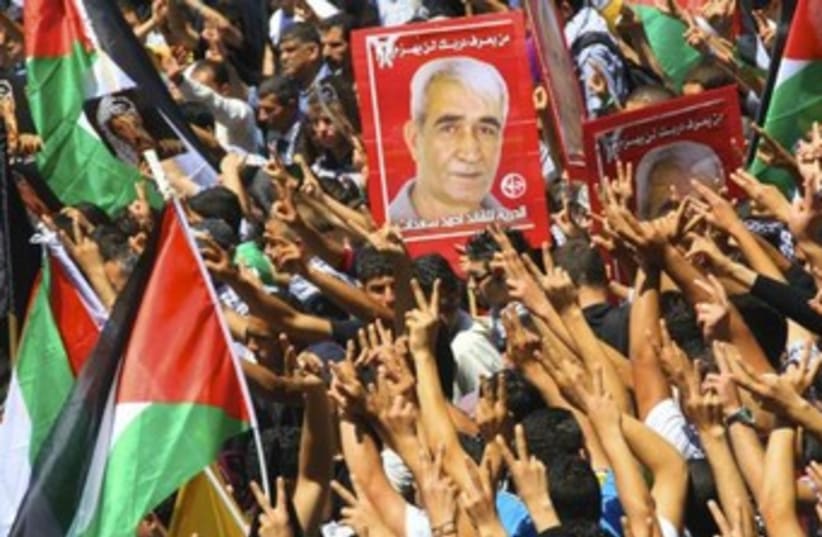
By MICHAEL FREUNDPalestinians in Ramallah on 'Nakba Day' 370(photo credit: TOVAH LAZAROFF)
Amounting crisis of gastronomic proportions was averted this past week when Israel and hunger-striking Palestinian prisoners agreed to a deal that was brokered by Egypt, ending the stand-off between the two sides.After more than a month of missed meals, skipped snacks and disregarded desserts, the jailed terrorists have at last returned to the prison cafeteria, prompting sighs of relief from throughout the international community.Having successfully highlighted the wilted waistlines of imprisoned Palestinian terrorists, Amnesty International can now finally get back to addressing some of those other pesky issues bedeviling the region, such as the slaughter in Syria or the tumult in Egypt.But have no fear, dear reader. Israel drove a really hard bargain this time around. In exchange for the Palestinians’ grudging willingness to resume indulging in three hearty meals a day courtesy of the Israeli tax payer, the Jewish state agreed to a series of demands aimed at easing the prisoners’ conditions.These included lifting a ban on visits to detainees by relatives living in Hamas-ruled Gaza, and freeing 19 dangerous prisoners from solitary confinement.Not without reason, Hamas was delighted by this turn of events, as Israel handed them a scrumptious propaganda victory. As Reuters reported, “Gaza’s Hamas leaders hailed the strike as a successful campaign against Israel and celebrations quickly spread to the streets where motorists honked horns, and passersby embraced and shouted ‘Allahu Akbar.”“This is a first step toward liberation and victory,” crowed Hamas spokesman Fawzi Barhoum.The reaction in Israel was somewhat less sanguine, and rightly so.After all, this was an obtuse and short-sighted deal, the likes of which will only encourage further mischief and misconduct down the road. Rewarding the prisoners by giving in to their demands sends a dangerous message and virtually invites future hunger strikes and other disturbances as a means of squeezing still more concessions out of Israel.Indeed, parliamentarians on both the Left and the Right were sharply critical of the government’s handling of this affair, with Labor MK Isaac Herzog correctly noting that it only serves to strengthen Hamas, and Likud MK Danny Danon slamming it as a “prize for terrorism.”Why, then, did the government agree to it? According to spokesman Mark Regev, the move was intended as a “gesture” to Palestinian Authority Chairman Mahmoud Abbas, the same guy who has been refusing to sit down and negotiate with Israel.“It is our hope,” Regev said, apparently with a straight face, “that this gesture by Israel will serve to build confidence between the parties and advance peace.”But the Palestinian leader did not seem particularly moved. Barely a day later, Abbas gave a speech in Ramallah to mark “Nakba Day,” when Palestinians bemoan the “catastrophe” of Israel’s establishment. In his remarks, Abbas repeatedly blasted Israel, demanding that it hand over all of Jerusalem to Palestinian control.“We insist on each particle and each stone in Jerusalem,” Abbas said, apparently not feeling the need to make any like-minded “gestures” towards Israel.This sorry episode demonstrates a deeply troubling weakness which lies at the root of Israeli policy. Instead of caving in to Palestinian demands, Israel should have tackled the matter head on and simply forced the prisoners to eat.This is common practice. Just two months ago, an inmate in Connecticut who had embarked on a hunger strike to protest the judicial system lost his battle against prison officials when the state’s Supreme Court upheld their right to feed him against his will.William Coleman, who is serving an eight-year sentence for raping his wife during divorce and custody proceedings, was said to have dropped from 237 to 139 pounds, prompting officials to fear for his health.The court supported a lower court’s ruling which found that the State Department of Corrections’ responsibility to preserve life and prevent copy-cat hunger strikes outweighed Coleman’s rights to free speech and privacy.This is so patently obvious that it is hard to comprehend why Israel’s prison officials did not adopt a similar stance.To be sure, force-feeding hundreds of Palestinian prisoners would have prompted a media maelstrom and generated still more heat in Israel’s direction.But caving in to the inmates’ demands has only bought short-term peace and quiet at the expense of long-term security and order.An opportunity was missed here, one that could have put a dent in the persistent efforts by the Palestinians to test Israel’s mettle and probe for still more areas in which to weaken our resolve. We have once again sent a message that if you push us hard enough, we will not hesitate to falter.At this rate, it won’t be long before Palestinian prisoners start launching more hunger strikes and demanding far greater concessions.Land for lunch, anyone? It might sound absurd, but if we cannot overcome some empty Palestinian stomachs, then Israel may be in for a diplomatic diet we will soon come to regret.
if(catID != 151){
var cont = `Take Israel home with the new Jerusalem Post Store