Media Comment: Duplicity and repentance in the media
Some of Israel’s most important media personalities are coming out after the fact, admitting the media failed miserably in covering Schalit.
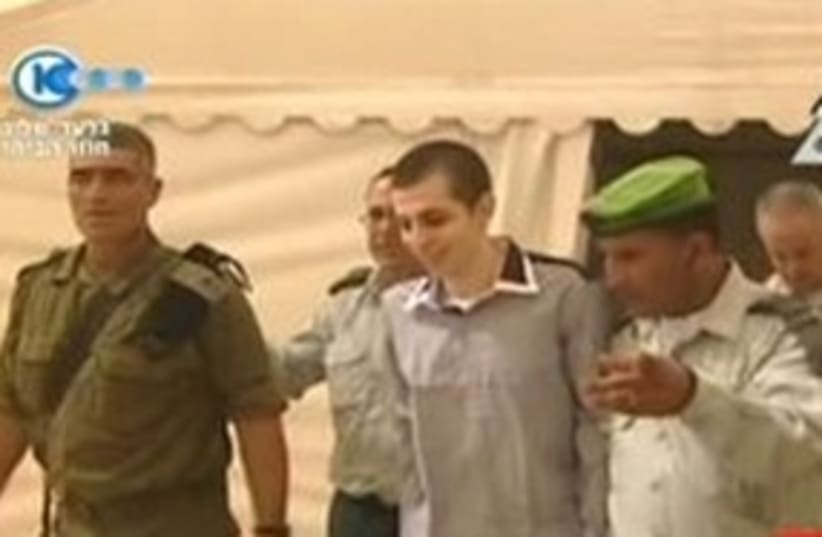
By YISRAEL MEDAD, ELI POLLAKGilad Schalit first meets with IDF officers 311(photo credit: Channel 10)
As soon as St.-Sgt. Gilad Schalit had returned from Hamas captivity, multiple media outlets – establishment as well as independent – indulged in an orgy of introspection.Nir Wolf of Israel Hayom focused on PR firm employed by Gilad Schalit’s father Noam. Tammy Shinkman, who was the person involved in headed the PR effort, defined her “codes of communication” in a Globes interview as “the empowerment of emotions.” Her strategy was to emotionalize Schalit’s captivity by turning the soldier into “everyone’s son.”Rationality was purposely ignored.
The role played by the media in aiding the PR campaign was a hot topic. Globes media reporter Lior Averbuch interviewed Channel 1 TV’s Ayala Chason, Channel 2 TV’s Roni Daniel and Channel 10 TV’s Alon Ben-David. Chason admitted that the coverage of Schalit was “completely not objective... the media was mobilized. As an example consider the daily countdown in some of the outlets.”Only Roni Daniel denied that either he or the media were mobilized in favor of Schalit. Alon Ben-David agreed with Chason: “Just like [with] the social justice campaign, the media mobilized itself for Schalit.”Terminology such as “the son of all of us” or “the child,” and not “the soldier,” reflected the media’s agenda.Schalit was not depicted as the brave warrior defending the homeland but as a tender child in need of comfort and concern.It is interesting to compare Haaretz’s Ari Shavit, before and after. In an article written two years ago, Shavit supported making a deal, yet warned of the consequences, noting that it could lead to dozens of Israeli victims. He repeats this line immediately prior to Schalit’s release; on October 10 he writes, “There is one overwhelming reason to support the deal – Israeli solidarity. ...Without the mutual responsibility there is no meaning to our life here.”But then, in the aftermath, he writes, “this morning is the first one after a loss of balanced thinking and panic overtaking us. For 1,940 days and nights, the kitsch dominated us.”CHANNEL 10’s Raviv Drucker, on the other hand, was consistent in his criticism of the deal. In an interview in The Marker, Drucker claimed that “the media... behaved emotionally, crazily and irrationally. ...It acted childishly, [its message was] return Gilad ,we don’t care how, we don’t want to hear the price.”Even the Israel Broadcasting Authority’s complaints commissioner Elisha Spiegelman, in an answer to a complaint over the biased media coverage, noted that “the media in its entirety, and to my dismay also the journalists of the IBA, violated all principles of balance during the past few years.”The upshot is that some of Israel’s most important media personalities are coming out after the fact and admitting that the media failed miserably.Is this a positive development? Could it be that some of our opinion-makers’ second thoughts mean they will behave differently next time? Not really. This type of ex-post-facto breast beating is a regular feature of Israel’s media scene. As the book of Ecclesiastes tells us, “there is nothing new under the sun.”The media, which overwhelmingly supported Shimon Peres for prime minister in 1996, was left in shock and bereavement the morning after the election, when it became clear that Binyamin Netanyahu was the victor.Yet a few days later, media figures admitted anti-Netanyahu bias. Yediot Aharonot’s Nahum Barnea, a future recipient of the Israel Prize, wrote at the time in “The Seventh Eye”: “It is doubtful whether the majority of the journalists were to be considered ‘with Peres,’ but they were absolutely anti- Netanyahu... Netanyahu had to overcome a hostile media. Netanyahu was forced to deal with two fronts – against the Labor Party and against the media.”Did such introspection lead to any change? In the aftermath of the 1999 elections, Ilana Dayan, writing in The Jerusalem Post stated, “All the publicists and columnists were as one. More out of hatred, there was a mass mobilization aimed at causing the failure of Netanyahu.”Then-prime minister Ehud Barak was lauded for his “leadership” when Israel hastily retreated from Lebanon in 2000, stabbing its Lebanese allies in the back and creating the situation that eventually led to the disastrous Second Lebanon War.Hanan Naveh, at the time working for Kol Yisrael’s Reshet Bet, admitted later that three news editors who had sons in Lebanon had decided that “the army has to leave.”The media also safeguarded former prime minister Ariel Sharon from criminal investigation when he decided on, and then implemented, the unilateral retreat from the Gaza Strip and northern Samaria.Speaking on a panel called “A time of forgiveness – An Israeli reckoning on the eve of Yom Kippur” at Bar Ilan University in 2006, then-editor of Haaretz David Landau stated openly that his newspaper “supported the disengagement... we thought that stopping the greater corruption of occupying Gaza justifies ignoring the smaller corruption.”Without the media, the recent social protest movement would have amounted to next to nothing. As summarized by Sara Beck from Channel 2 TV, the difference between the protests against the disengagement and the social protests is that it’s easier when the media supports you.So, should we take our media seriously? Is the breast-beating in earnest or is it merely an attempt to evade responsibility, or perhaps just find another “good topic” with which to fill up space and sell advertisements? The future will tell, but the prognosis is not very encouraging.The writers are, respectively, chairman and vice-chairman of Israel’s Media Watch.
Related Tagsbias
if(catID != 151){
var cont = `Take Israel home with the new Jerusalem Post Store