At a time when Israel is most in need of these qualities – courage, strategic foresight, self-confidence, understanding of and with others, strength, humanity and humility – the man who personified and symbolized all these is no longer among us.
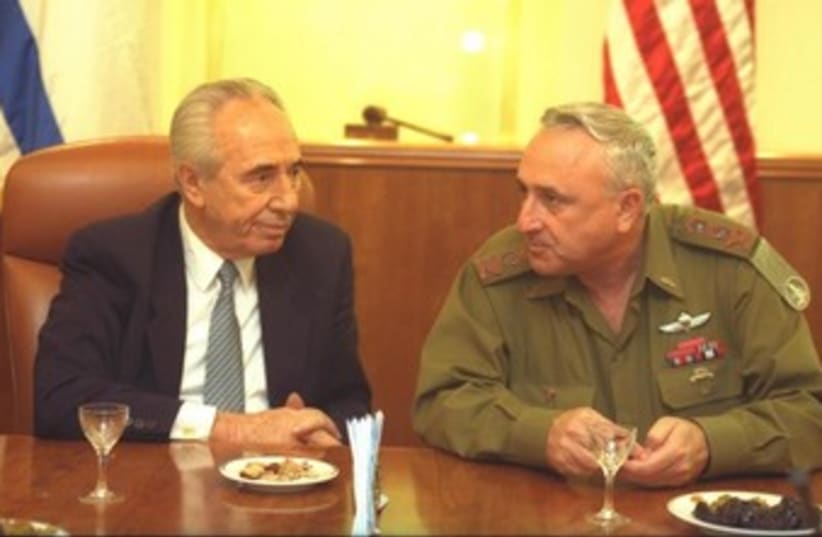
By URI SAVIRPresident Peres and Amnon Lipkin-Shahak 370(photo credit: Courtesy GPO)
Israel is not the same without Amnon Lipkin-Shahak. Our human landscape is poorer, more arid, with less humanity, courage and wisdom.It took his sad passing away for the country to express and understand what a man he was – a symbol, maybe the most outstanding one, of the beautiful and moral Israel.But Lipkin-Shahak was much more than a symbol. He was an Israeli patriot; a courageous fighter; a decorated and respected commander; a winner in necessary wars, who understood maybe best, the necessity for Israel to translate its power into an accommodation with the Arabs, especially with the Palestinians; a charismatic and humane person and personality, who was respected by all; and a man of family and love.I was privileged to have known Amnon for 25 years.We worked together on peace at very critical crossroads for the country. Yet I am not writing this article to recount our friendship, which meant a lot to me, but to tell about the man, whose personality and life should be a guiding light for our future.As President Shimon Peres said in his moving eulogy, Lipkin-Shahak’s legacy to all of us is in the necessity and the possibility to win the biggest of victories – peace.His legacy emanates from the many important stations of his life: • The courageous fighter: At a very young age he became a decorated officer – one of only two men be decorated twice with the Medal of Courage, for the courageous battle against terrorists in Karama (1968) and Beirut (1973); a red beret, whose many military operations remain untold.When I visited the PLO in Tunis with him many years ago, I had the distinct sense that this was not his first “visit” to the city; in the past in commando battle, in 1994 in the battle for peace.• The intelligence officer: Lipkin-Shahak was chief of our illustrious Military Intelligence service for five years.Military intelligence is about knowing and understanding the enemy. Israel is known to have one of the best and most effective intelligence services – although we have sometimes misread our neighbors, as happened twice with Anwar Sadat (in the 1973 war offensive and in the 1977 peace offensive). This is due to the fact that we probably know much about the Arabs and understand little.Lipkin-Shahak had both attributes – knowledge and understanding. Once, when I visited him in his office, he was virtually buried under a pile of intelligence materials.I asked him: “How can you read and digest so much information?” Amnon answered: “I read for several hours, then I tell myself that probably 90 percent of what I just read is irrelevant to reality, and that I have to rely on my understanding, intuition and experience. He really knew and understood the neighborhood in which he lived.• The strategist and chief of staff: Unlike most in our military and defense establishment, who had and still have a narrow, short-term view of our security, Lipkin- Shahak thought about our national security for the long-term, and knew the best way to combine strategy and tactics.For him, long-term security meant a strong Israel, capable of defending itself and deterring its enemies, and also a country able to create alliances and new relations with our neighbors. These qualities convinced Yitzhak Rabin to appoint him chief of staff. Lipkin-Shahak, as I witnessed firsthand, was the officer, if not the person, closest to Rabin: to Amnon, Rabin actually listened.• The man of peace: After the Oslo Agreements, when Rabin and Peres began to involve the military leadership of the country in the decision-making process and the negotiations, Lipkin-Shahak was appointed to head our negotiation team on the first implementation of the accords in Gaza and Jericho. As the one who headed our delegation for the accords, I was asked to be on his side – at the time he was deputy chief of staff.After meeting the PLO in fierce, uncompromising battle, he now met its leadership favoring important political compromise. We spent hundreds of hours of negotiations in Taba and Cairo. To the PLO leadership he met – Yasser Arafat, Abu Mazen (Mahmoud Abbas), Abu Ala (Ahmed Qurei), Nabil Sha’ath, Jibril Rajoub, and Muhammad Dahlan – he was the officer who had fought and chased them in battle and commando operations.Yet after meeting him, despite his strong positions on security, they not only listened to him but began to respect him.Lipkin-Shahak’s security demands were always clearly and strongly stated in favor of the need to fight terrorism, necessary deployment of the IDF and security cooperation. Yet he understood very well that security for Israel in the long-term was closely linked, if not dependent on, a political settlement with our neighbors, primarily the Palestinians. Though he perhaps knew best how to win on the battleground, he also knew that one cannot defeat another people, or dominate their lives and destinies; and that a political accommodation was therefore necessary and possible.This became evident when after the horrendous massacre in Hebron in the beginning of 1994, committed by the insane Jewish terrorist Baruch Goldstein, Lipkin- Shahak and I were sent secretly, together with other officers, to meet with Yasser Arafat in Tunis. The PLO leader in a rage had decided consequently to stop all negotiations, and the peace process itself. Before flying to Tunis, we met with Rabin and Peres.We knew Arafat was under heavy pressure and criticism from Palestinian public opinion for the compromises he made at Oslo with Israel, and was even held indirectly responsible for the killings of 29 Palestinians during Muslim prayer at a holy site. Arafat, therefore, through the Americans, demanded the immediate evacuation of the Jewish quarter in Hebron. We asked our superiors how we should respond to the Palestinian demand. We were told by Rabin: “At this time just express our condolences and ask him to return to negotiations.”While we knew that the prime minister had opted for some evacuation of Jews from the heart of Hebron, we found out later that he was convinced by Ehud Barak and other officers to abstain from that move, fearing a strong reaction by the settlers.In Tunis, we met a deeply shaken Arafat at his headquarters.While receiving us politely, he was clearly in a rage: “Tell Rabin” he cried out, “that my people are humiliated and angry, that without the evacuation of the Jewish quarter I will be unable to renew the negotiations. Does your government want to destroy me?” His peers were even more adamant.We expressed our condolences and sorrow for the killing of innocent Palestinians by an Israeli, and left to consult with Jerusalem by phone, and with the Americans who were also present in Tunis for talks with Arafat, with Dennis Ross leading the delegation, dispatched by president Bill Clinton to rescue the peace process. Ross tried to convince us to find a compromise formula that would reinstate Arafat’s clout as a leader, and allow for the renewal of negotiations. Yet our leaders remained adamant: “There is nothing you can give Arafat, except for an unarmed international force in Hebron” is what we heard from Rabin and Peres on the phone.Amnon and I went on a long walk through the streets of Tunis, to discuss how to present this to Arafat and convince him to renew negotiations. After a long conversation, Lipkin-Shahak told me characteristically: “I will always do what is best – tell him the truth: that he will get nothing from us that can strengthen his hand with his own people, and that he must face his people as a leader, share a dire reality with them, and decide according to their long-term interests, to renew negotiations and the peace process.”We returned this time to Arafat’s home, and Lipkin- Shahak asked to see him alone, just the two of them.The PLO leader asked him to join him in his kitchen, while the two delegations waited in the living room. I could only hear Amnon saying: “Mr. Chairman, I speak to you as one general to another, it is time for you to show leadership.” Their conversation lasted for no more than 10 minutes.Amnon joined us and left Arafat to reflect for a long time. We waited in tense silence. Aborting the talks could mean the end of the peace process and the renewal of terrorism for years to come. Then Arafat joined us, and to the surprise and dismay of his colleagues announced with relative calm that he had decided to renew the negotiations almost immediately in Cairo, and that he would speak to his people in a televised address. Lipkin- Shahak had convinced him that real leadership was about unpopular decisions and loneliness, attributes very characteristic for Lipkin-Shahak himself throughout his professional life.This was one of the many times that the quiet, charismatic, tough and humane Lipkin-Shahak was able to convince the Palestinian leadership of the value of compromise, based on clearly set limits.In time, although a very tough negotiator, Amnon Lipkin-Shahak became the one Israeli the Palestinians grew to respect and trust most – a fierce enemy in battle, a strong Israeli patriot with rigorous demands on security, and a man who knew best how to create a common language. I know of no diplomat who has such diplomatic qualities; an officer and a man of peace.• The politician: It is precisely the aforementioned qualities that made him unfit for Israeli politics. I joined him in the effort to create a political center, together with Dalia Rabin, Yitzhak Mordechai, Dan Meridor and Roni Milo, merging Left and Right in favor of peace, after the extreme social polarization in the aftermath of Rabin’s assassination.In the Knesset and government, Lipkin-Shahak was disappointed with the disgusting and dishonest nature of Israeli politics, and we resigned together from the Knesset in 2001. He had already proclaimed that “Bibi Netanyahu was dangerous for Israel,” although he did not have a much better opinion of Ehud Barak. People of great ego were hardly his cup of tea. He was a true believer and servant of the Israeli cause.• The citizen: While he joined the private sector, for example at El Al, he continued to give his sagacious advice to the political leadership when asked for, and contributed to peaceful regional cooperation in his eight-year tenure as chairman of the board of the Peres Center for Peace.Throughout his career Amnon Lipkin-Shahak proved to be a unique and admired personality. He was courageous, physically and mentally, and proved to have military courage and civil courage, and also personal courage in his confrontation with cancer. He never complained and rarely spoke about himself, and had a tremendous ability to listen to and understand others.These are all uncharacteristic qualities for an Israeli, and yet Lipkin-Shahak in his personality, thought and emotion remains the quintessential Israeli, the reflection of a beautiful Israeli. A man with great charisma and charm, people loved and followed Lipkin-Shahak, and I was no exception.Above all he proved to have tremendous humanity in both his professional and his personal life. Humanitarian values shaped his actions and opinions, human consideration fostered his friendships. And more than anything he loved his family, his children and the love of his life, Tallie, whom he mentioned with passion at every occasion.At a time when Israel is most in need of these qualities – courage, strategic foresight, self-confidence, understanding of and with others, strength, humanity and humility – the man who personified and symbolized all these is no longer among us. Arrogance, short-sightedness and self-obsession are on the rise. Yet we owe it to one of Israel’s best leaders and sons to follow his legacy.The writer is president of the Peres Center for Peace and served as Israel’s chief negotiator for the Oslo Accords.
if(catID != 151){
var cont = `Take Israel home with the new Jerusalem Post Store