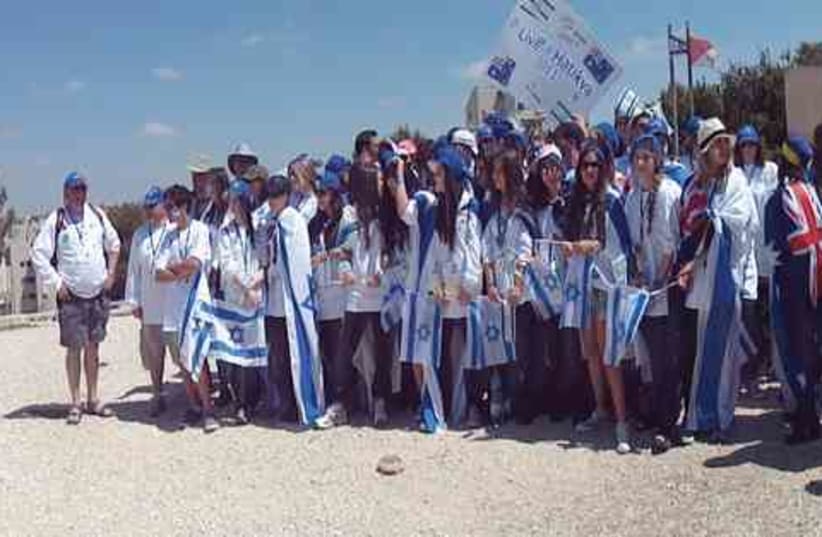
Terra Incognita: Falling out of love with ‘Hatikva’
Why do people assume that changing a word here or there is what would bring the Israeli Arabs into the fold?
By SETH J. FRANTZMANHatikva(photo credit: Live Hatikva)
Part of the Jewish world seems to be abuzz with a new plan for rewriting Israel’s national anthem, “Hatikva.” Two left-leaning newspapers, Israel’s Haaretz and America’s The Forward, celebrated Israel’s 64th independence day with lead editorials demanding “an anthem for all.”Haaretz editorialized that “No Arab citizen who had any self-respect, political awareness or national consciousness could sing these words without committing the sins of hypocrisy and falsehood...Hatikva is not their song.”Ten days later the same newspaper, perhaps forgetting it had already run an editorial on this matter, again noted that “Israel needs an anthem that represents Arabs and Jews.” On April 27, the newspaper’s Independence Day issue again told the country that “Israel needs national symbols all citizens can identify with. Independence Day, like Hatikva and the flag... is not a holiday for Israeli Arabs... they lost their land and national honor [on that day].”The Forward came out against Israel’s national anthem after its columnist “Philologos” noted that “It’s unacceptable to have an anthem that can’t be sung by 20% of a population. Permitting it to stand mutely while others sing is no solution.”It is interesting that The Forward acknowledged that it was up to Israelis to decide, but the editorial also claimed “the conversation, like the song, belongs to all of us.”These editorials offer up a litany of lies. First of all, in a classic colonial paternalistic mentality, that is all too common in the way people from the West treat the Middle East, the editors assumed they knew the hearts and minds of the Arabs.The Jewish writers spoke about Arab honor and “no Arab citizen who had any self-respect.” The Orientalist always knows the Arab better than she knows herself, thus only the non-Arab can propose an anthem that the Arab can identify with.Of course, no one asked “them,” because the conversation belongs to “us,” which is a nice way of saying “the progressive elites know what is best for the savages.”But if we get past the sheer idiocy of Neshama Carlebach and her friends at The Forward in New York deciding what is best for people sitting in Eilabun and Rahat, we can see what else the doyens of delusion got wrong.Merav Michaeli, another well-meaning leftist, wrote that “in the rest of the world an anthem is not holy. But in Israel apparently it is,” because Israelis can’t see that their soul is not only Jewish.In fact many other national anthems include verses that seem hard to understand today. The French sing: “Ye sons of France... to arms... the avenging sword unsheath.” I can’t see the French in their coffee-shops unsheathing much more than a baguette today, and yet they seem to be able to sing the anthem, “sons” and daughters alike.Ireland proudly displays her national anthem on the government’s webpage. It speaks of “see in the east a silvery glow, out yonder waits the Saxon foe.” No doubt, England is not the “foe” it was of old, and yet they still love the anthem.But if Israel’s anthem is not unusual in its historical oddities that doesn’t mean there is nothing to talk about. The decision by so many to opine on changing the anthem is a symbol, not of the way the anthem is held up to be holy, but of the feeling that the country is fragile and that anything about it can be changed at a whim. Israel is the ultimate “opt-out” republic in this sense.One Supreme Court justice doesn’t think the anthem represents him, so he doesn’t sing it. One day an ultra-Orthodox judge will surely feel the same way. And what of the Jews who came to Israel from the East, rather than the West (the anthem speaks of “onward, towards the ends of the east”). Jews from Yemen, Russia, Iraq, Syria, Iran, India could all opt out as well. The radical Left doesn’t like the anthem, so it opts out.It should leave many wondering why it is that when the Left ran the country, the ideological ancestors of the editors of Haaretz no less, and when Meretz was in the government in the 1990s, why didn’t they create an inclusive anthem? Why only now have they discovered that the Arabs “cannot” sing it? Why do people assume that changing a word here or there is what would bring the Israeli Arabs into the fold? When the anthem is sung at graduation at Israel’s universities, half the Arabs do not stand. The ones that stand don’t sing the words at all, as opposed to singing them and simply leaving out the bit about a “Jewish soul.” It doesn’t seem as if changing a word will change anything.The country and society sent a message a long time ago that the Arab minority could and should opt out of much of the state. Many applauded Supreme Court Justice Selim Joubran’s doing so at a ceremony in February, and many articulated for him how his saying a few words here and there would damage his “honor” and “self-respect.”The reality is that for many people in the world the words of a national anthem are relatively obscure. How many Mexicans truly believe in “war, war, without quarter to any who dare... may your fields be watered with blood.”One supposes that Mexican Jews stand at attention when the anthem is played. Do they identify with the fields flowing with the blood of the Mexican heroes of old? And yet they stand. They don’t opt out.Yet, ask so many Jews in the world if the Arabs of Israel can stand and they will say “I’ve read they cannot.” They cannot stand because long ago, in 1949, when the anthem was still being described as “the Jewish national anthem,” no one expected them to. And to this day not only has the expectation not changed, but in fact every group that feels a slight unease about any little bit of the anthem has been encouraged to simply walk away from it.
if(catID != 151){
var cont = `Take Israel home with the new Jerusalem Post Store