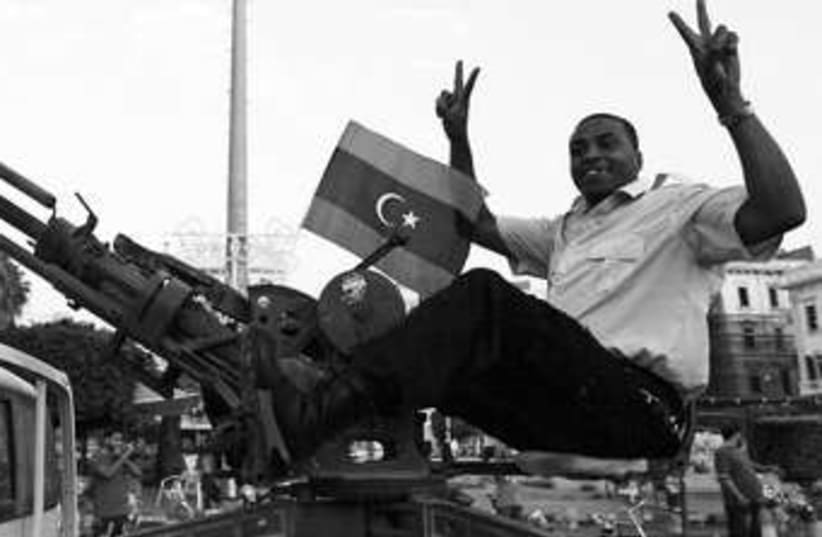
Libya is now an American puppet state, says Rubin.
By BARRY RUBINPolice officer in Tripoli(photo credit: Reuters)
It is amazing how events in international affairs that would have been easily and accurately understood decades ago are now surrounded by obfuscation and misunderstanding.Such is the case with Libya and the US role there.The facts are clear. Along with its NATO allies, the United States helped overthrow the dictatorship of Muammar Gaddafi in Libya and installed a new regime. This government, non-Islamist, technocratic, and led by defected old-regime politicians or former exiles, won the election and is now in power.What does this mean? Simple. Libya is now a US client state. In the eyes of many Arabs and Muslims – especially the radicals, but not just them – Libya is now an American puppet state. Most important of all, it is not an Islamist Shari’a state. The revolutionaries – a group including the Muslim Brotherhood, radical small groups and the local al-Qaida affiliates – want to change that situation.How do you do that? One way is to attack the regime’s institutions, including raiding police stations to get weapons. Another way is to assassinate officials. A tempting way to build popular support is to murder Americans.The killing of the ambassador and five other Americans (a Foreign Service reserve officer, two bodyguards and two Marines) has nothing to do with a video made in California. It has everything to do with the Libyan Islamist revolution. This revolution will go on for years and will become increasingly bloody. It is nothing short of amazing that US leaders don’t seem to recognize this.Bush occupied Iraq and Afghanistan; Obama occupied Libya and killed Osama bin Laden. Have no doubt that the revolutionaries – including the Muslim Brotherhood – and a lot of others view Obama as just as bad as Bush. Obama’s attempts at appeasement have further convinced them that America is finished and easily bullied. In his speech of September 2010 calling for revolution in Egypt, Muslim Brotherhood leader Muhammad al- Badi said so explicitly.In Iraq, a combination of factors has defused the situation directly, though resentments born years ago still are part of the package of genuinely popular but also jihadi-stimulated anti-Americanism. The surge won the war and the long-planned withdrawal was implemented by Obama. A government exists which is hardly a model of democracy but sufficiently stable for the foreseeable future. The Sunnis have basically given up trying to take over the country; the central government accepts the Kurds having a de facto state in the north. A lot of people are still being murdered by terrorism.Afghanistan, because it isn’t an Arab country, has a relatively small impact in the Arabicspeaking world and eventually US forces will withdraw from there as well. The Taliban, treacherously aided by forces including official government agencies in Pakistan, will go on trying to overthrow the US-sponsored government and might succeed. But that’s a problem for the future.As for bin Laden, obviously his death is a cause for al-Qaida to seek revenge. But, of course, they’d be attacking Americans and US installations even if he was still alive. It’s a myth that al-Qaida has been defeated. Precisely because it is so decentralized, the group’s local affiliates are quite active in North Africa, Yemen, Egypt (especially the Sinai Peninsula for the first time ever), the Gaza Strip and increasingly in Syria.Others who are not al-Qaida and never saw bin Laden as their leader will opportunistically use the US killing of the September 11 architect to stir up anger. They will also use inevitable periodic incidents like the recent anti-Muslim film that appeared in the US.There will always be more such incidents.Jihadis are surfing the Internet looking for some obscure incident or writing to promote.That’s what happened with the video, which some of them translated into Arabic and widely circulated. And when there is no real such incident, the revolutionaries will fabricate one.Aside from everything else, Libya has two special factors. First, it is beset by tribalism and regionalism which create a complex web of conflicts. Despite its oil wealth, this makes Libya extremely hard to govern. Some tribal and regionalist forces will remain interest groups; others will adopt a revolutionary Islamist ideology. There is no way of resolving these issues. Any Libyan government will have to go for massive repression – as Gaddafi did and the current government won’t – or engage in a constant juggling game.In Iraq, a major plus for achieving a stable regime was the common interest of Shias – though they quarreled endlessly among themselves – in sticking together to keep the Sunnis from massacring them and reclaiming power. The Kurds, while claiming autonomy, were also a stabilizing force. No such powerful political glue exists in Libya.Second, the regime is very heavily infiltrated – far more so than Iraq or Afghanistan – by revolutionary Islamist elements. Extremists did a lot of the fighting against Gaddafi and picked up a lot of arms. One of the most popular and important army commanders is the former head of the Libyan al-Qaida affiliate.Anything the US government tells its Libyan counterparts – where the ambassador or embassy staff is located, for example – will quickly be passed on to the terrorists.All of this is a nightmare. The United States is only at the start of a nasty conflict in Libya which is going to be very anti-American. It is shocking that there is so little recognition of that fact and an apparently sincere belief that all the problems there are due to a YouTube video. Having such a serious problem is bad enough; refusing to recognize that one has a serious problem is potentially fatal.The writer is director of the Global Research in International Affairs (GLORIA) Center, Interdisciplinary Center Herzliya, and editor of the Middle East Review of International Affairs (MERIA) journal. His latest books are The Israel-Arab Reader (seventh edition), The Long War for Freedom: The Arab Struggle for Democracy in the Middle East (Wiley), and The Truth About Syria (Palgrave- Macmillan). GLORIA Center is at www.gloriacenter.org.
if(catID != 151){
var cont = `Take Israel home with the new Jerusalem Post Store