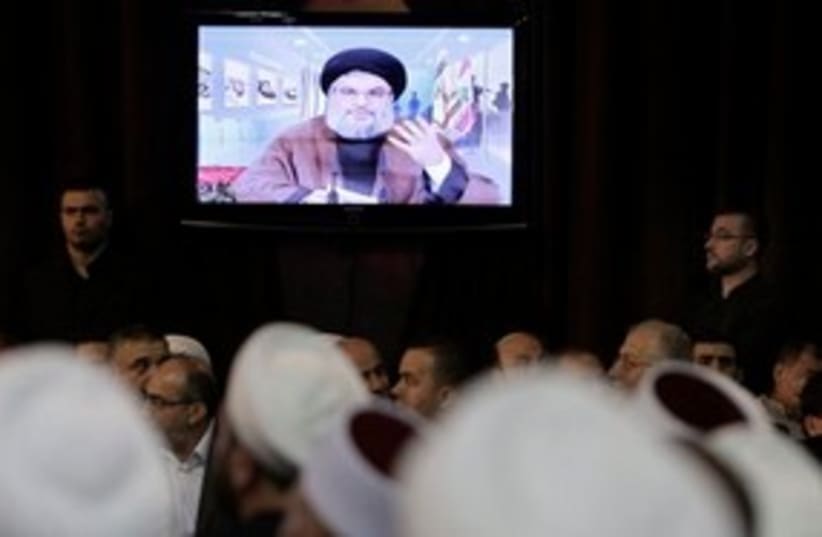
By JERUSALEM POST EDITORIALhassan nasrallah 311(photo credit: AP)
During the 1990s, before more sophisticated security technology had evolved and when it was far simpler to breach and decrypt data, any hacker in northern Israel and southern Lebanon could have deciphered and recorded on his home VCR information from overflying Israeli drones. Therefore, when Hizbullah chief Hassan Nasrallah bragged last week about a colossal feat of decoding drone photographs and thereby waylaying Israeli commandos in 1997, he was, unsurprisingly, exaggerating the achievement as part of his ongoing psychological warfare.Nasrallah is a proven master at toying with our emotions and those of both his supporters and foes in Lebanon. His sound-and-light show, replete with dramatic music which accompanied the projected slides, must be considered against this background.The Hizbullah chief was dredging up a 13-year-old incident to reopen Israeli wounds over the deaths of 12 Shayetet 13 fighters, as well as retrigger speculation and possible recriminations within Israel. Nasrallah was also out to boast about supposed superior intelligence-gathering capabilities. But most of all, he was dragging in any red herrings he could to obstruct and/or reframe the Hariri assassination investigation.NASRALLAH HAS consistently resorted to a combination of cold, calculated mendacity and terror to try to lower morale in Israel and boost it within his own powerbase.But in this instance, he has more than the classic goals of propaganda in mind. Nasrallah is near-desperate because the international probe into the February 14, 2005 assassination of former Lebanese premier Rafik Hariri is on the verge of completion, and odds are that Hizbullah will be declared the culprit.All of Lebanon – including current Prime Minister Saad Hariri (son of the assassination victim) – shudders at the possible consequences.Primarily feared is a repeat of the May 7, 2008 Hizbullah attack on Beirut and Druse townships. Nasrallah was directly asked about this at his press conference last Monday and significantly made sure to keep his threat viable by replying that all his options remained open. This was a blatant signal to the Lebanese government that there will be hell to pay unless it intercedes and preempts a finding from the UN tribunal liable to destabilize the country.IN THE service of derailing the probe, and seeking to press the Lebanese government to cease all cooperation with the tribunal, Nasrallah sought to deflect the blame for the car-bombing that killed Hariri onto Israel – the perpetual all-purpose villain. To build up his “case,” he presented a worthless mélange of chatter and supposed visual corroboration.This included released IDF footage of rescue attempts in the aftermath of the 1997 ambush, along with unidentified aerial shots – some of which could have been downloaded at the time, while others could have originated from any light plane and helicopter or even from available Internet images.Whatever the veracity, none of this disjointed concoction is relevant. None of it was, or could be, convincingly connected to the Hariri murder and none could conceivably ever constitute relevant material in any selfrespecting court of law.Nasrallah’s tactic was to overwhelm his audience with a deluge of immaterial information in the hope that the sheer confluence of confusing quantities would serve as a smoke screen and cloud reason. Hence also the curious contention that if Israel warned Rafik Hariri that he was in danger, then Israel wasn’t striving to save him but, rather, setting him up.Nasrallah cynically peddled large quantities of innuendo.But he presented not a shred of proof linking Israel to the Hariri assassination. Indeed, he didn’t even manage anything tenuouslyresembling circumstantial evidence.All this, however, isn’t to say that Nasrallah’s allegations, absurd and self-serving though they be, should be scornfully pooh-poohed by Israel.Ours is not a region renowned for rational deduction.It’s not implausible that a terrified Lebanese establishment, along with Iran and Syria – both of which have cogent reasons to cover up the truth – would at some point seize on the fabrications proffered by Nasrallah.This could in no time become conventional wisdom throughout much of Arab public opinion, and from there affect minds in the West, where Nasrallah plainly hopes it will ultimately expediently skew the probe.Thus Israel would do well not to allow Nasrallah to push it, absurdly, into the dock. Israeli officials have already indicated that they are certain Hizbullah was behind the killing. In the appropriate public and private forums, within the necessary security limitations, Israel should rebut Nasrallah’s falsehoods.
if(catID != 151){
var cont = `Take Israel home with the new Jerusalem Post Store